
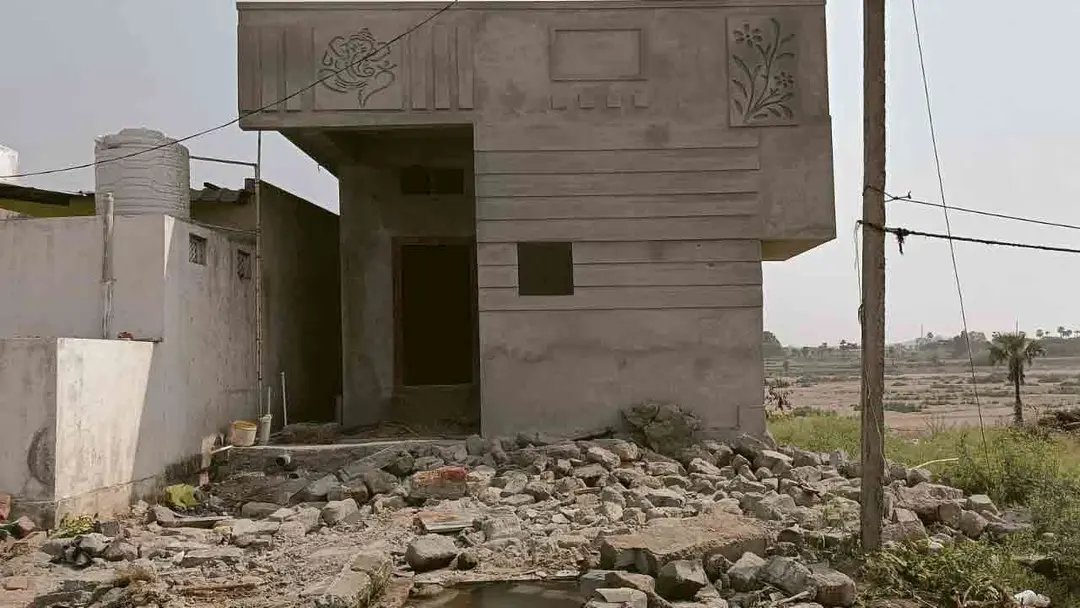
Elderly man ostracised, shed razed in Padira; police book five
In Padira village of Ellareddipet mandal in Telangana's Rajanna Sircilla district, caste elders ostracised an elderly man, Kancharla Devayya, and demolished the tin shed he lived in, according to his police complaint. The dispute began over demands to remove the shed, which obstructed a new house being built by his elder son Srinivas, a Gulf migrant. SI Rahul Reddy said cases were booked against Kancharla Raju, Sharabandu, Mallesham, Shankar and Narsayya. On daughter-in-law Latha's complaint, Devayya and Satish were also booked.
Source
Rajanna Sircilla — వార్తలు · read the original report ↗
Desk check · some claims need care
What the desk checked (4)
- Caste elders ostracised Kancharla Devayya of Padira village and demolished his tin shed — Based on Devayya's police complaint as reported in the source; not independently established
- Police registered a case against Kancharla Raju, Sharabandu, Mallesham, Shankar and Narsayya — Attributed in source to SI Rahul Reddy
- Devayya's elder son Srinivas migrated to a Gulf country and was building a new house behind the shed — Appears in source as part of the complainant's account; no other source given
- Latha, Srinivas's wife, complained of mental harassment, leading to a case against Devayya and Satish — Attributed in source to the SI; source text is internally inconsistent in one place, naming her father-in-law as 'Srinivas'
Analysts’ view opinion
This case sits at the intersection of two distinct legal questions arising from one family dispute: a purported "excommunication" ordered by caste elders, and the forcible demolition of a dwelling. As a matter of constitutional principle, no caste body in India has any power to punish or outcast anyone — such "verdicts" are legally void, and acts carried out to enforce them stand as independent offences if proved. At the same time, a counter-complaint by the daughter-in-law, Latha, has led to a case against Devaiah and Satish, meaning police must now investigate cross-complaints in parallel.
- A caste panchayat's order of social boycott has no legal standing whatsoever; enforcing it through ostracism and demolition would constitute separate offences if the complaint is borne out.
- Forcibly removing a structure a person is living in — even a tin shed — without a court order is not permissible in law, and that bar applies to family members too.
- Who holds the right to the shed and the plot behind it is a civil question for a civil court to decide, not a community assembly.
- Cross-cases from both sides of the same dispute often blunt each other evidentially, which makes independent witnesses and physical evidence of the demolition decisive.
- The investigating agency carries a duty of protection towards an elderly complainant left without shelter; continuation of the boycott would itself amount to a fresh offence.
What to watch — Watch which specific sections the FIRs are registered under, whether arrests follow, whether the boycott is formally lifted, and whether Devaiah is provided alternative shelter.
So far there are only complaints and a sub-inspector's statement — the story does not establish the accused persons' version, the exact sections invoked, or whose property claim is stronger, and guilt remains a matter for the courts.
Deep dive
Research brief · 8 facts · 5 dates · exam-readyThe brief
Context
In Padira village of Ellareddipet mandal, Rajanna Sircilla district of Telangana, caste elders allegedly ostracised an elderly resident, Kancharla Devayya, and demolished the tin (rekula) shed he was living in. The trigger was a family dispute over removing the shed, which stood in the way of a new house being built behind it by Devayya's elder son Srinivas, a Gulf migrant worker. Devayya's daughter-in-law Latha complained to the caste elders that he was abusing her and the elders; the elders then pressed him to remove the shed, and when he refused, declared social boycott and razed the structure. Police have registered cases on complaints from both sides.
Key facts
- Kancharla Devayya of Padira village, Ellareddipet mandal, Rajanna Sircilla district, was declared socially boycotted (kula bahishkarana) by caste elders, as per his police complaint.
- The tin shed in which Devayya lived was demolished in front of him by the caste elders, according to the complaint.
- Devayya's elder son Srinivas migrated to a Gulf country for livelihood and was building a new house behind Devayya's tin shed.
- Srinivas had promised to remove the shed and rebuild it elsewhere, and the caste elders had agreed to this arrangement.
- Devayya sought to postpone removal of the shed because his younger brother Chandrayya had recently died of illness.
- Latha, Srinivas's wife and Devayya's daughter-in-law, complained to caste elders that Devayya was abusing her and the elders.
- Police booked cases against Kancharla Raju, Sharabandu, Mallesham, Shankar and Narsayya, SI Rahul Reddy said.
- On Latha's complaint of mental harassment, cases were also registered against Devayya and Satish, according to the SI.
Timeline
- Recently (date not stated in the source)Devayya's younger brother Chandrayya dies of illness, prompting Devayya to seek more time before removing his shed.
- Monday nightCaste elders come to Devayya's house and pick a quarrel after Latha's complaint to them.
- Tuesday morningElders return and insist the shed be removed; on his refusal they declare caste ostracism and raze the shed.
- March 10, 2026 (report datelined Ellareddipet)Devayya lodges a police complaint; police register a case and take up investigation.
- Not stated in the sourceLatha approaches police alleging mental harassment; cases booked against Devayya and Satish.
Who has a stake
- Kancharla Devayya (elderly complainant) — Lost the tin shed he lived in and was socially boycotted; is also an accused in his daughter-in-law's harassment complaint.
- Caste elders named as accused (Kancharla Raju, Sharabandu, Mallesham, Shankar, Narsayya) — Face police cases for declaring caste ostracism and demolishing the shed.
- Latha (daughter-in-law) — Complained to caste elders over the shed dispute and to police alleging mental harassment by Devayya and Satish.
- Srinivas (elder son, Gulf migrant) — His under-construction house was obstructed by the shed; he had promised to relocate it.
- Satish (younger son / brother-in-law) — Booked on Latha's complaint of mental harassment.
- Ellareddipet police / SI Rahul Reddy — Investigating both sets of complaints and enforcing law against extra-judicial caste panchayat action.
Why it matters
The case shows caste panchayats still acting as parallel authorities in rural Telangana, punishing an individual with social boycott and destruction of his dwelling over a private family property dispute. Social ostracism strips a person of community support, credit and dignity, and here it was accompanied by the loss of shelter for an elderly man. Police registering cases against the elders signals that such extra-judicial punishment is a criminal matter, not a community custom.
UPSC angle
Prelims pointers
- Village: Padira, Ellareddipet mandal, Rajanna Sircilla district, Telangana.
- 'Kula bahishkarana' (caste ostracism / social boycott) declared by caste elders is the core allegation in the police complaint.
- Five persons named: Kancharla Raju, Sharabandu, Mallesham, Shankar, Narsayya; case details stated by SI Rahul Reddy.
- Cross-complaint: Latha alleged mental harassment; Devayya and Satish booked.
- Gulf migration angle: complainant's elder son Srinivas had migrated to a Gulf country for livelihood.
- Specific sections of law invoked: not stated in the source.
Mains framing
Extra-judicial caste panchayats that impose social boycotts represent a parallel, unaccountable justice system operating in the shadow of the constitutional order. The Padira episode illustrates how a purely civil, intra-family dispute over a tin shed obstructing a new house escalated into collective punishment once one party invoked caste elders rather than the courts or gram panchayat: the elders ostracised an elderly man and demolished his only shelter when he refused to comply. The drivers are familiar — dependence on informal dispute resolution in villages, the moral authority of caste elders, remittance-driven construction pressures in Gulf-migrant households, and intra-family power asymmetries that leave the elderly vulnerable. Implications include the denial of shelter and dignity to a senior citizen, chilling of individual dissent within the caste group, and erosion of faith in formal institutions; the cross-complaint by the daughter-in-law also shows how family conflict can be weaponised. The way forward, consistent with what the source supports, lies in prompt police registration and investigation of boycott cases as crimes rather than customs, accessible formal grievance redress at the village level for property and family disputes, and protection and rehabilitation for those whose homes are destroyed.
Key terms
- Kula bahishkarana (caste ostracism)
- Social boycott imposed by caste elders, cutting a person off from community participation and support.
- Caste panchayat / caste elders
- Informal village body of community elders that settles disputes and enforces its decisions outside the legal system.
- Rekula shed (tin shed)
- A tin-sheet dwelling; the structure Devayya lived in and which was demolished.
- Mandal
- Sub-district administrative unit in Telangana; here Ellareddipet mandal of Rajanna Sircilla district.
- SI (Sub-Inspector)
- Police officer heading a station-level investigation; SI Rahul Reddy stated the cases booked.
- Gulf migration
- Migration from Telangana districts to Gulf countries for work; Devayya's son Srinivas had migrated for livelihood.
Practice questions
- Caste panchayats imposing social boycotts function as a parallel justice system. Examine the causes of their persistence in rural India and suggest measures to curb extra-judicial punishments.
- Discuss how family property disputes in migrant-remittance households can escalate into collective caste sanctions, with reference to the Padira case in Rajanna Sircilla district.
- How can the criminal justice system better protect elderly persons who lose shelter and social standing due to informal community sanctions? Illustrate with a recent example.
Grounded only in the source report — figures and dates are the source's, not inferred.