
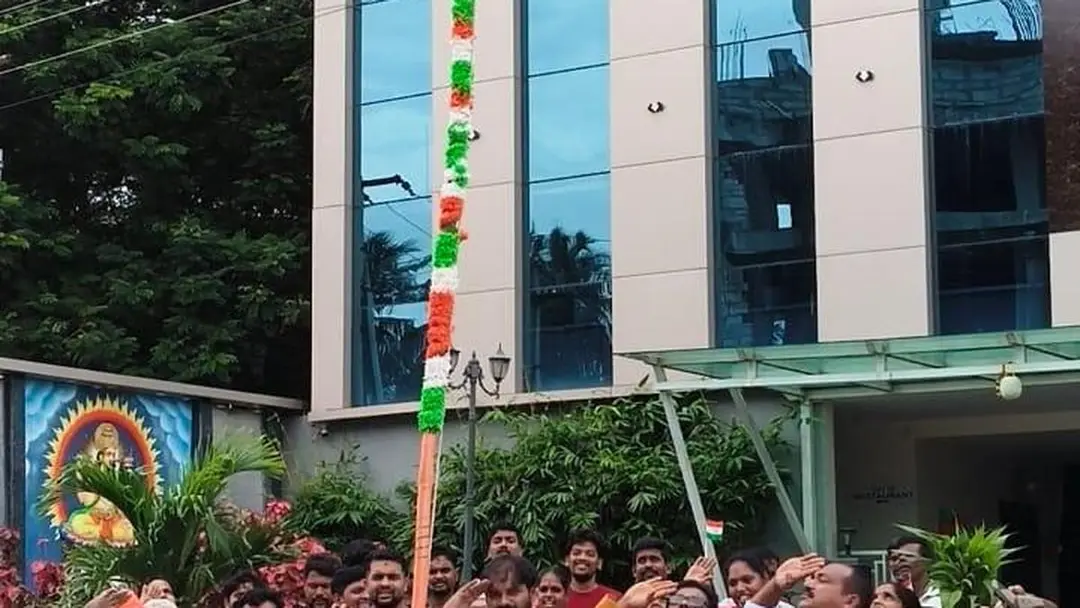
Srikakulam, Vizianagaram mark 80th Independence Day
Factories, shops, rural homes and colonies across Srikakulam and Vizianagaram districts hoisted the national flag under the 'Har Ghar Tiranga' campaign on the 80th Independence Day on Saturday (August 15, 2026), following relaxation of Flag Code rules. SSR Charitable Trust founder Sura Srinivasa Rao thanked the Union government for easing the norms. In Vizianagaram, Arya Vysya Sangham president Ravva Srinivas and secretary Kapuganti Ravi hoisted the flag at a temple premises.
Source
Vizianagaram — news · read the original report ↗
Desk check · compared with the source
What the desk checked (4)
- Flags were hoisted at homes, factories and shops in Srikakulam and Vizianagaram under 'Har Ghar Tiranga' on the 80th Independence Day, August 15, 2026. — Figure and date appear in source; described as reporter observation, no official data given.
- SSR Charitable Trust founder Sura Srinivasa Rao thanked the Union government for relaxing norms and celebrated at Navabharat Junction, Thotapalem and Polytechnic College Road. — Directly attributed to Srinivasa Rao with quote in source.
- Arya Vysya Sangham president Ravva Srinivas and secretary Kapuganti Ravi hoisted the flag at Sri Kanyakaparameswari temple on GT Road, Fort City, Vizianagaram. — Names and venue stated in source; no independent confirmation possible.
- MBA College professor Penki Ravikumar hoisted flags at Arikathota in Ramabhadrapuram mandal and said restrictions on public flag hoisting existed until 2002. — Attributed quote; the 2002 reference is the speaker's statement, not verified by the desk.
Analysts’ view opinion
On the surface this is a flag-hoisting story. Politically, though, the shift of Independence Day observance from Collectorates, courts and colleges to homes, shops and temple terraces under 'Har Ghar Tiranga' moves ownership of the national symbol from the official machinery to the street — a change with real political value. In districts like Srikakulam and Vizianagaram, the faces of the campaign are industrialists, trade community bodies and academics, meaning patriotic mobilisation travels through local social networks rather than party offices. The public thank-you to the Union government for relaxing the Flag Code is the kind of credit that opponents find awkward to contest.
- Moving celebrations from government offices into colonies and homes transfers custody of the national symbol from officialdom to ordinary citizens — politically valuable ground.
- The only political evaluation recorded in the story is gratitude to the Union government for relaxing Flag Code norms, which lands as grassroots credit for the Centre.
- That an industrialist, Arya Vysya Sangham office-bearers and a professor — not party leaders — front the events gives the campaign non-partisan credibility.
- Rival parties have little room to oppose a patriotic-symbol platform, so joining the celebrations is the standard strategic response rather than criticism.
- The reminder that the flag must be respected and never touch the ground hints at the flip side: wider participation raises the risk of disrespect incidents becoming political flashpoints.
What to watch — Watch which party most effectively absorbs this household flag culture into its own organisational network, and whether any flag-dishonour incidents turn into political rows.
The story establishes no numbers on participation, no party involvement and nothing about electoral effect — the political reading here is inference from general context, not reported fact.
Deep dive
Research brief · 8 facts · 3 dates · exam-readyThe brief
Context
On the 80th Independence Day, August 15, 2026, residents of Srikakulam and Vizianagaram districts in Andhra Pradesh hoisted the national flag at factories, shops, homes in rural areas and colonies under the Centre's 'Har Ghar Tiranga' campaign. The source attributes this widened public participation to a relaxation of Flag Code rules, which earlier restricted where, when and with what material the tricolour could be flown. Earlier, flag hoisting was largely confined to the Collector's office, courts, schools and colleges.
Key facts
- The 80th Independence Day was observed on Saturday, August 15, 2026, across Srikakulam and Vizianagaram districts.
- Factories, shops and residences in rural areas and colonies hoisted the national flag as part of the 'Har Ghar Tiranga' campaign following relaxation of Flag Code rules.
- SSR Charitable Trust founder and industrialist Sura Srinivasa Rao hoisted the flag at Navabharat Junction, Srikakulam, and thanked the Union government for relaxing the norms.
- Mr. Srinivasa Rao said they earlier went to Srikakulam Government Degree College, but this year celebrated at Navabharat Junction, Thotapalem and Polytechnic College Road.
- In Vizianagaram, Arya Vysya Sangham president Ravva Srinivas and secretary Kapuganti Ravi hoisted the flag on the terrace of Sri Kanyakaparameswari temple on GT Road, Fort City.
- MBA College professor Penki Ravikumar and others hoisted flags at Arikathota in Ramabhadrapuram mandal of Vizianagaram district and took up charitable activities.
- Dr. Ravikumar said that until 2002 there were many restrictions on hoisting the flag in public places, including hoisting only between sunrise and sunset.
- Until 2002, only hand-spun or hand-woven flags were permitted for Independence Day, Republic Day and other patriotic occasions, per Dr. Ravikumar.
Timeline
- Until 2002Many restrictions applied to hoisting the Indian flag in public places: only between sunrise and sunset, and only hand-spun or hand-woven flags for patriotic occasions.
- Before the relaxation (past practice)Flag hoisting was usually confined to the Collector's office, courts, schools and colleges; residents went to institutions such as Srikakulam Government Degree College.
- Saturday, August 15, 202680th Independence Day marked with flag hoisting at homes, factories, shops, colonies, a temple terrace and village locations across Srikakulam and Vizianagaram.
Who has a stake
- Residents of Srikakulam and Vizianagaram districts — Able to hoist the tricolour at their own homes and establishments rather than travelling to official venues; many expressed happiness.
- Union government — Credited with relaxing Flag Code norms and running the 'Har Ghar Tiranga' campaign that widened participation.
- SSR Charitable Trust / Sura Srinivasa Rao — Led flag hoisting at Navabharat Junction, Thotapalem and Polytechnic College Road in Srikakulam.
- Arya Vysya Sangham, Vizianagaram (Ravva Srinivas, Kapuganti Ravi) — Hoisted the flag at Sri Kanyakaparameswari temple, GT Road, Fort City, taking celebrations to a community religious space.
- Dr. Penki Ravikumar, MBA College professor, and associates — Hoisted flags at Arikathota village and combined the occasion with charitable activities; flagged the duty to respect flag rules.
- District administration (Collector's office, courts, schools, colleges) — Traditional venues of official flag hoisting, now supplemented by widespread citizen-led hoisting.
Why it matters
The spread of flag hoisting from official buildings to homes, shops, factories and temples shows how a change in codified rules can directly reshape everyday civic participation in national commemorations. It also raises the accompanying duty of flag etiquette, as residents themselves stressed that the tricolour must not touch the ground and must be handled as per the rules.
UPSC angle
Prelims pointers
- 'Har Ghar Tiranga' is the campaign under which citizens hoist the national flag at their homes and establishments.
- August 15, 2026 was observed as the 80th Independence Day.
- Until 2002, the flag could be hoisted in public places only between sunrise and sunset, per the source.
- Until 2002, only hand-spun or hand-woven flags were permitted for Independence Day and Republic Day, per the source.
- Srikakulam and Vizianagaram are districts in Andhra Pradesh; Vizianagaram's Fort City has the Sri Kanyakaparameswari temple on GT Road.
- Ramabhadrapuram is a mandal in Vizianagaram district where flags were hoisted at Arikathota.
Mains framing
The Srikakulam-Vizianagaram experience on the 80th Independence Day illustrates how procedural liberalisation can democratise symbolic citizenship. Historically, as noted in the source, restrictions until 2002 limited public flag hoisting to daylight hours and to hand-spun or hand-woven flags, and the practical result was that ceremonies clustered around the Collector's office, courts, schools and colleges. With Flag Code norms relaxed and the 'Har Ghar Tiranga' campaign in place, participation shifted to homes, colonies, shops, factories, a temple terrace and a village in Ramabhadrapuram mandal, with community bodies such as the SSR Charitable Trust and the Arya Vysya Sangham taking the lead, and in one case combining the occasion with charitable work. The implication is twofold: greater emotional ownership of the national symbol at the household level, and a correspondingly larger responsibility for flag etiquette, as Dr. Penki Ravikumar's caution that the flag must not touch the ground underlines. The way forward, on the evidence of the source, lies in sustaining mass participation while spreading awareness of the rules that govern respectful display of the tricolour.
Key terms
- Har Ghar Tiranga
- Campaign encouraging citizens to hoist the national flag at their own homes and establishments, cited as the basis for this year's district-wide hoisting.
- Flag Code
- The set of rules governing display and hoisting of the national flag; its relaxation enabled wider public hoisting, per the source.
- SSR Charitable Trust
- Trust founded by industrialist Sura Srinivasa Rao, which led flag hoisting at Navabharat Junction in Srikakulam.
- Arya Vysya Sangham
- Community association in Vizianagaram whose president and secretary hoisted the flag at Sri Kanyakaparameswari temple.
- Mandal
- Administrative sub-district unit in Andhra Pradesh; Ramabhadrapuram mandal in Vizianagaram district saw hoisting at Arikathota.
Practice questions
- How has the relaxation of Flag Code norms altered the character of Independence Day observance from an official ceremony to a citizen-led one? Discuss with reference to the 'Har Ghar Tiranga' campaign.
- Examine the balance between encouraging mass display of the national flag and ensuring respect for flag etiquette.
- Discuss the role of community organisations and trusts in mobilising civic participation during national commemorations, with examples from Srikakulam and Vizianagaram.
Grounded only in the source report — figures and dates are the source's, not inferred.