
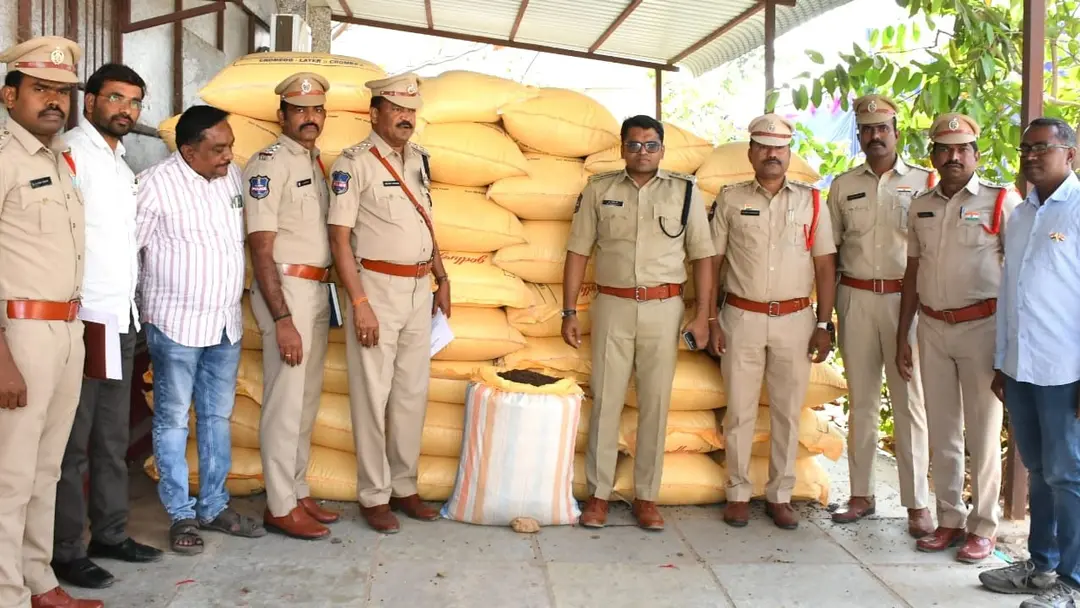
10 tonnes of fake cotton seeds seized in Narayanpet district
Police in Telangana's Narayanpet district seized 10 tonnes of fake HT cotton seeds valued at about Rs 1 crore. SP Dr Vineeth said district police, a task force and the agriculture department raided Bandagonda village in Narayanpet mandal and Bhuneed in Kothapalli mandal on Sunday evening. The seeds were recovered from the homes of V. Balakrishna Naidu and Sasivardhan Naidu of Bhuneed. Two cases were registered. District Agriculture Officer John Sudhakar said the quantity was enough to sow three mandals.
Source
Narayanpet — నేరాలు · read the original report ↗
Desk check · compared with the source
What the desk checked (5)
- 10 tonnes of fake HT cotton seeds worth about Rs 1 crore were seized. — Attributed to Narayanpet SP Dr Vineeth at a media conference; quantity and value are stated as approximate in the source.
- Raids were conducted on Sunday evening at Bandagonda (Narayanpet mandal) and Bhuneed (Kothapalli mandal) by police, task force and agriculture department. — Attributed to the SP; figure and locations appear in the source.
- Seeds were recovered from the homes of V. Balakrishna Naidu and Sasivardhan Naidu, a father and son from Bhuneed. — Named accused attributed to police statement; no response from the accused in the source.
- Balakrishna Naidu was earlier involved in similar offences under Maddur, Narva and Daultabad police stations, cases pending in court. — Attributed to police investigation; court status stated by the SP, not independently shown.
- The seized quantity is enough to sow crops in about three mandals. — Attributed to District Agriculture Officer John Sudhakar as an estimate.
Analysts’ view opinion
This is more than a routine seizure: fake-seed cases typically engage a mix of seed-regulation law and general criminal provisions on cheating and adulteration, and the registration of two separate cases at two police stations widens the investigative footprint. Officials say one of the named men already has similar cases pending in court — those remain allegations, not convictions, though they can legitimately weigh at the bail stage. The strength of the prosecution will rest less on the headline tonnage than on sampling and lab testing of the seized seed, the seizure memo and an unbroken chain of custody.
- At the press-conference stage these are allegations only; guilt requires trial and admissible evidence, and the named father and son retain the presumption of innocence.
- Proving the seed is 'spurious' will turn on agriculture-department laboratory analysis; absence of packaging or lot numbers raises suspicion but is not by itself legal proof.
- Because the recovery was from private homes, compliance with search-and-seizure procedure and witnessed inventories is the point most likely to be tested in court.
- Two FIRs in two station jurisdictions raises the procedural question of whether the matters are tried together or separately.
- The stated volume — said to be enough for roughly three mandals, just ahead of sowing — bears on gravity of the offence and on farmer redress, though the story mentions no specific compensation route.
What to watch — Watch whether arrests and remand follow, how a court treats the pending earlier cases if bail is sought, and when the seed-sample laboratory results come in.
The story does not specify which statutes or sections were invoked, whether arrests have been made, where the supply chain originated, or whether the earlier cases produced any convictions.
Deep dive
Research brief · 8 facts · 3 dates · exam-readyThe brief
Context
Police in Narayanpet district of Telangana have cracked down on the illegal sale of fake herbicide-tolerant (HT) cotton seeds to farmers. Acting jointly with a special police team, a task force and the agriculture department, they raided two villages and seized 10 tonnes of spurious HT cotton seeds worth about Rs 1 crore. HT cotton seeds are not approved for commercial cultivation in India, and spurious seed rackets typically target cotton growers ahead of the sowing season, leaving farmers with crop failure and no legal recourse.
Key facts
- About 10 tonnes of fake HT cotton seeds valued at roughly Rs 1 crore were seized in Narayanpet district, Telangana.
- Raids were conducted on Sunday evening at Bandagonda village (Narayanpet mandal) and Bhuneed village (Kothapalli mandal).
- The operation was a joint effort of district police, a task force, a special police team and the agriculture department.
- The seeds were recovered from the homes of V. Balakrishna Naidu and Sasivardhan Naidu, a father and son from Bhuneed village.
- Two cases were registered: one at Narayanpet Rural police station and another at Madduru police station.
- Investigation revealed Balakrishna Naidu had earlier committed similar offences under Madduru, Narva and Daulatabad police station limits; those cases are pending in courts.
- District Agriculture Officer John Sudhakar said the seized quantity was enough to sow crops across about three mandals.
- SP Dr Vineeth disclosed the details at a media conference on Monday; the news report is dated January 26, 2026, 05:47 PM IST.
Timeline
- Earlier (dates not stated in the source)Balakrishna Naidu allegedly involved in similar fake seed offences under Madduru, Narva and Daulatabad police station limits; cases pending in courts.
- Sunday eveningJoint raids by district police, task force, special police team and agriculture department at Bandagonda and Bhuneed villages; 10 tonnes of fake HT cotton seeds seized.
- MondaySP Dr Vineeth announces the seizure at a media conference; two cases registered and the special team felicitated.
Who has a stake
- Farmers of Narayanpet district — Risk of buying spurious HT cotton seeds leading to crop loss; advised to buy only billed, lot-numbered seeds from recognised shops.
- Narayanpet district police and SP Dr Vineeth — Leading enforcement against fake seed traders; warned of strict action and appealed for public information.
- Task force and special police team — Executed the raids; felicitated by the SP for cracking the case.
- Agriculture department / District Agriculture Officer John Sudhakar — Co-conducted raids, assessed the seized quantity as enough for three mandals, and issued buying advisories.
- Accused V. Balakrishna Naidu and Sasivardhan Naidu — Face two fresh cases in addition to earlier pending cases in courts.
Why it matters
Ten tonnes of spurious seed was enough to sow three mandals, meaning thousands of acres and farm households could have faced germination failure and debt in a single season. The case also shows repeat offending: one accused already has similar cases pending in courts, raising questions about deterrence in seed-law enforcement. For farmers, the practical safeguard remains buying only packed, lot-numbered seed from licensed dealers with a bill.
UPSC angle
Prelims pointers
- Narayanpet is a district in Telangana; the raids covered Bandagonda (Narayanpet mandal) and Bhuneed (Kothapalli mandal).
- Seizure: 10 tonnes of fake HT cotton seeds worth about Rs 1 crore.
- HT cotton refers to herbicide-tolerant cotton seed, sold illegally in this case.
- Two FIRs registered — Narayanpet Rural police station and Madduru police station.
- Agriculture department advisory: buy seeds only from recognised fertiliser shops, insist on a bill, and check the lot number.
- Officials named: SP Dr Vineeth; District Agriculture Officer John Sudhakar.
Mains framing
The Narayanpet seizure of 10 tonnes of fake HT cotton seeds worth about Rs 1 crore illustrates how spurious seed networks exploit the cotton belt ahead of sowing. The drivers are visible in the case itself: seed sold without packaging or lot numbers, storage in private homes in villages, and an accused with similar prior cases still pending in court, suggesting that prosecution delays weaken deterrence. The implications are severe for farmers, who bear the entire risk of germination failure and yield loss while having no bill or traceable dealer to claim against, and for the state, which faces reduced output across an area the agriculture department estimated at three mandals. The response demonstrated here — coordinated action by district police, a task force, a special police team and the agriculture department, backed by public awareness appeals to report fake seed trade — points to the way forward: intelligence-led pre-sowing raids, faster trial of seed offences, strict licensing and lot-number verification at retail, and farmer education to buy only packed, billed seed from recognised outlets.
Key terms
- HT cotton seeds
- Herbicide-tolerant cotton seeds; in this case fake versions were being sold illegally to farmers.
- Mandal
- An administrative sub-district unit in Telangana; the seized seed was said to suffice for sowing three mandals.
- Task force
- A dedicated police unit that joined the district police and agriculture department in the raids.
- Lot number
- A batch identification mark on genuine seed packets; officials urged farmers to buy only lot-numbered seed.
- District Agriculture Officer (DAO)
- District-level agriculture department head; here John Sudhakar, who assessed the seized quantity and advised farmers.
Practice questions
- Spurious seed rackets persist despite repeated seizures. Examine the causes and suggest enforcement and regulatory measures to protect farmers.
- Discuss the role of coordinated action between police, task forces and the agriculture department in curbing illegal seed trade, with reference to the Narayanpet case.
- How does the sale of unapproved herbicide-tolerant cotton seed affect farm incomes and agricultural regulation in India? Analyse.
Grounded only in the source report — figures and dates are the source's, not inferred.