
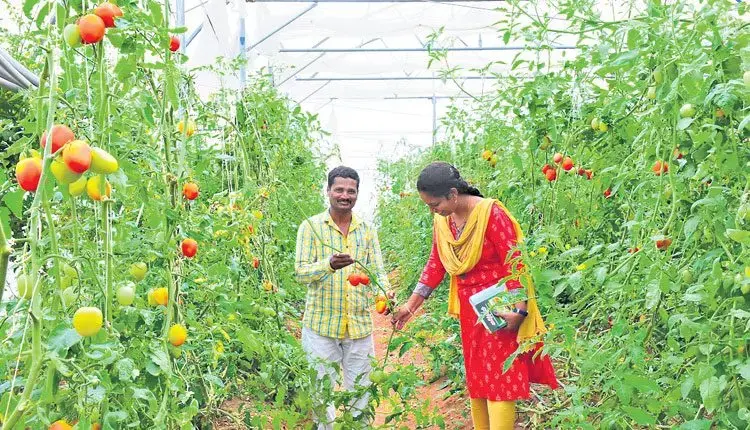
New horticulture scheme planned for Sri Sathya Sai district farmers
The government has prepared a new scheme to raise horticulture output in drought-prone Rayalaseema. Sri Sathya Sai district has been divided into 23 clusters and 348 Rythu Seva Kendras, with proposals sent for implementation in three phases. Officials said mango, tomato, sweet orange, areca nut and pomegranate are grown on about 1.5 lakh hectares, yielding 8.80 lakh tonnes annually. Targets include expanding over 70,000 more hectares by the second year and setting up 398 pack houses.
Source
Sri Sathya Sai — వ్యవసాయం · read the original report ↗
Desk check · some claims need care
What the desk checked (5)
- Sri Sathya Sai district has been divided into 23 clusters and 348 Rythu Seva Kendras for the scheme. — Figures appear in source, attributed to officials without naming any official or department.
- Mango, tomato, sweet orange, areca nut and pomegranate are grown on about 1.5 lakh hectares yielding 8.80 lakh tonnes a year. — Figures appear in source and are credited to officials' assessment; no document or dataset cited.
- Horticulture is to be expanded over 70,000-plus additional hectares by the second year, using Handri-Neeva water, local tanks and borewells. — Stated as a target in source; no formal order, budget or timeline document referenced.
- 398 pack houses, plus cold storages, ripening chambers, reefer vans and pre-cooling units are to be set up. — Figure appears in source; no sanctioning authority or cost named.
- The scheme will completely end Rayalaseema farmers' hardships and guarantee a golden future. — Unsourced promotional prediction, not a verifiable fact; should be dropped or clearly framed as an official aspiration.
Analysts’ view opinion
Read closely, this looks less like a plan to simply plant more and more like a plan to stop losing what is already grown — the emphasis on 398 pack-houses, cold storage, reefer vans and processing units points that way. In a drought-prone belt, horticulture can lift income per hectare, but it is also a higher-capital, higher-risk switch for a farmer. Adding 70,000-plus hectares to the current 1.5 lakh hectares producing 8.80 lakh tonnes would be a large supply jump; if market and cold-chain capacity lags, the farmer absorbs it as lower prices.
- For mango and tomato, much of the value is lost after harvest rather than in the field, so pack-houses, pre-cooling and reefer vans are where net farm income can realistically improve.
- The cluster design — 23 clusters and 348 farmer service centres — is essentially an attempt to buy scale economies in grading, aggregation and buyer access.
- If acreage expansion outpaces marketing and storage capacity, especially in a perishable like tomato, the correction shows up as a price crash borne by growers.
- Drip and micro-irrigation, canopy management and fruit covers all need upfront outlay; the story does not state subsidy shares or credit terms, which will decide whether small farmers can participate.
- With water sourced from Handri-Neeva, local tanks and borewells, payback on long-gestation orchards remains tied to rainfall and water releases.
What to watch — Watch whether the proposals clear financial approval and get budget allocations, how many pack-houses and cold-chain units are actually functioning in phase one, and what price farmers realise in the first season after expansion.
This is still a proposal stage scheme: the story does not establish total cost, funding source, farmer contribution or an implementation timeline, so any income gain cannot yet be quantified.
Deep dive
Research brief · 8 facts · 3 dates · exam-readyThe brief
Context
Rayalaseema, a chronically drought-prone region of Andhra Pradesh, pushes farmers towards alternative, less water-intensive crops, and horticulture has become the mainstay in districts like Sri Sathya Sai. The State government has now drawn up a dedicated horticulture development plan for the district, dividing it into 23 clusters and 348 Rythu Seva Kendras, with proposals sent for implementation in three phases. The plan combines area expansion, modern cultivation practices, micro-irrigation and post-harvest infrastructure such as pack houses and cold chains. Water for the expansion is to come from Handri-Neeva canal supplies, local tanks and borewells.
Key facts
- Sri Sathya Sai district has been divided into 23 clusters and 348 Rythu Seva Kendras for the new horticulture scheme.
- Proposals have been sent officially to implement the special scheme in three phases.
- Mango, tomato, sweet orange (chinni), areca nut and pomegranate are currently grown on about 1.5 lakh hectares in the district.
- Annual output from these crops is estimated at 8.80 lakh tonnes, as identified by officials.
- Target: expanding horticulture crops to over 70,000 additional hectares by the second year.
- 398 pack houses are to be made available for safe storage of produce.
- Handri-Neeva waters, local tanks and borewells are to be the irrigation base for raising production.
- Canopy management — branch pruning and height control — is to be implemented in mango and sweet orange orchards, with protective fruit covers for select orchards.
Timeline
- Present (as reported)1.5 lakh hectares under mango, tomato, sweet orange, areca nut and pomegranate yielding 8.80 lakh tonnes a year.
- Current stageDistrict divided into 23 clusters and 348 Rythu Seva Kendras; proposals sent for three-phase implementation.
- By the second yearTarget of expanding horticulture to over 70,000 more hectares.
Who has a stake
- Horticulture farmers of Sri Sathya Sai district — Area expansion, modern practices, better prices and direct marketing without middlemen.
- State government / horticulture officials — Designed the cluster-based scheme, sent proposals and must deliver infrastructure and training.
- Rythu Seva Kendras (348) — Serve as the ground-level delivery units for the scheme and cluster-wise awareness meetings.
- Young farmers — Special incentives are proposed to draw them into horticulture cultivation.
- Traders and middlemen — Improved marketing facilities aim to reduce their role in the produce chain.
- Processing units (pomegranate arils, banana powder) — To be set up locally as the plan gives high priority to processing.
Why it matters
Rayalaseema's farmers depend on alternative crops because of recurring drought, so raising horticulture productivity and adding post-harvest infrastructure directly affects their incomes. Cluster-based planning with pack houses, cold storages, ripening chambers, reefer vans and pre-cooling units addresses the perishability and price-crash problem that hurts fruit and vegetable growers most. If delivered, it could shift the district from raw produce sales to value-added processing and direct marketing.
UPSC angle
Prelims pointers
- Sri Sathya Sai district (Andhra Pradesh) divided into 23 clusters and 348 Rythu Seva Kendras under the new horticulture plan.
- Current horticulture area in the district: about 1.5 lakh hectares; annual yield 8.80 lakh tonnes.
- Scheme target: over 70,000 additional hectares by the second year; 398 pack houses.
- Key crops: mango, tomato, sweet orange (chinni), areca nut, pomegranate.
- Irrigation sources cited: Handri-Neeva waters, local tanks and borewells.
- Post-harvest components: cold storages, ripening chambers, reefer vans, pre-cooling units; processing of pomegranate arils and banana powder.
Mains framing
Drought-prone Rayalaseema's shift to horticulture is essentially an adaptation strategy: with erratic rainfall and limited surface water, farmers prefer perennial fruit crops and vegetables over water-intensive staples. The Sri Sathya Sai district plan attempts an integrated response \u2014 cluster-based organisation (23 clusters, 348 Rythu Seva Kendras), phased implementation, productivity gains through canopy management and protective fruit covers, water-use efficiency through drip and micro-irrigation over thousands of hectares, and post-harvest capacity through 398 pack houses, cold storages, ripening chambers, reefer vans and pre-cooling units. The stated economic logic is to capture value locally via processing units for pomegranate arils and banana powder, cut out middlemen through better marketing, and draw young farmers in with special incentives. The risks, which the source does not detail, lie in dependence on Handri-Neeva flows, tanks and borewells in a deficit region, and in the execution of three-phase proposals. The way forward implied by the plan is cluster-wise farmer training, assured irrigation, and completing the cold chain so that expanded area translates into realised farm income rather than distress sales.
Key terms
- Rythu Seva Kendra
- Village-level farmer service centre in Andhra Pradesh; 348 of them are the delivery units for this scheme.
- Canopy management
- Pruning of branches and control of tree height in orchards such as mango and sweet orange to improve yield and quality.
- Pack house
- Facility for grading, sorting and packing harvested produce before transport; 398 are planned in the district.
- Handri-Neeva
- Canal water source cited, along with local tanks and borewells, for irrigating the expanded horticulture area.
- Micro-irrigation / drip
- Water-saving irrigation methods the State has decided to extend over thousands of hectares.
- Reefer van / pre-cooling unit
- Refrigerated transport and rapid cooling equipment for perishables, to be set up in rural areas.
Practice questions
- Horticulture is increasingly the preferred adaptation option in drought-prone regions. Examine, with reference to Rayalaseema, how cluster-based planning and post-harvest infrastructure can raise farm incomes.
- Discuss the role of cold chain infrastructure — pack houses, cold storages, ripening chambers, reefer vans — in reducing distress sales of perishable horticulture produce.
- To what extent can local processing units and direct marketing reduce the dependence of small horticulture farmers on intermediaries? Analyse.
Grounded only in the source report — figures and dates are the source's, not inferred.