
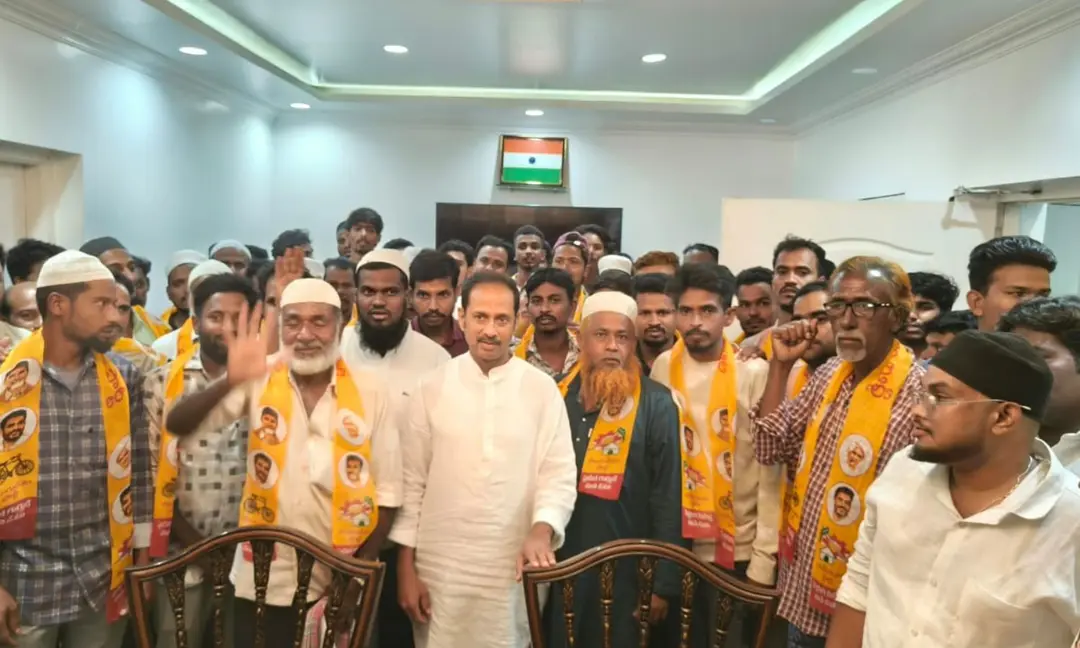
300 minority families quit YSRCP, join TDP in Kadiri
About 300 Muslim minority families from Nizam Vali Colony in Kadiri town of Sri Sathya Sai district quit the YSRCP and joined the Telugu Desam Party. The families belong to the old 15th ward, now the 18th ward. At an event held at the MLA's office under ward incharge Hyder Ali, MLA Kandikunta Venkata Prasad draped them with party scarves. He said he would ensure respect for all who joined and work to resolve their problems.
Source
Sri Sathya Sai — వార్తలు · read the original report ↗
Desk check · compared with the source
What the desk checked (4)
- About 300 Muslim minority families from Nizam Vali Colony, Kadiri, quit YSRCP and joined TDP. — Figure appears in source as an approximation ('సుమారు 300'); no official list or independent confirmation given.
- The joining event was held at the MLA's office in Kadiri in the presence of MLA Kandikunta Venkata Prasad. — Stated in source as event description; no direct quote source cited beyond the event.
- The families belong to old Ward 15, now Ward 18, and joined under ward incharge Hyder Ali. — Internally consistent detail provided by the source; not externally verified.
- MLA said he would ensure respect for new entrants and work to resolve their problems. — Attributed to the MLA as paraphrase of his remarks at the event.
Analysts’ view opinion
The switch of around 300 Muslim minority families in Kadiri is a ward-level event, but its political messaging is bigger: the TDP wants to show that the minority vote is not locked to any single party. The fact that the event was staged at the sitting MLA's own office, with the MLA personally draping party scarves, points to inductions built on the familiar calculus of access to power — grievance redressal and reach to government schemes. For the YSRCP it is a symbolic setback, though the number of families and any actual vote impact are not independently verified.
- Minority communities have conventionally been counted among the YSRCP's firmer support blocs, which is exactly why the TDP is likely to amplify this switch as a narrative win.
- The inductions were led by ward in-charge Haider Ali, strengthening the reading that this is a transfer driven by one local leader's personal following rather than a broad ideological shift.
- The MLA's language of "solving problems" and "partnership in development" fits the standard local-politics pull towards whichever party holds office.
- The explicit mention of old Ward 15 and new Ward 18 suggests a ward-level strategic value, most relevant in a local-body election frame.
- No YSRCP response appears in the story; opposition parties typically dismiss such events as inflated headcounts or pressure-driven.
What to watch — Watch whether similar inductions spread to other wards in the Kadiri constituency ahead of local-body polls, and how the YSRCP structures its counter-response.
The story does not independently establish the exact number of families, their past voting behaviour, or whether this converts into real votes — and it carries no YSRCP version of events.
Deep dive
Research brief · 8 facts · 2 dates · exam-readyThe brief
Context
In Kadiri town of Sri Sathya Sai district in Andhra Pradesh, about 300 Muslim minority families from Nizam Vali Colony left the YSR Congress Party (YSRCP) and joined the Telugu Desam Party (TDP). The families belong to what was the old 15th ward, now redrawn as the new 18th ward. The defection event was organised at the MLA's office in Kadiri under 15th ward TDP incharge Hyder Ali, in the presence of Kadiri constituency MLA Kandikunta Venkata Prasad. Such mass-joining ceremonies, marked by the draping of party scarves, are a routine instrument of local political consolidation in Andhra Pradesh.
Key facts
- About 300 Muslim minority families from Nizam Vali Colony, Kadiri town, quit the YSRCP and joined the TDP.
- The families belong to the old 15th ward, which is now the new 18th ward of Kadiri town.
- Kadiri is located in Sri Sathya Sai district of Andhra Pradesh.
- The joining programme was held at the MLA's office in Kadiri town.
- The event was organised under the leadership of 15th ward TDP incharge Hyder Ali.
- Kadiri MLA Kandikunta Venkata Prasad draped party scarves on the new entrants, including Khaja, Baba Fakruddin, Ali, Babu, Siraj, Imam Sab, Mohammad, Moinuddin, Aslam, Mubarak, Irfan and Babjan.
- The MLA said he would ensure due respect for everyone joining the TDP and work to resolve their problems.
- The MLA said government programmes for minority welfare and development would be taken forward and everyone would be made a partner in Kadiri constituency's development.
Timeline
- Earlier (date not stated in the source)The old 15th ward of Kadiri town was redrawn as the new 18th ward.
- Day of the event (date not stated in the source)About 300 Muslim minority families from Nizam Vali Colony formally joined the TDP at the MLA's office in Kadiri, receiving party scarves from MLA Kandikunta Venkata Prasad.
Who has a stake
- The 300 Muslim minority families of Nizam Vali Colony — Seek resolution of local problems and access to minority welfare and development programmes after switching parties.
- Telugu Desam Party (TDP) — Gains a bloc of minority voters in Kadiri, strengthening its ward-level base ahead of local contests.
- YSR Congress Party (YSRCP) — Loses a sizeable minority support base in Kadiri's 18th ward, denting its local organisational strength.
- Kandikunta Venkata Prasad, Kadiri MLA — Consolidates his constituency base; has publicly promised respect, problem-solving and inclusive development.
- Hyder Ali, 15th ward TDP incharge — Credited with organising the mass joining; his standing within the party rises.
- TDP leaders, cadre, minority leaders and ward leaders — Expressed happiness at the induction; participated in the programme.
Why it matters
Mass ward-level defections are the visible currency of Andhra Pradesh's bipolar politics, where control of colonies and wards translates into results in municipal and assembly contests. The switch of a 300-family minority bloc from YSRCP to TDP in Kadiri signals how welfare delivery and local grievance redressal, rather than ideology, drive community-level realignment. It also shows the role of ward incharges and MLAs as brokers between communities and the state.
UPSC angle
Prelims pointers
- Kadiri town and assembly constituency lie in Sri Sathya Sai district, Andhra Pradesh.
- Kadiri MLA named in the story: Kandikunta Venkata Prasad (TDP).
- YSRCP = YSR Congress Party; TDP = Telugu Desam Party — the two main poles of Andhra Pradesh politics.
- Nizam Vali Colony falls in the old 15th ward, now the new 18th ward of Kadiri town.
- About 300 Muslim minority families switched parties in the reported event.
- Ward incharge is a party-level local organisational post; Hyder Ali held it for the 15th ward.
Mains framing
Local-level mass defections such as the shift of about 300 Muslim minority families from the YSRCP to the TDP in Kadiri illustrate how party loyalty in Andhra Pradesh is mediated at the ward and colony level rather than by ideology. The causes visible in the source are transactional and developmental: the families' expectation of problem redressal, the MLA's promise of "due respect" and inclusion in constituency development, and the assurance that government minority welfare and development programmes would be carried forward. The implication is twofold — for parties, control of ward incharges (here Hyder Ali) becomes decisive in mobilising community blocs; for citizens, access to welfare and grievance redressal can appear contingent on aligning with the incumbent MLA's party, which raises questions about the neutrality of public service delivery. A way forward consistent with the source is institutional rather than political: ensuring that minority welfare schemes and civic problem-solving reach wards through transparent, rule-based municipal channels, and strengthening ward committees and grievance mechanisms so that representation does not hinge on party affiliation. The episode is also a reminder that ward delimitation (old 15th becoming new 18th) reshapes local political arithmetic.
Key terms
- YSRCP
- YSR Congress Party, one of the two principal political parties of Andhra Pradesh; the party the 300 families left.
- TDP
- Telugu Desam Party, the party the minority families joined at the Kadiri event.
- Ward incharge
- A party-appointed local organiser responsible for mobilising voters within a municipal ward; here Hyder Ali of the 15th ward.
- Party scarf (kanduva)
- The party shawl draped on new entrants as the symbolic act of formally joining a political party in Telugu states.
- Sri Sathya Sai district
- Andhra Pradesh district in which Kadiri town and assembly constituency are located.
- Nizam Vali Colony
- The Kadiri locality in the old 15th/new 18th ward from which the 300 Muslim families defected.
Practice questions
- Mass defections at the ward level have become a defining feature of competitive politics in Andhra Pradesh. Examine the causes and consequences for democratic accountability.
- Discuss how dependence on local political intermediaries for access to welfare schemes affects the neutrality of public service delivery. Suggest institutional safeguards.
- How does municipal ward delimitation alter local political mobilisation? Illustrate with reference to community-based voting blocs.
Grounded only in the source report — figures and dates are the source's, not inferred.