
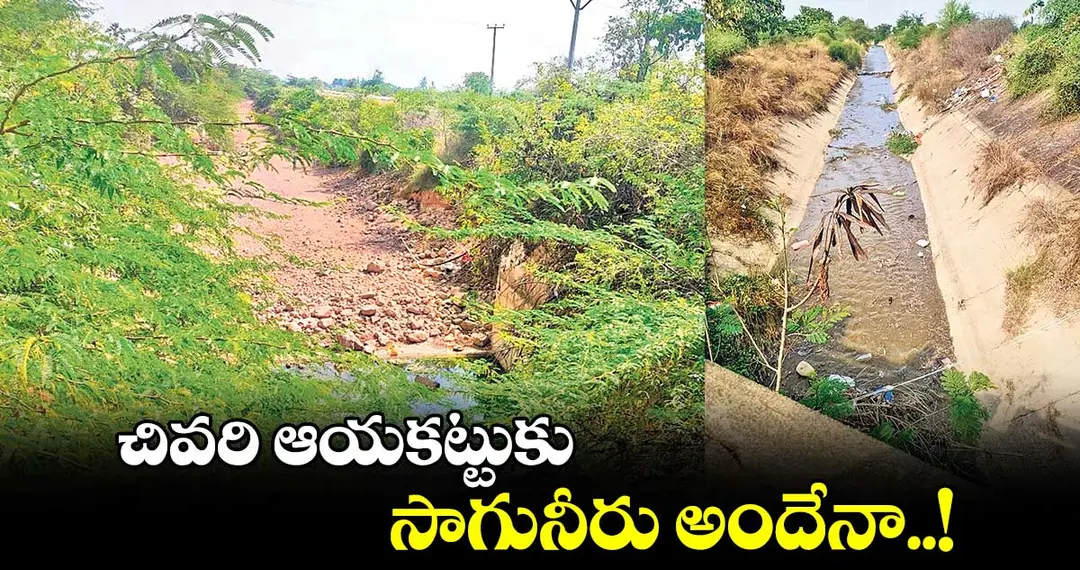
5.77 lakh acres to get Yasangi water in erstwhile Warangal
The government has decided to supply Yasangi irrigation water on an on-and-off (warabandi) basis under SRSP Stage 1 and 2 in erstwhile Warangal district. Officials estimate about 5.77 lakh acres can be served, subject to water availability. From January 1 to March 31, 2025, water will be released for a week and stopped the next week. In Mahabubabad district, farmers say the unlined DBM 60 canal is overgrown with thorny bushes and want it modernised.
Source
Warangal — నీరు · సాగునీరు · read the original report ↗
Desk check · compared with the source
What the desk checked (6)
- Government will supply Yasangi irrigation water on an on-and-off (warabandi) basis under SRSP Stage 1 and 2 in erstwhile Warangal district — Attributed to the state government/irrigation department decision as reported in the source; no order number cited.
- About 5.77 lakh acres in erstwhile Warangal may get water depending on availability — Figure appears in source as an official estimate by irrigation officials.
- Ayacut break-up: SRSP Stage 1 (LMD) 2,21,947 acres; Kaleshwaram 93,070 acres; SRSP-2 90,611 acres; Devadula 1,71,528 acres — Figures stated as per irrigation officials' proposals; the four figures total 5.77 lakh acres, internally consistent.
- Water released one week and stopped the next, from January 1 to March 31, 2025 — Dates and schedule appear in source; attributed to the release plan, no separate document cited.
- DBM 60 main canal and distributaries in Mahabubabad district are overgrown with thorny bushes due to lack of lining — Reporter's observation plus farmers' demand for lining; no engineering assessment given.
- Irrigation EE Sammireddy said proposals for modernisation will be sent to the government and urged farmers not to block canals or fix illegal motors — Directly attributed to a named official in the source.
Analysts’ view opinion
A commitment of irrigation water for about 5.77 lakh acres is, in effect, an income signal for the rural economy of erstwhile Warangal: once farmers believe water will come, they spend on seed, fertiliser, machinery hire and labour, and that money circulates through local markets. But the "on and off" (warabandi) design is the real economic story — it is an admission that supply is finite, and it shifts timing risk onto the cultivator. Unlined canals choked with thorny growth mean conveyance losses, and those losses almost always land hardest on tail-end farmers.
- The assurance itself moves input demand — seed, fertiliser, tractor hire, wage labour days and crop borrowing decisions all hinge on this announcement.
- Alternate-week supply rations water but also rations certainty; a week's delay at a critical crop stage can cut yields and therefore farm incomes.
- Missing canal lining is a hidden cost: seepage and weed obstruction reduce the area actually served per unit of water released, lowering the return on every drop the state supplies.
- The gains are unevenly distributed — head-reach farmers and those with borewell backup can absorb gaps, while tail-end and small tenant cultivators carry more of the downside.
- Official warnings about illegal motors and canal blockages are a classic common-pool resource problem; weak enforcement means the paper allocation and the delivered allocation diverge.
What to watch — Watch whether the January-to-March release schedule is actually held to, and whether modernisation proposals for canals like DBM 60 attract a real budget line rather than another round of requests.
The figure is an official estimate, not a delivered outcome — the story establishes no data on acreage actually irrigated, cropping patterns, yields or the cost of the lining work being sought.
Deep dive
Research brief · 8 facts · 3 dates · exam-readyThe brief
Context
Yasangi is the rabi (winter) cropping season in Telangana. For Yasangi 2024-25, the state's irrigation department decided to supply canal water to the full ayacut in erstwhile Warangal district under Sriram Sagar Project (SRSP) Stage 1 and Stage 2 using the on-and-off or "warabandi" rotation system, instead of continuous release. Officials estimate about 5.77 lakh acres can be irrigated depending on water availability in the projects. In Mahabubabad district, ayacut farmers say the DBM 60 main canal and its distributaries under SRSP Stage 2 have never been lined and are choked with thorny bushes, and are demanding lining and modernisation.
Key facts
- Irrigation officials estimate about 5.77 lakh acres in erstwhile Warangal district can get Yasangi water on the on-and-off (warabandi) system, subject to water availability in projects.
- Water release runs from January 1 to March 31, 2025, with supply for one week followed by a week of stoppage.
- SRSP Stage 1 (LMD) ayacut as per irrigation officials' proposals: 2,21,947 acres.
- Kaleshwaram project ayacut in the area: 93,070 acres.
- SRSP Stage 2 ayacut: 90,611 acres.
- Devadula lift irrigation scheme: 1,71,528 acres proposed to get Yasangi water.
- In Mahabubabad district, the DBM 60 main canal and distributaries under SRSP Stage 2 are unlined and overgrown with thorny (kampa) bushes.
- The DBM 60 main canal runs from Patelgudem in Thorrur mandal through Danthalapally mandal to Maripeda mandal.
Timeline
- Before the releaseState government decides to supply Yasangi water under SRSP Stage 1 and 2 in erstwhile Warangal district on the on-and-off (warabandi) basis; irrigation department plans full ayacut supply.
- January 1, 2025SRSP waters released for Yasangi cultivation, as confirmed by Mahabubabad Irrigation EE Sammireddy.
- January 1 to March 31, 2025Alternating schedule: water released for one week, supply stopped the next week.
Who has a stake
- Ayacut farmers of erstwhile Warangal district — Access to assured Yasangi irrigation for about 5.77 lakh acres; tail-end farmers risk losing water if canals are blocked upstream.
- Farmers under DBM 60 canal, Mahabubabad — Unlined canals filled with thorny bushes reduce flow; they are demanding lining and modernisation.
- Telangana Irrigation Department — Must manage limited storage across SRSP Stage 1 and 2, Kaleshwaram and Devadula and enforce the rotation schedule.
- Sammireddy, Executive Engineer, Irrigation, Mahabubabad — Appealed for economical use of water, warned against canal obstruction and illegal motors, and will send modernisation proposals to government.
- State government — Deciding on funds for canal lining and modernisation proposals sent by field officials.
Why it matters
Yasangi (rabi) paddy in Telangana depends heavily on canal releases, and rotational warabandi supply is how the state stretches limited project storage across a large ayacut. Whether 5.77 lakh acres actually get water depends less on the announcement and more on canal condition — unlined, bush-choked channels like DBM 60 waste water and starve tail-end farmers. The episode shows why maintenance and modernisation, not just new projects, decide irrigation outcomes.
UPSC angle
Prelims pointers
- Yasangi is the rabi/winter crop season in Telangana; Vanakalam is the kharif season.
- Warabandi (on-and-off) means rotational turn-by-turn water supply — here one week on, one week off.
- SRSP = Sriram Sagar Project on the Godavari; LMD (Lower Manair Dam) is linked to SRSP Stage 1.
- Devadula is a lift irrigation scheme; Kaleshwaram is a major Godavari lift irrigation project.
- Release window announced: January 1 to March 31, 2025, for erstwhile Warangal district.
- DBM 60 canal runs Patelgudem (Thorrur mandal) — Danthalapally mandal — Maripeda mandal, Mahabubabad district.
Mains framing
Telangana's Yasangi irrigation plan for erstwhile Warangal — about 5.77 lakh acres under SRSP Stage 1 (2,21,947 acres), SRSP Stage 2 (90,611 acres), Kaleshwaram (93,070 acres) and Devadula (1,71,528 acres) — illustrates the core dilemma of canal irrigation: allocating finite storage over a large declared ayacut. The state's response is rotational warabandi supply from January 1 to March 31, 2025, one week on and one week off, which rations water and in principle gives tail-end reaches a turn. But delivery efficiency undercuts allocation: farmers in Mahabubabad report that the DBM 60 main canal and distributaries remain unlined and overgrown with thorny bushes, causing seepage and obstruction, while officials themselves flag bunding of canals and illegal motor-fitting that stop water from reaching downstream. The way forward, as indicated in the source, lies in canal lining and modernisation proposals being sent to the government, strict enforcement against canal obstruction and unauthorised lifting, and farmer-level economy in water use — in short, pairing capital-intensive project creation with last-mile distribution network maintenance and participatory water management.
Key terms
- Yasangi
- The rabi or winter cropping season as referred to in Telangana.
- Warabandi (on-and-off)
- Rotational water distribution where supply is given in fixed turns — here one week of release followed by one week of stoppage.
- SRSP
- Sriram Sagar Project; its Stage 1 (LMD) and Stage 2 canals serve erstwhile Warangal district.
- Ayacut
- The command area of land designated to receive irrigation water from a project or canal.
- Devadula lift irrigation scheme
- Lift irrigation scheme expected to supply Yasangi water to 1,71,528 acres in the region.
- Canal lining
- Providing a hard surface to canal beds and sides to curb seepage and weed growth; demanded by DBM 60 farmers.
Practice questions
- Rotational (warabandi) water supply is often presented as an equity measure in canal irrigation. Examine its advantages and limitations with reference to the Yasangi releases in erstwhile Warangal district.
- "Irrigation potential created is not irrigation potential utilised." Discuss with reference to unlined canals, weed growth and illegal water lifting in Telangana's SRSP command area.
- Discuss the role of canal modernisation and participatory irrigation management in improving water-use efficiency in rabi paddy cultivation.
Grounded only in the source report — figures and dates are the source's, not inferred.