
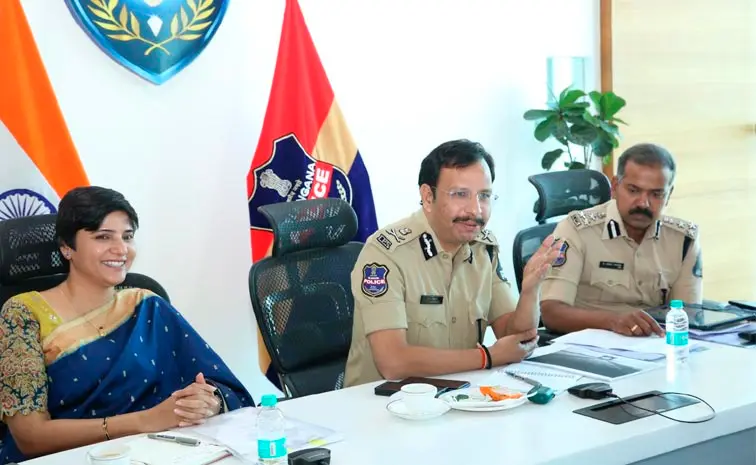
Hyderabad police launch 'C-Mitra' virtual desk for cyber victims
Hyderabad police have launched 'C-Mitra', a virtual helpdesk that lets cyber fraud victims complete the complaint process without visiting a police station, described as the first such system in the country. After a complaint on 1930 or the national cyber portal, virtual police officers call victims and send an AI-prepared draft. The signed copy must be sent by post, courier or drop box. A 24-member team works 8 am to 8 pm. Cases up to Rs 3 lakh will be registered as zero FIRs.
Source
Hyderabad — నేరాలు · read the original report ↗
Desk check · compared with the source
What the desk checked (5)
- Hyderabad police have launched 'C-Mitra', a virtual helpdesk letting cyber fraud victims complete the complaint process from home, described as a first in the country. — Central claim of the source; attributed to Hyderabad police generally, no named officer quoted.
- Only 18% of complaints received on 1930 and the national cyber portal currently become FIRs; C-Mitra aims to raise this to 100%. — Figures appear in the source without a named source or dataset; flag for verification.
- Cases up to Rs 3 lakh will be registered as zero FIRs and transferred to local police stations; above Rs 3 lakh at the cyber crime police station. — Procedural detail stated in the source as policy; no document or official cited.
- The helpdesk works 8 am to 8 pm with a 24-member team; official landline 040-4189-3111 and WhatsApp messages only from 87126 series numbers. — Specific operational details given in the source; internally consistent, unattributed.
- C-Mitra does not investigate cases, promise recovery of money, give legal advice, or ask for OTPs or money. — Stated in the source as a public caution; consistent with the rest of the text.
Analysts’ view opinion
'C-Mitra' is best read as an administrative reform rather than a new legal power. It changes the delivery channel for an obligation that already exists in law — receiving a complaint and registering an FIR — by bringing it to the complainant's home. The disclosed figure that only 18% of complaints currently convert into FIRs is the legally significant part, since courts have repeatedly held that police are duty-bound to register an FIR when information disclosing a cognisable offence is received. At the same time, AI-assisted drafting and reliance on a wet signature raise fresh procedural questions.
- FIR registration is a pre-existing legal entitlement; C-Mitra does not create it but makes access to it easier.
- The Zero FIR route — registering irrespective of territorial jurisdiction and transferring the case onward — is an already recognised procedure, and the Rs 3 lakh threshold is an internal workload split rather than a limit on a victim's rights.
- Even with an AI-generated draft, legal responsibility for the contents of the signed complaint rests with the complainant, so careful reading and correction matters.
- Requiring a physically signed copy by post, courier or drop box reintroduces friction into an otherwise digital process; the story says a digital-signature option is under consideration.
- Explicitly stating that C-Mitra does not investigate, does not give legal advice and does not promise recovery of money is sound expectation-setting.
What to watch — Watch whether the complaint-to-FIR conversion rate actually rises, whether the digital-signature option is implemented, and whether the model is extended beyond the Hyderabad commissionerate.
The story rests on an official announcement and establishes nothing about case volumes, average registration times, or how this process will hold up if tested in court.
Deep dive
Research brief · 8 facts · 3 dates · exam-readyThe brief
Context
Cyber frauds such as OTP scams, "digital arrests" and trading or investment frauds have grown with digitisation. Victims normally complain on the 1930 helpline or the national cybercrime portal (cybercrime.gov.in), but until now had to visit a police station in person to get an FIR registered. Hyderabad police have launched 'C-Mitra', a virtual helpdesk staffed by "virtual police officers" that, they say, is the first system of its kind in India and lets the entire complaint process be completed from home. The source notes that only 18% of complaints made to 1930 and the national portal currently convert into FIRs.
Key facts
- 'C-Mitra' is a virtual helpdesk of the Hyderabad police, described in the source as the first such system in the country, allowing complaint-to-FIR without visiting a police station.
- Only 18% of complaints received on 1930 and the national cyber portal currently become FIRs; C-Mitra aims to raise this to 100%.
- A dedicated team of 24 members, aided by AI, runs the desk from 8 am to 8 pm.
- After a complaint on 1930 or cybercrime.gov.in, virtual police officers call the victim, collect details and send an AI-prepared complaint draft.
- The victim must print and sign the draft and send it by post or courier to Cyber Mitra Help Desk, SHO, Crime Police Station, Commissioner Office, Basheerbagh, Hyderabad - 500029, or use the drop box at the cyber crime PS.
- Cases up to Rs 3 lakh will be registered as zero FIRs and transferred to the concerned local police station; complaints above Rs 3 lakh will be registered at the cyber crime police station.
- Earlier practice: frauds above Rs 1 lakh were registered at the cyber crime station and lesser amounts at the local police station.
- Official calls come only from landline 040-4189-3111 and WhatsApp messages only from 87126 series numbers; staff never ask for OTP or money.
Timeline
- Existing practice before C-MitraVictims complained on 1930 or the national cyber portal but had to visit a police station for FIR registration; cases above Rs 1 lakh went to the cyber crime station, smaller ones to local stations.
- Now (launch reported)Hyderabad police launch C-Mitra virtual helpdesk with 24-member AI-assisted team, 8 am to 8 pm, zero FIRs for cases up to Rs 3 lakh.
- Future (under consideration)A digital signature option for submitting the signed complaint is being examined.
Who has a stake
- Cyber fraud victims in the Hyderabad Police Commissionerate — Only residents within the commissionerate limits are eligible; they save time and avoid station visits to get an FIR.
- Hyderabad police / Cyber Crime Police Station — Registers FIRs on the signed complaints and handles cases above Rs 3 lakh; hopes staff can focus more on investigation.
- Local police stations — Receive zero FIR cases up to Rs 3 lakh transferred for further investigation; also handle case status queries.
- C-Mitra virtual police officers (24-member team) — Call victims, explain the process, prepare AI-drafted complaints; do not investigate or give legal advice.
- Fraudsters impersonating C-Mitra — Fake calls in C-Mitra's name are a risk; genuine staff never ask for OTP or money.
Why it matters
A large gap between cyber complaints and actual FIRs weakens both victim redress and investigation; C-Mitra targets that gap by shifting registration to a virtual, AI-assisted process. If it works, it could become a template for other commissionerates in handling high-volume, low-value cyber frauds through zero FIRs.
UPSC angle
Prelims pointers
- 1930 is the national cyber financial fraud helpline; complaints can also be filed at https://www.cybercrime.gov.in/
- C-Mitra: Hyderabad police virtual helpdesk; 24-member team; available 8 am to 8 pm.
- Under C-Mitra, cases up to Rs 3 lakh are registered as zero FIRs and sent to local police stations; above Rs 3 lakh at cyber crime PS.
- Only 18% of 1930/portal complaints currently become FIRs; C-Mitra target is 100%.
- C-Mitra official landline: 040-4189-3111; WhatsApp only from 87126 series numbers.
- C-Mitra does not investigate cases, promise money recovery or give legal advice.
Mains framing
Cybercrime in India has outgrown the traditional complaint architecture: victims of OTP fraud, 'digital arrest' scams and investment frauds report on the 1930 helpline or the national portal, yet only 18% of such complaints become FIRs, largely because registration still requires a physical visit to a police station and victims are unsure what to write or which sections apply. Hyderabad's C-Mitra addresses this procedural bottleneck rather than the crime itself: virtual police officers call the victim, an AI tool drafts the complaint, and the signed copy reaches police by post, courier or drop box, after which an FIR is registered and communicated by message. Structurally, the reform also raises the zero FIR threshold to Rs 3 lakh so that smaller cases are recorded centrally and transferred to local stations, freeing station staff for investigation. The gaps the source itself flags are instructive: the process is limited to Hyderabad Commissionerate residents, still depends on a physical signed copy (digital signature only "under consideration"), operates only 8 am to 8 pm, and creates a fresh impersonation risk, which is why police stress that C-Mitra never asks for OTPs or money. The way forward implied by the source is wider coverage, digital signatures, and clear public communication that the desk registers but does not investigate.
Key terms
- C-Mitra
- Hyderabad police's virtual cyber helpdesk enabling complaint and FIR registration from home, run by a 24-member AI-assisted team.
- 1930
- National helpline number on which cyber fraud victims report financial cyber crimes.
- National Cyber Crime Portal
- https://www.cybercrime.gov.in/, the online platform for filing cyber crime complaints.
- Zero FIR
- An FIR registered at one station irrespective of jurisdiction and then transferred to the concerned station for investigation; used here for cases up to Rs 3 lakh.
- Virtual police officer
- C-Mitra team member who phones the victim, explains the virtual process and sends the AI-prepared complaint draft.
- Digital arrest
- A cyber fraud type cited in the source in which victims are coerced under a fake arrest pretext.
Practice questions
- Only 18% of cyber complaints made to 1930 and the national portal become FIRs. Examine how procedural barriers cause this gap and assess whether virtual helpdesks like C-Mitra can close it.
- What is a zero FIR? Discuss the implications of Hyderabad police registering cyber fraud cases up to Rs 3 lakh as zero FIRs and transferring them to local stations.
- Use of AI in drafting police complaints promises speed but raises questions of accuracy and accountability. Critically comment with reference to the C-Mitra model.
Grounded only in the source report — figures and dates are the source's, not inferred.