
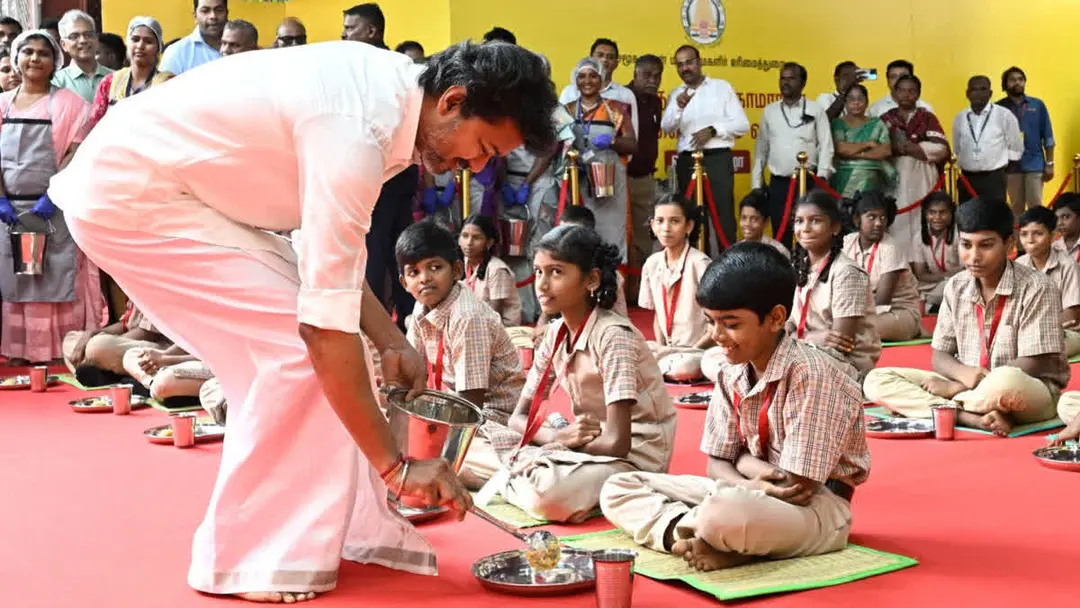
Tamil Nadu extends free breakfast scheme to Classes 6 to 8
Tamil Nadu Chief Minister C Joseph Vijay on Tuesday launched the expanded Perunthalaivar Kamarajar Free Breakfast scheme at a government middle school in Gandhi Gramam, Tiruvanmiyur, Chennai. The expansion covers around 15.30 lakh additional students of Classes 6 to 8 in 15,454 government and government-aided schools. An additional ₹217.63 crore takes the total allocation to ₹724 crore. The menu includes upma, kichadi and pongal, with millet-based dishes twice a week. Implementation is deferred in Chengalpattu and Tirupur due to the October 6 by-election code.
Source
Tamil Nadu — CM & govt · read the original report ↗
Desk check · compared with the source
What the desk checked (5)
- CM C Joseph Vijay launched the expanded Perunthalaivar Kamarajar Free Breakfast scheme at a government middle school in Gandhi Gramam, Tiruvanmiyur, Chennai, on Tuesday. — Reported directly by the source with place, date and event detail; no independent confirmation possible.
- The expansion covers about 15.30 lakh additional students in Classes 6 to 8 across 15,454 government and government-aided schools. — Specific figures appear in the source; no issuing authority named for the numbers.
- An additional ₹217.63 crore has been allocated this financial year, taking the total breakfast programme allocation to ₹724 crore. — Figure appears in source; attribution implied to government budget documents.
- Implementation is deferred in Chengalpattu and Tirupur due to the Model Code of Conduct for the October 6 Assembly by-elections. — Stated in source without named official attribution.
- Scheme history: Chennai Corporation school meals, statewide expansion under Kamaraj in 1962, Nutritious Meal Programme under MGR in 1982, eggs added in 1989, breakfast scheme by M K Stalin in 2022, extended to aided urban primary schools in August 2025. — Attributed in part to state government records and budget documents; dates are internally consistent.
Analysts’ view opinion
This is not a new scheme so much as another storey added to a school-nutrition structure Tamil Nadu has been building for six decades. Extending the breakfast programme from Classes 1-5 to Classes 6-8 layers a morning meal onto an age group already covered by the noon meal — using existing delivery machinery rather than creating new plumbing. With ₹217.63 crore extra taking the total to ₹724 crore, the real test now is execution quality rather than expenditure.
- The expansion covers about 15.30 lakh students across 15,454 government and government-aided schools, so the beneficiaries are overwhelmingly lower-income families dependent on state schooling.
- From Kamaraj-era school meals to MGR's Nutritious Meal Programme to the 2022 breakfast scheme for Classes 1-5, this move reads as policy continuity rather than rupture.
- Adding millet-based dishes twice a week signals menu diversification, but the story does not set out portion sizes, nutritional norms or quality-monitoring arrangements.
- Cooking a second meal alongside the noon meal is likely to add pressure on kitchen staff, cooking infrastructure and supply chains, which is where such schemes usually strain.
- Deferral in Chengalpattu and Tirupur under the model code of conduct for the October 6 by-elections shows how electoral timelines can shape the rollout of welfare launches.
What to watch — Watch for measurable movement in attendance and dropout rates, when the two deferred districts are brought in, and whether the ₹724 crore commitment holds in the next budget cycle.
The story establishes the launch and the allocation, not any independent assessment of nutritional adequacy, attendance impact or on-ground readiness to deliver.
Deep dive
Research brief · 8 facts · 8 dates · exam-readyThe brief
Context
Tamil Nadu has a school-meal tradition going back decades, from meals in Chennai Corporation schools to the statewide mid-day meal under K Kamaraj in 1962 and the Nutritious Meal Programme under M G Ramachandran in 1982. In 2022, then Chief Minister M K Stalin launched a free breakfast scheme for Classes 1 to 5 to tackle morning hunger and help children concentrate in class. On September 22, 2026, Chief Minister C Joseph Vijay launched the expanded Perunthalaivar Kamarajar Free Breakfast scheme at a government middle school in Gandhi Gramam, Tiruvanmiyur, Chennai, taking it to Classes 6 to 8. The rollout is statewide except in Chengalpattu and Tirupur, where the Model Code of Conduct for the October 6 Assembly by-elections has deferred implementation.
Key facts
- Chief Minister C Joseph Vijay launched the expanded Perunthalaivar Kamarajar Free Breakfast scheme on Tuesday, September 22, 2026, at a government middle school in Gandhi Gramam, Tiruvanmiyur, Chennai.
- The expansion covers around 15.30 lakh additional students of Classes 6 to 8 across 15,454 government and government-aided schools.
- An additional Rs 217.63 crore has been allocated in the current financial year, taking the total breakfast programme allocation to Rs 724 crore.
- The menu includes upma, kichadi and pongal, with millet-based preparations twice a week.
- Implementation is deferred in Chengalpattu and Tirupur due to the Model Code of Conduct for the October 6 Assembly by-elections.
- School meals were first provided in Chennai Corporation schools and expanded statewide during K Kamaraj's tenure in 1962 to raise enrolment and cut dropouts.
- The programme became the Nutritious Meal Programme under M G Ramachandran in 1982; eggs were added in 1989 to improve nutritional value.
- In August 2025, the breakfast scheme's coverage was extended to Classes 1 to 5 in government-aided primary schools in urban areas.
Timeline
- Before 1962Meals first provided to children in Chennai Corporation schools, as per state government records.
- 1962Mid-day meal scheme expanded statewide during Chief Minister K Kamaraj's tenure (CM from 1954 to 1963).
- 1982Programme transformed into the Nutritious Meal Programme under Chief Minister M G Ramachandran.
- 1989Eggs added to school meals to improve nutritional value.
- 2022Then Chief Minister M K Stalin launched the Chief Minister's Breakfast Scheme for Classes 1 to 5.
- August 2025Coverage extended to Classes 1 to 5 in government-aided primary schools in urban areas.
- September 22, 2026CM C Joseph Vijay launched the expansion to Classes 6 to 8, covering about 15.30 lakh more students.
- October 6 (by-election date)Assembly by-elections in Chengalpattu and Tirupur; scheme rollout there deferred under the MCC.
Who has a stake
- Students of Classes 6 to 8 — About 15.30 lakh children gain a free morning meal intended to address hunger and improve concentration in class.
- Government and government-aided schools (15,454) — Have to implement daily breakfast service alongside existing noon-meal arrangements.
- Tamil Nadu government — Bears an additional Rs 217.63 crore this financial year, with total breakfast allocation at Rs 724 crore.
- Chief Minister C Joseph Vijay — Launched and owns the expanded scheme, continuing the state's school nutrition legacy.
- Chengalpattu and Tirupur districts — Rollout deferred because of the Model Code of Conduct for the October 6 Assembly by-elections.
Why it matters
Extending the free breakfast to upper primary classes targets the years when dropouts and attendance gaps often begin, linking nutrition directly to school attendance and learning. The move also shows how a welfare programme begun in Chennai Corporation schools and scaled statewide in 1962 has been steadily widened, with each expansion carrying a fresh fiscal commitment — Rs 724 crore in total this year.
UPSC angle
Prelims pointers
- Perunthalaivar Kamarajar Free Breakfast Scheme: Tamil Nadu; expanded to Classes 6 to 8 on September 22, 2026.
- Expansion covers about 15.30 lakh students in 15,454 government and government-aided schools.
- Additional allocation Rs 217.63 crore; total breakfast programme allocation Rs 724 crore.
- K Kamaraj (CM 1954-1963) expanded the mid-day meal statewide in 1962; MGR renamed it the Nutritious Meal Programme in 1982; eggs added in 1989.
- Breakfast scheme for Classes 1 to 5 launched in 2022 by then CM M K Stalin; extended to urban government-aided primary schools in August 2025.
- Model Code of Conduct deferred the rollout in Chengalpattu and Tirupur, which vote in Assembly by-elections on October 6.
Mains framing
Tamil Nadu's school nutrition programmes illustrate how food-based incentives have been used as an instrument of educational policy: meals began in Chennai Corporation schools, were scaled statewide in 1962 under K Kamaraj with the explicit twin aims of raising enrolment and cutting dropouts, became the Nutritious Meal Programme in 1982 under MGR, gained eggs in 1989, and were supplemented by a free breakfast for Classes 1 to 5 in 2022 to counter morning hunger and poor classroom concentration. The 2026 extension to Classes 6 to 8 — about 15.30 lakh students in 15,454 schools at an additional Rs 217.63 crore, total Rs 724 crore — addresses the upper primary stage, while the inclusion of millet-based dishes twice a week signals attention to dietary diversity alongside calorie adequacy. The implications are threefold: a recurring and rising fiscal commitment, administrative demands on schools running two meals a day, and the need for evidence on whether attendance, retention and nutritional outcomes actually improve. A way forward consistent with the record would be transparent outcome monitoring, quality and hygiene assurance in kitchens, and timely coverage of districts where rollout has been deferred by the electoral code, so that eligibility does not depend on the election calendar.
Key terms
- Perunthalaivar Kamarajar Free Breakfast Scheme
- Tamil Nadu's free school breakfast programme, named after K Kamaraj, now extended to Classes 6 to 8.
- Nutritious Meal Programme
- The 1982 transformation of Tamil Nadu's mid-day meal scheme under Chief Minister M G Ramachandran.
- Model Code of Conduct (MCC)
- Election-period norms that have deferred the scheme's rollout in Chengalpattu and Tirupur ahead of the October 6 by-elections.
- Government-aided schools
- Privately managed schools receiving state aid; brought under the breakfast scheme, including urban primary sections in August 2025.
- Millet-based preparations
- Millet dishes included in the breakfast menu twice a week, alongside upma, kichadi and pongal.
Practice questions
- Trace the evolution of Tamil Nadu's school nutrition schemes from the mid-day meal of 1962 to the 2026 breakfast expansion, and assess their role in improving enrolment and retention.
- Discuss the fiscal and administrative challenges of extending free breakfast to Classes 6 to 8 across 15,454 schools, and suggest measures to sustain quality.
- How does the Model Code of Conduct affect the rollout of welfare schemes? Examine with reference to the deferral in Chengalpattu and Tirupur.
Grounded only in the source report — figures and dates are the source's, not inferred.