
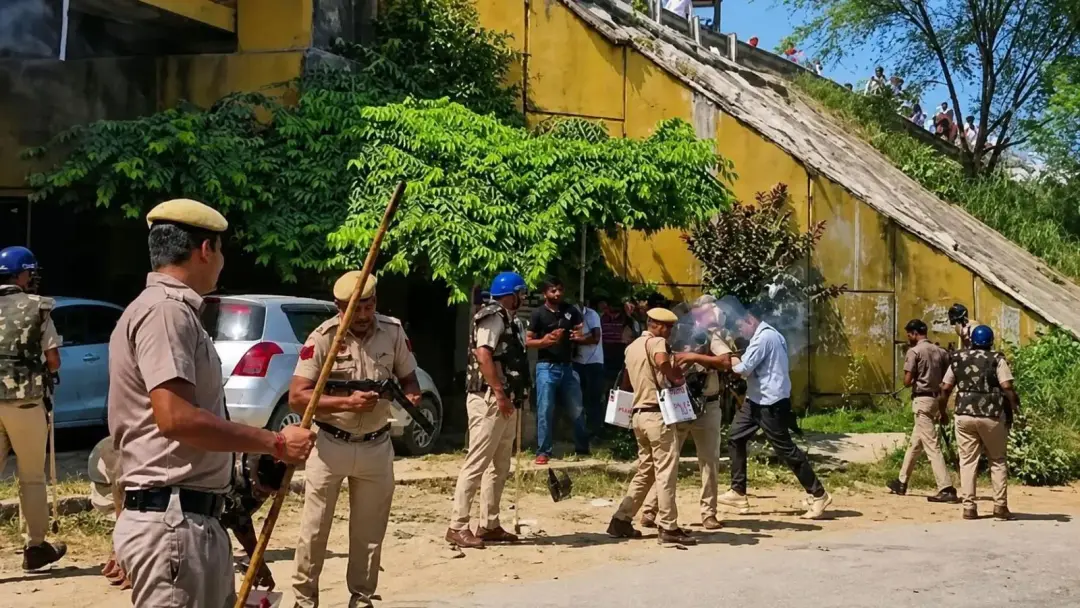
Haryana farmers block NH-44 over paddy procurement; tear gas used
Demanding that paddy procurement begin without further delay, Haryana farmers blocked the Delhi-Chandigarh National Highway-44 near Shahabad in Kurukshetra district for some time on Tuesday, prompting police to use tear gas and water cannons to disperse them. The Bharatiya Kisan Union (Charuni) had announced the blockade if procurement did not start by September 22. Union president Gurnam Singh Charuni said farmers' produce was lying in mandis without procurement at minimum support prices.
Source
Indian Express — Cities · read the original report ↗
Desk check · compared with the source
What the desk checked (5)
- Farmers blocked NH-44 near Shahabad in Kurukshetra on Tuesday and police used tear gas and water cannons. — Stated as reported fact in the source; no individual official is quoted on the police action.
- Bharatiya Kisan Union (Charuni) had announced a highway blockade on September 22 if procurement did not begin. — Attributed to the organisation and its president Gurnam Singh Charuni, who is quoted directly.
- Haryana government on September 15 asked the Centre to advance procurement to September 20 from October 1. — Attributed to the state government's letter to the Centre, which is quoted in the source.
- MSP for kharif marketing season 2026-27 fixed at Rs 2,441 per quintal for common paddy and Rs 2,461 for Grade A. — Figures appear in the source without naming the issuing authority; procurement window given as October 1 to November 15, 2026.
- 24 lakh acres of paddy registered on Meri Fasal Mera Byora, with 19.34 lakh acres verified via satellite imagery. — Attributed to Agriculture Minister Shyam Singh Rana's earlier statement.
Analysts’ view opinion
This looks like a law-and-order story, but at its core it is a calendar problem: the gap between when the crop reaches the mandi and when official procurement opens is what pushed farmers onto the highway. Every day of that gap erodes the seller's bargaining power — with grain already lying in mandis and no government agency buying, pricing power shifts to the private buyer. That the Haryana government itself asked the Centre to advance procurement suggests the demand has economic logic; equally, the 17 per cent moisture norm is a real constraint tied to storage losses and fiscal cost.
- An MSP of Rs 2,441 a quintal for common paddy and Rs 2,461 for Grade A is only a paper price when no state agency is in the market; the realised price is then set by private buyers.
- The cost of the delay falls on the farmer — waiting time in the mandi, handling and transport, storage losses, and delayed cash for the next crop cycle.
- The state's request to shift procurement from October 1 to September 20 is in effect an official acknowledgement that early-maturing varieties have genuinely arrived ahead of the schedule.
- Officials' moisture argument is not mere technicality: buying wet grain raises storage losses and fiscal cost, while farmers say they want only already-dry grain bought — so the dispute is as much about what is bought as when.
- Even a short blockade of NH-44 adds cost to Delhi-Chandigarh freight movement, though the reported availability of alternative local routes limits that damage.
What to watch — Watch whether the Centre advances the procurement date or eases moisture conditions — that single decision will determine whether mandi prices stay anywhere near MSP.
The story does not establish how much grain is actually lying unsold, what prices farmers are currently realising, or how far below MSP any sales have occurred, so the scale of the loss cannot be quantified.
Deep dive
Research brief · 8 facts · 5 dates · exam-readyThe brief
Context
Paddy arrivals in Haryana mandis have begun earlier than the Centre's official procurement calendar, which sets government purchase at minimum support prices (MSP) in the state from October 1 to November 15, 2026. Farmers say early-maturing non-basmati varieties are already harvested and lying in mandis, and that without state agency procurement they will be forced to sell below MSP. The Bharatiya Kisan Union (Charuni) had warned it would block the Delhi-Chandigarh National Highway-44 if procurement did not start by September 22, and on that Tuesday farmers blocked the highway near Shahabad in Kurukshetra, where police used tear gas and water cannons.
Key facts
- Haryana farmers blocked Delhi-Chandigarh National Highway-44 near Shahabad, Kurukshetra district, on Tuesday; police used tear gas and water cannons to disperse them.
- Bharatiya Kisan Union (Charuni) had announced it would block the highway on September 22 if paddy procurement had not begun by then.
- Under the Centre's schedule, government paddy procurement at MSP in Haryana runs from October 1 to November 15, 2026.
- On September 15, the Haryana government asked the Centre to advance procurement to September 20 from October 1, citing early crop arrival and farmers' demands.
- For kharif marketing season 2026-27, MSP is Rs 2,441 per quintal for common paddy and Rs 2,461 for Grade A paddy.
- Officials cite the prescribed 17 per cent moisture limit, saying freshly harvested paddy may exceed it and not meet procurement specifications.
- Farmers initially demanded procurement from September 15 before agreeing to a September 22 start date, according to Gurnam Singh Charuni.
- Agriculture Minister Shyam Singh Rana said 24 lakh acres of paddy were registered on the Meri Fasal Mera Byora portal, of which 19.34 lakh acres were verified through satellite imagery.
Timeline
- September 15Haryana government writes to the Centre seeking advancement of procurement to September 20 from October 1; farmers had originally sought a September 15 start.
- Before September 22Bharatiya Kisan Union (Charuni) announces a highway blockade on September 22 if procurement does not begin, after officials assure they will consider advancing it.
- September 22 (Tuesday) morningAdministrative officials hold talks with Gurnam Singh Charuni to pacify the farmers.
- September 22 (Tuesday)Farmers block NH-44 near Shahabad in Kurukshetra; police use tear gas and water cannons; heavy police deployment; alternative local routes kept open.
- October 1 to November 15, 2026Centre's scheduled window for MSP paddy procurement in Haryana.
Who has a stake
- Haryana paddy farmers — Produce lying in mandis without MSP procurement; fear of distress sale below MSP during the early part of the season.
- Bharatiya Kisan Union (Charuni) and its president Gurnam Singh Charuni — Leading the agitation and negotiating an advanced procurement start date.
- Haryana government / Agriculture and Farmers Welfare Minister Shyam Singh Rana — Requested the Centre to advance procurement and promised farmers will not face difficulties in selling produce.
- Union government (Centre) — Sets the procurement schedule (October 1-November 15, 2026) and MSP; must decide on advancing the window.
- Police and district administration, Kurukshetra — Law and order during the blockade; talks with farm leaders, heavy deployment, diversion via alternative routes.
- Private exporters / basmati trade — Minister said private exporters are already procuring basmati rice in the mandis, while non-basmati farmers await MSP purchase.
Why it matters
The clash shows how a mismatch between an administratively fixed procurement calendar and actual crop maturity can push farmers into distress sales below MSP and onto the streets. It also frames the technical dispute at the heart of procurement — the 17 per cent moisture norm versus farmers' claim that dry paddy is already in mandis — which recurs each kharif season in north-western India.
UPSC angle
Prelims pointers
- MSP for kharif marketing season 2026-27: Rs 2,441 per quintal (common paddy), Rs 2,461 per quintal (Grade A paddy).
- Centre's paddy procurement window for Haryana: October 1 to November 15, 2026.
- Prescribed moisture limit for paddy procurement: 17 per cent.
- NH-44 is the Delhi-Chandigarh national highway; blockade site was Shahabad in Kurukshetra district, Haryana.
- Meri Fasal Mera Byora is Haryana's crop registration portal; 24 lakh acres registered, 19.34 lakh acres satellite-verified.
- Gurnam Singh Charuni is president of the Bharatiya Kisan Union (Charuni); Shyam Singh Rana is Haryana's Agriculture and Farmers Welfare Minister.
Mains framing
The Kurukshetra highway blockade illustrates a structural friction in India's procurement architecture: the MSP purchase calendar is fixed centrally in advance, while sowing and harvesting patterns shift with early-maturing non-basmati varieties and seasonal conditions. When arrivals precede the procurement window — here, paddy reaching mandis well before the October 1 start — farmers face the prospect of selling below the announced MSP of Rs 2,441 per quintal for common paddy, which converts an administrative timing issue into an income and agitation issue. The state government's own request to advance procurement to September 20 shows it accepts the mismatch; the Centre and officials counter with quality specifications, notably the 17 per cent moisture cap, since high-moisture grain risks storage losses in the public stock. Farmers narrow the demand to dry paddy already in mandis, suggesting a workable middle path: flexible, arrival-linked opening of procurement centres, moisture-testing and drying infrastructure at mandis, and use of digital crop registration and satellite verification (24 lakh acres registered, 19.34 lakh verified on Meri Fasal Mera Byora) to plan capacity. The alternative — repeated confrontation with tear gas and water cannons at highway chokepoints — imposes costs on farmers, commuters and the state's credibility alike.
Key terms
- Minimum Support Price (MSP)
- The assured price at which government agencies purchase notified crops; fixed at Rs 2,441 per quintal for common paddy for KMS 2026-27.
- Kharif Marketing Season (KMS) 2026-27
- The marketing period for the monsoon-sown crop for which the current paddy MSP has been announced.
- Moisture limit of 17 per cent
- Prescribed maximum moisture content for paddy to qualify for government procurement; freshly harvested grain may exceed it.
- Meri Fasal Mera Byora
- Haryana government portal for farmers to register crop and area details, verified here through satellite imagery.
- Bharatiya Kisan Union (Charuni)
- Farmers' organisation led by Gurnam Singh Charuni that called the September 22 NH-44 blockade over delayed procurement.
- Mandi
- Regulated agricultural market yard where farmers bring produce for sale to government agencies or private buyers.
Practice questions
- Why do mismatches between centrally fixed procurement calendars and actual crop arrivals lead to farmer distress? Discuss with reference to the 2026 Haryana paddy procurement agitation.
- Examine the tension between grain quality norms such as the 17 per cent moisture limit and farmers' demand for timely MSP procurement. Suggest measures to reconcile the two.
- How can digital crop registration and satellite verification tools like Meri Fasal Mera Byora improve procurement planning and reduce distress sales?
Grounded only in the source report — figures and dates are the source's, not inferred.