
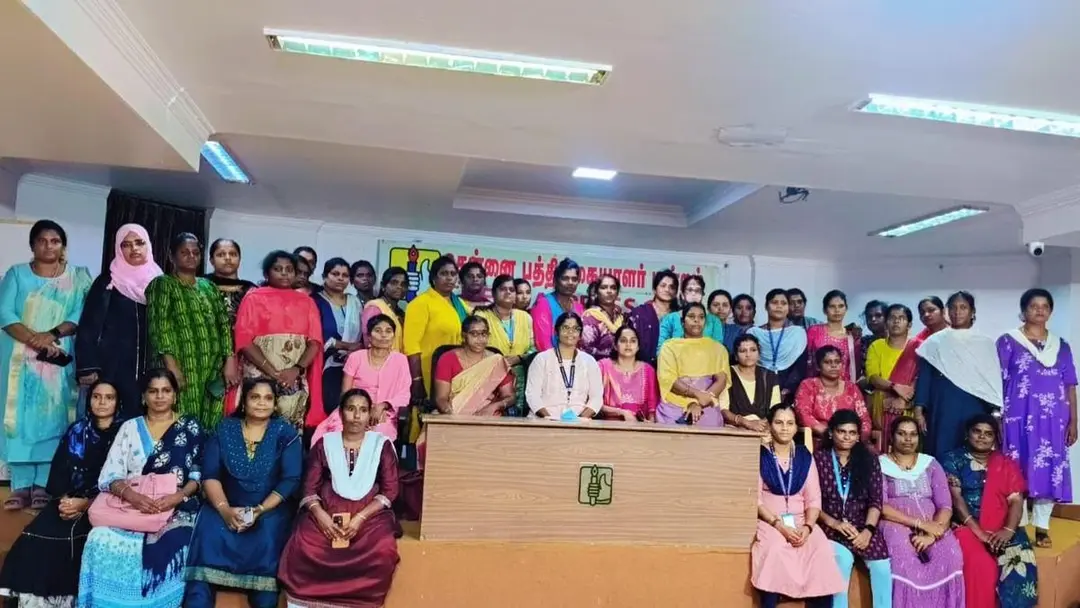
Tamil Nadu MLHPs seek job regularisation, higher basic salary
The Tamil Nadu Mid-Level Healthcare Providers' Union has given Chief Minister C. Joseph Vijay a representation seeking job regularisation, a basic salary hike, paid maternity leave and official re-designation of MLHPs as Community Health Officers. The union, representing 4,848 health and wellness centres in the State, said MLHPs deliver 12 packages of services and perform 14 medical tests. Contractual MLHPs draw a basic salary of Rs 21,000, up from Rs 18,000, against Rs 60,000-70,000 in other States.
Source
The Hindu — National · read the original report ↗
Desk check · compared with the source
What the desk checked (5)
- The union submitted a representation to Chief Minister C. Joseph Vijay seeking job regularisation, salary hike, paid maternity leave and re-designation of MLHPs as Community Health Officers. — Attributed to the Tamil Nadu Mid-Level Healthcare Providers' Union memorandum as reported in the source.
- The union represents 4,848 health and wellness centres in the State; MLHPs deliver 12 service packages and perform 14 types of medical tests. — Figures appear in the source, sourced to the union's memorandum.
- Contractual MLHPs draw a basic salary of Rs 21,000, up from Rs 18,000, while counterparts in other States get Rs 60,000-70,000 plus monthly incentives. — Figures stated in the union petition; no independent or government confirmation in the source.
- Jan Arogya Samiti funds held in joint accounts of panchayat presidents and PHC medical officers are not properly utilised, forcing contract staff to spend personal money. — Allegation attributed to union office-bearers N. Sundari, R. Jeyasurya and P. Surya; no response from authorities included.
- The union wants GNM and B.Sc Nursing graduates given priority over ANM diploma holders in nursing recruitment. — Demand attributed to the union at the Sunday press meet.
Analysts’ view opinion
This is a classic contract-cadre problem in India's primary health architecture: MLHPs sit at the delivery end of the health and wellness centre model, carrying a defined service load, but remain outside the regular pay and tenure structure. The union's own framing — 12 service packages and 14 tests across 4,848 centres versus a ₹21,000 basic salary, against ₹60,000-₹70,000 cited for other States — is essentially an argument that the job has been designed as permanent while the employment terms stay temporary. The re-designation demand as Community Health Officers matters more than it sounds, because a title change usually carries pay-scale, cadre and career-progression consequences. The Jan Arogya Samiti allegation is the sharper governance point, since it concerns whether devolved funds are reaching the frontline at all.
- The core design flaw alleged here is a mismatch between a fixed, expanding service mandate and a contractual employment model with no regularisation pathway.
- Wide inter-State pay variation for comparable frontline roles is a known feature of centrally designed but State-implemented health schemes, and it fuels exactly this kind of parity demand.
- Re-designation as Community Health Officers is not cosmetic — nomenclature typically determines pay scale, cadre rights and promotion ladders, which is why it is bundled with regularisation.
- The Jan Arogya Samiti complaint is a decentralisation-accountability issue: joint-account control by panchayat presidents and PHC medical officers leaves contract staff with responsibility but no spending authority, allegedly pushing routine costs onto them personally.
- The demand to prioritise GNM and B.Sc Nursing graduates over ANM diploma holders is a separate qualification-hierarchy question, and any such move would have distributional consequences for existing diploma-holder aspirants.
What to watch — Watch whether the State responds with an interim pay revision and incentive structure rather than full regularisation — the usual fiscally cautious middle path — and whether any audit or utilisation review of Jan Arogya Samiti funds follows.
The story records the union's claims and allegations only; it does not establish the government's position, any fiscal cost estimate, verification of the fund-misuse charge, or the exact States and terms behind the ₹60,000-₹70,000 comparison.
Deep dive
Research brief · 8 facts · 3 dates · exam-readyThe brief
Context
Mid-Level Healthcare Providers (MLHPs) are the frontline staff who run Health and Wellness Centres, the lowest tier of India's public primary health architecture, offering a defined set of service packages and diagnostic tests. In Tamil Nadu, many of them are hired on contract rather than on regular government pay scales. The Tamil Nadu Mid-Level Healthcare Providers' Union, representing 4,848 health and wellness centres in the State, has submitted a representation to Chief Minister C. Joseph Vijay seeking regularisation, a higher basic salary, paid maternity leave and re-designation as Community Health Officers. The union also raised concerns about the use of Jan Arogya Samiti funds at a press meet at the Chennai Press Club.
Key facts
- The union's representation to Chief Minister C. Joseph Vijay seeks job regularisation, a basic salary hike, paid maternity leave and re-designation of MLHPs as Community Health Officers.
- The union represents 4,848 health and wellness centres in Tamil Nadu.
- MLHPs deliver 12 packages of services and perform 14 types of medical tests, as per the memorandum.
- Contractual MLHPs in Tamil Nadu draw a basic salary of Rs 21,000, raised from Rs 18,000.
- Counterparts in other States receive Rs 60,000 to Rs 70,000 along with monthly incentives, the petition said.
- Jan Arogya Samiti funds are managed through joint bank accounts held by village panchayat presidents and primary health centre medical officers.
- The union alleged contract staff spend personal money on centre maintenance, equipment cleaning and purchasing registers, while regular-scale employees and medical officers use the funds.
- The union demanded priority in nursing recruitment for General Nursing and Midwifery and B.Sc Nursing graduates over Auxiliary Nurse Midwife diploma holders.
Timeline
- Before the press meet (date not stated in the source)The Tamil Nadu Mid-Level Healthcare Providers' Union hands over a representation to Chief Minister C. Joseph Vijay with its demands.
- Sunday (press meet)Union State president N. Sundari, secretary R. Jeyasurya and treasurer P. Surya address a press meet at the Chennai Press Club urging proper utilisation of Jan Arogya Samiti funds.
- September 21, 2026The report is published.
Who has a stake
- Contractual MLHPs in Tamil Nadu — Seek regularisation, a higher basic salary than Rs 21,000, paid maternity leave and re-designation as Community Health Officers.
- Tamil Nadu Mid-Level Healthcare Providers' Union — Representing staff of 4,848 health and wellness centres; pressing the demands and alleging misuse of Jan Arogya Samiti funds.
- Chief Minister C. Joseph Vijay / Tamil Nadu government — Recipient of the representation; must decide on regularisation, pay revision and fund utilisation norms.
- Village panchayat presidents and PHC medical officers — Hold joint bank accounts operating Jan Arogya Samiti funds; accused by the union of not using funds for health centre activities or meetings.
- GNM and B.Sc Nursing graduates, and ANM diploma holders — Competing claims in nursing recruitment; the union wants GNM and B.Sc Nursing graduates prioritised.
- Patients at health and wellness centres — Depend on MLHPs for 12 service packages and 14 medical tests; affected by staffing and funds issues.
Why it matters
MLHPs are the first point of contact for primary care at thousands of health and wellness centres, so their pay, tenure security and working conditions directly shape the reach of preventive and diagnostic services. A near three-fold pay gap with other States, alongside allegations that contract staff fund basic centre upkeep from their own pockets, raises questions about the sustainability of India's primary health workforce model.
UPSC angle
Prelims pointers
- MLHP: Mid-Level Healthcare Provider, the staff running Health and Wellness Centres; the union seeks re-designation as Community Health Officer (CHO).
- Tamil Nadu has 4,848 health and wellness centres as per the union.
- MLHPs deliver 12 packages of services and perform 14 types of medical tests.
- Contractual MLHP basic salary in Tamil Nadu: Rs 21,000 (raised from Rs 18,000); other States: Rs 60,000-70,000 plus monthly incentives.
- Jan Arogya Samiti funds are operated through joint bank accounts of village panchayat presidents and PHC medical officers.
- Nursing qualifications named: GNM (General Nursing and Midwifery), B.Sc Nursing and ANM (Auxiliary Nurse Midwife) diploma.
Mains framing
The demands of Tamil Nadu's Mid-Level Healthcare Providers expose a structural fault line in India's primary healthcare expansion: service delivery at health and wellness centres has been scaled up rapidly, but the workforce carrying it out remains largely contractual and under-compensated. The union's own figures illustrate the asymmetry: MLHPs deliver 12 service packages and 14 diagnostic tests across 4,848 centres, yet draw a basic salary of Rs 21,000 against Rs 60,000-70,000 in other States, without regularisation or paid maternity leave. A second layer is financial decentralisation without accountability: Jan Arogya Samiti funds, operated through joint accounts of panchayat presidents and PHC medical officers, are alleged to be inaccessible to contract staff, who then spend personal money on maintenance, cleaning and registers. The recruitment dispute between GNM/B.Sc Nursing graduates and ANM diploma holders adds a skills-hierarchy question. A grounded way forward would involve transparent audit and utilisation norms for Samiti funds, clarity on pay parity and designation across States, and a defined career pathway for contractual primary-care staff, though the source does not record any government response.
Key terms
- Mid-Level Healthcare Provider (MLHP)
- The lead health worker at a health and wellness centre; the union wants them officially re-designated as Community Health Officers.
- Health and Wellness Centre
- Primary-level health facility; 4,848 such centres in Tamil Nadu are represented by the union.
- Jan Arogya Samiti
- Local health committee whose funds are held in joint bank accounts of village panchayat presidents and PHC medical officers.
- Primary Health Centre (PHC)
- Government primary care facility whose medical officer is a joint signatory on Jan Arogya Samiti accounts.
- GNM / B.Sc Nursing / ANM
- Nursing qualifications; the union wants GNM and B.Sc Nursing graduates prioritised over ANM diploma holders in recruitment.
- Job regularisation
- Conversion of contractual posts into regular government service with attendant pay scale and benefits.
Practice questions
- Contractual employment of frontline health workers has helped expand primary care coverage but created new equity problems. Discuss with reference to the demands of Tamil Nadu's Mid-Level Healthcare Providers.
- Examine the role of local bodies such as Jan Arogya Samitis in health financing. What accountability mechanisms are needed for decentralised health funds?
- Should pay and designation of primary healthcare workers be standardised across States? Argue with reference to the wide salary differentials reported for MLHPs.
Grounded only in the source report — figures and dates are the source's, not inferred.