
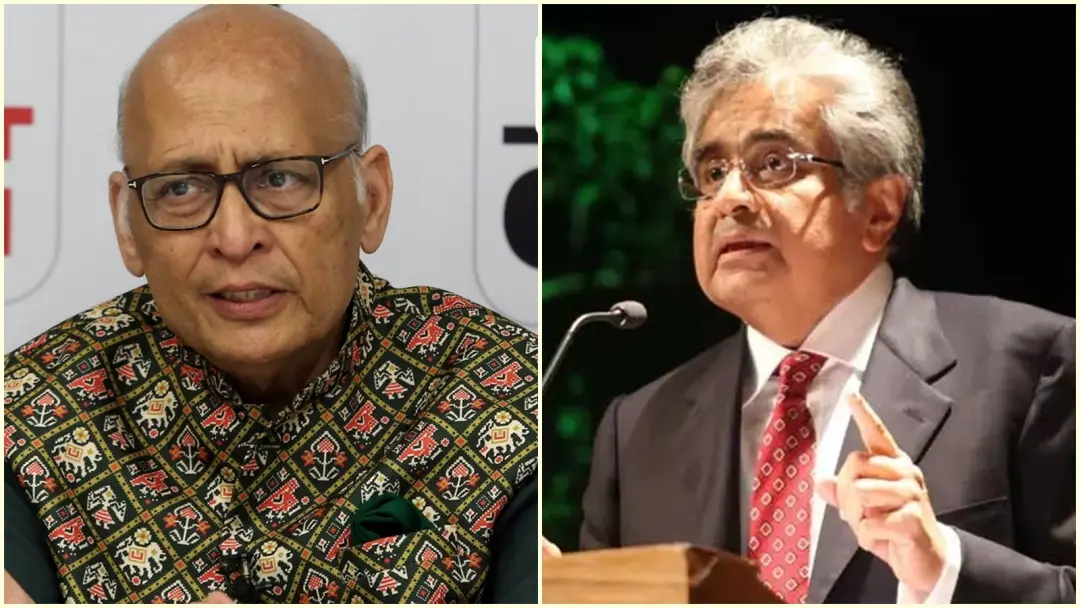
Tata Sons-Trusts dispute may reach court, say Salve, Singhvi
Senior advocates Harish Salve and Abhishek Manu Singhvi said the Tata Sons-Tata Trusts dispute is likely to move from the boardroom to a courtroom. The Tata Sons board on Thursday approved a five-year term for chairman N Chandrasekaran in a 4-1 vote. Noel Tata, chairman of Tata Trusts, which holds about 66% of Tata Sons, voted against; Trust nominee Venu Srinivasan voted in favour. Trusts called the September 17 resolution void ab initio.
Source
Indian Express — India · read the original report ↗
Desk check · compared with the source
What the desk checked (5)
- Tata Sons board approved a five-year term for chairman N Chandrasekaran in a 4-1 vote on Thursday — Figure and vote split appear in source; not attributed to a named official.
- Noel Tata voted against the move while Trust nominee Venu Srinivasan voted in favour — Stated in source without direct attribution to a named spokesperson.
- Tata Trusts holds about 66% of Tata Sons — Approximate figure as given in source; no document cited.
- Tata Trusts said the September 17 resolution is void ab initio, citing Article 121 — Attributed to a Tata Trusts statement issued on Sunday.
- Salve said the Tata Group is 'the face of India' and cannot be run by three trustees — Direct quote attributed to Salve in an ANI interview from London.
Analysts’ view opinion
This is not a personality clash so much as an expensive fight over who controls India's largest corporate group and how it is governed. With Tata Sons moving towards a public listing, the fact that the chairman of the Trusts — holding about 66% — voted against and has called the September 17 resolution void ab initio injects real uncertainty into valuation and timing. A courtroom would eventually bring clarity, but clarity bought with time and cost.
- The push towards listing followed the RBI's rejection of Tata Sons' deregistration application, so this is as much a regulatory compulsion as a strategic choice.
- Markets typically apply a governance discount where control rights are legally contested; pricing any issue is harder until ownership questions are settled.
- The cost question matters: legal expense and decision delay ultimately land on the company, and through dividends on the philanthropic activity the Trusts fund.
- Large, long-gestation commitments of the kind Salve referenced — Air India, defence work, hydrogen projects — need a stable board and steady capital access, and leadership uncertainty can slow execution.
- There is a serious counter-case: if the Trusts' reading of Article 121 and the veto convention holds, it would reinforce the principle that a majority owner's rights cannot be diluted — a signal investors of all sizes care about.
What to watch — Watch whether a case is actually filed, whether any court order touches the listing process, and how group listed stocks trade on each development.
The story reports that both senior counsel expect litigation, not that any case has been filed; it does not establish who has the stronger legal position, nor any specific impact on valuation or the listing timetable.
Deep dive
Research brief · 8 facts · 5 dates · exam-readyThe brief
Context
Tata Sons, the holding company of the Tata Group, is about 66% owned by Tata Trusts, the philanthropic trusts now chaired by Noel Tata. On Thursday the Tata Sons board approved a five-year term for chairman N Chandrasekaran in a 4-1 vote, with Noel Tata dissenting, even though Chandrasekaran had said in August he would not seek another term. Tata Trusts has called the September 17 resolution void ab initio, and senior advocates Harish Salve and Abhishek Manu Singhvi say the dispute is likely to move from the boardroom to a courtroom.
Key facts
- Tata Sons board approved a five-year term for chairman N Chandrasekaran on Thursday in a 4-1 vote.
- Tata Trusts holds about 66% of Tata Sons; its chairman Noel Tata voted against the move.
- Trust nominee Venu Srinivasan voted in favour of the resolution.
- Chandrasekaran had said in August that he would not seek another term.
- Tata Trusts said in a statement on Sunday that the September 17 resolution is void ab initio.
- Trusts cited Article 121 of Tata Sons' Articles of Association, requiring the affirmative vote of a majority of Trust-nominated directors.
- The board decided by majority to proceed with steps towards a public listing after the RBI rejected Tata Sons' application for deregistration as an upper layer non-banking finance company.
- Harish Salve is likely to appear for Tata Sons; Abhishek Manu Singhvi is advising Tata Trusts/Noel Tata.
Timeline
- 2021Supreme Court judgment in the Tata-Mistry case; Singhvi had then represented Tata Sons against Cyrus Mistry.
- August (year not stated in the source)N Chandrasekaran said he would not seek another term as Tata Sons chairman.
- September 17Board resolution passed that Tata Trusts later described as void ab initio.
- Thursday (date not stated in the source)Tata Sons board approved a five-year term for Chandrasekaran in a 4-1 vote and decided by majority to move towards a public listing.
- Sunday (date not stated in the source)Tata Trusts issued a statement invoking Article 121 and calling the resolution void ab initio.
Who has a stake
- Tata Sons — Its board's decision on the chairman's term and on steps towards a public listing is being challenged as invalid.
- Tata Trusts — As holder of about 66% of Tata Sons, it argues its nominated directors' affirmative vote and veto rights were bypassed.
- Noel Tata — Chairman of Tata Trusts; voted against the five-year term and may be represented by Singhvi in litigation.
- N Chandrasekaran — The chairman whose fresh five-year term is at the centre of the dispute.
- Venu Srinivasan — Trust nominee director who voted in favour, splitting the Trust-nominated bloc.
- Reserve Bank of India — Rejected Tata Sons' application for deregistration as an upper layer NBFC, a trigger for the listing question.
- Harish Salve and Abhishek Manu Singhvi — Senior advocates expected to lead opposing sides if the dispute reaches court.
Why it matters
Tata Sons sits atop what Salve called India's largest corporate enterprise, holding assets received from the government such as Air India, doing defence work and setting up hydrogen projects. A courtroom fight over who controls board decisions — the majority shareholder trusts or the board — touches governance norms, the reading of the Supreme Court's 2021 Tata-Mistry ruling, and the prospect of a public listing forced by the RBI's NBFC classification.
UPSC angle
Prelims pointers
- Tata Trusts holds about 66% of Tata Sons; Noel Tata is chairman of Tata Trusts.
- Article 121 of Tata Sons' Articles of Association: requires affirmative vote of a majority of Trust-nominated directors.
- RBI rejected Tata Sons' application for deregistration as an 'upper layer' non-banking finance company.
- Supreme Court's 2021 judgment in the Tata-Mistry case is central to the Trusts' claim of primacy and of upheld special Articles.
- Harish Salve is a former Solicitor General of India; Abhishek Manu Singhvi is a Rajya Sabha member.
- 'Void ab initio' means invalid from the very beginning — the Trusts' description of the September 17 resolution.
Mains framing
The Tata Sons-Tata Trusts standoff is essentially a corporate governance question: where does control lie when a philanthropic majority shareholder holding about 66% claims special rights under the Articles of Association, while the board asserts its majority decision-making? The Trusts rely on Article 121, which they say requires the affirmative vote of a majority of Trust-nominated directors and restricts the casting vote to tied votes, and on their reading of the Supreme Court's 2021 Tata-Mistry judgment as granting them primacy and upholding the special Articles; Singhvi adds that unanimity in Trust voting and veto provisions have been practised for decades. The other side, articulated by Salve, argues that a global institution carrying government-transferred assets such as Air India, defence work and hydrogen projects cannot be run on the cultural preference of a few trustees and must refresh itself and draw the best talent in an era of transparency. Complicating matters, the RBI's rejection of deregistration as an upper layer NBFC pushes Tata Sons towards a public listing, raising the stakes of who controls the board. The way forward, as both counsel implicitly concede, is either restored collegiality within the board or judicial clarification of the Articles and the 2021 ruling.
Key terms
- Tata Sons
- The holding company of the Tata Group, about 66% owned by Tata Trusts, chaired by N Chandrasekaran.
- Tata Trusts
- Philanthropic trusts chaired by Noel Tata that hold about 66% of Tata Sons and nominate directors to its board.
- Article 121
- Provision of Tata Sons' Articles of Association requiring the affirmative vote of a majority of Trust-nominated directors.
- Void ab initio
- Invalid from the outset; the Trusts' characterisation of the September 17 board resolution.
- Upper layer NBFC
- RBI classification for large non-banking finance companies; Tata Sons' bid for deregistration from it was rejected.
- Tata-Mistry case (2021)
- Supreme Court judgment that Singhvi reads as giving the Trusts primacy and upholding Tata Sons' special Articles.
Practice questions
- Examine the tension between majority shareholder rights and board autonomy in light of the Tata Sons-Tata Trusts dispute over Article 121.
- How does the RBI's 'upper layer' NBFC classification influence the listing debate at unlisted holding companies such as Tata Sons?
- Discuss the governance challenges when a philanthropic trust is the dominant shareholder of a large corporate group with strategic national assets.
Grounded only in the source report — figures and dates are the source's, not inferred.