
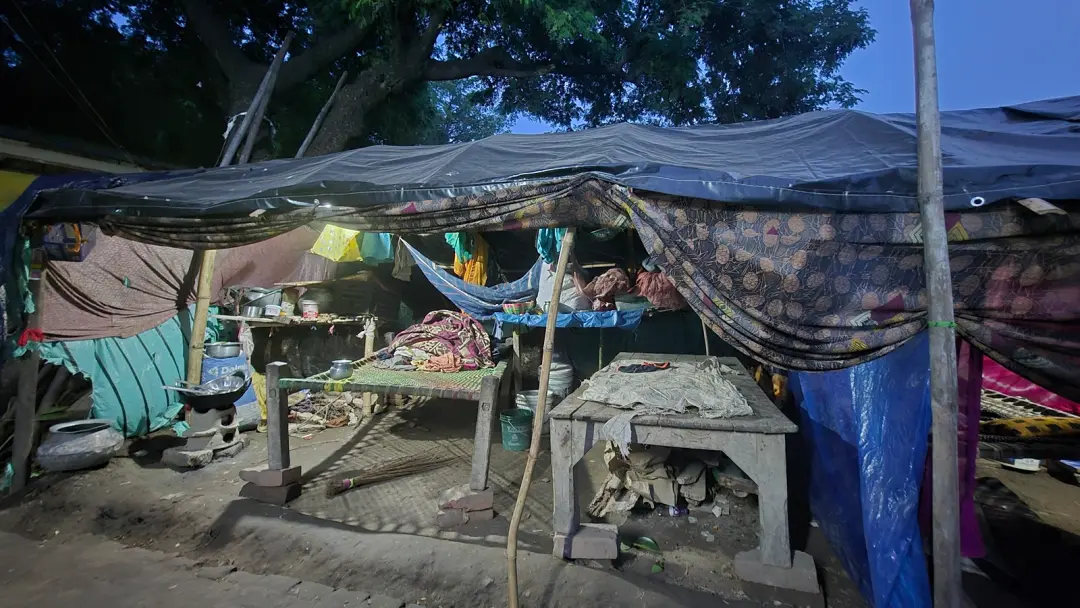
Displaced families spend month in Bhagalpur flood relief camps
Families displaced by floods in Bihar's Bhagalpur have spent nearly a month in tents of black plastic sheets. A control centre at Rabindra Bhawan on the Tilka Manjhi university campus oversees relief, including meals twice a day for around 250 families. The T N B Collegiate Ground camp feeds about 650 people from Dildarpur, Shankarpur and Bairariya and houses 400 cattle. Children attend art therapy including Manjusha painting. Residents are seeking rehabilitation on higher ground.
Source
Indian Express — India · read the original report ↗
Desk check · compared with the source
What the desk checked (5)
- The control centre at Rabindra Bhawan monitors relief including feeding of around 250 families, with meals served twice a day. — Figure appears in source; meal detail attributed to teacher Hanish Kumar overseeing food preparation.
- Around 400 cattle are kept at the T N B Collegiate Ground camp, with fodder and veterinary arrangements. — Attributed to Mrityunjay Kumar, a teacher posted at the relief camp.
- The T N B Collegiate Ground camp feeds around 650 people from Dildarpur, Shankarpur and Bairariya. — Attributed to the same camp teacher; place names appear in source.
- Surya Narayan Mandal owes two self-help group loans of about Rs 70,000-80,000. — Self-reported by the named resident; no documentary corroboration in source.
- Art therapy sessions including Manjusha painting are run daily by the state art and culture department with the district administration. — Attributed to Bhagalpur district art and culture officer Ankit Ranjan.
Analysts’ view opinion
The Bhagalpur camps are more than a humanitarian story — they are an annual test of Bihar's governance record. The account credits the administration with meals, a medical team, fodder and veterinary care for cattle, and even art therapy for children, all of which supports the claim that the system responded. But the residents' own demand — not another relief camp, but permanent rehabilitation on higher ground — is the line with the political power to shift the debate from relief to structural solutions, especially with displacement already a month old and fears it may stretch to Chhath.
- The scale of relief described — twice-daily meals for about 250 families, food for around 650 people, arrangements for roughly 400 cattle — is what an administration can point to as evidence of delivery.
- Against that, a month under black plastic sheets with homes still submerged gives critics an equally concrete counter-image.
- Many camp residents are migrant workers who rushed back from Hyderabad and Ludhiana, some without being paid, per the story — fusing flood loss with livelihood loss in a politically sensitive way.
- Submerged maize stocks and outstanding self-help group loans point towards demands for compensation and loan relief.
- The call for resettlement on higher ground raises long-term policy accountability for a flood cycle that recurs yearly — a question no single party has an easy answer to.
What to watch — Watch what is said about the period after the camps close — on compensation, loan relief and rehabilitation on higher ground — by both the government and the opposition.
The story does not establish any party's or leader's position, any electoral effect, or any government decision on rehabilitation; it documents conditions in the camps as they stand.
Deep dive
Research brief · 8 facts · 6 dates · exam-readyThe brief
Context
Floods along the Ganga in Bihar's Bhagalpur district have displaced hundreds of families who have spent nearly a month in relief camps made of black plastic sheets stretched over bamboo poles. Two major camps are described: one at Tilha Kothi inside the Tilka Manjhi Bhagalpur University campus, and another at the T N B Collegiate Ground. A control centre at Rabindra Bhawan, a university building, monitors relief operations, while the district administration and the state art and culture department run art therapy sessions for children. Many camp residents are migrant labourers who rushed back from cities such as Hyderabad and Ludhiana, leaving wages unpaid.
Key facts
- Families displaced by the Bhagalpur floods have lived in tents of black plastic sheets for nearly a month; floodwaters entered homes about a month before the report.
- The control centre at Rabindra Bhawan monitors relief operations including feeding around 250 families, with meals served twice a day, says teacher Hanish Kumar.
- The T N B Collegiate Ground Relief Camp feeds around 650 people from the submerged areas of Dildarpur, Shankarpur and Bairariya.
- Around 400 cattle are kept on the T N B Collegiate campgrounds, with separate arrangements for fodder and veterinary care, says teacher Mrityunjay Kumar.
- At the Tilha Kothi settlement, a medical team is stationed near the entrance and an anganwadi centre runs classes for around 30 children in two shifts.
- Children are being taught Manjusha, the traditional art form of the Bhagalpur region, along with storytelling, cultural programmes and film screenings, held daily.
- Surya Narayan Mandal, 52, has 10 family members in one shelter and owes two self-help group loans of around Rs 70,000-80,000 taken earlier this year.
- Families had harvested maize around April and stored grain at home as a cash reserve; that grain has been underwater for weeks.
Timeline
- Around AprilFamilies harvested maize from the previous crop cycle; part consumed at home, part sold when money was needed.
- Earlier this yearSurya Narayan Mandal took two loans of around Rs 70,000-80,000 from self-help groups for crops and household needs.
- Nearly a month before the reportFloodwater entered homes in areas such as Didarpur Bind Tola; water rose even above the first floors of houses.
- Days after the floodingMigrant workers including Raj Kishore, Suman Kumar and Karan Kumar returned from Hyderabad and Ludhiana, some without being paid wages.
- Last few days before the reportLocal artists began teaching Manjusha painting and running art therapy sessions for children in the camps.
- Expected by Chhath in NovemberUsha Devi says cleaning homes of mud and sludge and making them habitable may take until then.
Who has a stake
- Displaced families in Bhagalpur camps — Loss of documents, cash, jewellery, stored grain and homes; uncertainty over what happens after relief camps close.
- Migrant labourers from the flooded villages — Rushed back from Hyderabad and Ludhiana, losing a month's work and unpaid wages, compounding flood losses.
- Bhagalpur district administration — Running relief camps, food, medical teams, anganwadi classes and cattle arrangements; faces demands for rehabilitation on higher ground.
- Bihar state art and culture department — Runs daily art therapy, Manjusha painting and cultural programmes in collaboration with the district administration.
- Tilka Manjhi Bhagalpur University — Its campus, Tilha Kothi and Rabindra Bhawan are being used as a settlement and relief control centre.
- Livestock owners at T N B Collegiate Ground — Around 400 surviving cattle are their most valuable remaining asset; future fodder and water supply is uncertain.
- Teachers deployed at camps (Hanish Kumar, Mrityunjay Kumar) — Overseeing food preparation and camp management alongside their regular duties.
Why it matters
The story shows how an annual Ganga flood turns into a prolonged livelihood crisis: stored grain that worked as a household bank account is destroyed, self-help group loans remain unpaid, and migrant earnings are lost when workers rush home. Relief camps provide food, medical help and even art therapy, but residents say what they need is permanent rehabilitation on higher ground rather than repeated camp stays. It highlights the gap between short-term relief and long-term resettlement in flood-prone Bihar.
UPSC angle
Prelims pointers
- Manjusha is the traditional art form associated with the Bhagalpur region, taught to children as art therapy in the camps.
- Rabindra Bhawan on the Tilka Manjhi Bhagalpur University campus hosts the flood relief control centre; Rabindranath Tagore is known to have stayed there.
- Parts of Gitanjali, which earned Tagore the Nobel Prize in Literature, are associated with his time in Bhagalpur.
- T N B Collegiate Ground camp: about 650 people fed from Dildarpur, Shankarpur and Bairariya; around 400 cattle sheltered.
- Rabindra Bhawan control centre oversees feeding of about 250 families, with meals twice a day.
- Anganwadi centre at Tilha Kothi camp runs classes for about 30 children in two shifts.
Mains framing
The Bhagalpur camps illustrate how recurrent Ganga flooding converts a seasonal hazard into structural impoverishment for riverbank communities. Causes visible in the source are settlement close to the riverbed, dependence on stored grain as the only savings instrument, reliance on out-migration for cash income, and borrowing from self-help groups for crop inputs — all of which collapse together when water rises above the first floor of houses. The relief response is comprehensive within its limits: a control centre at Rabindra Bhawan feeding about 250 families twice a day, a 650-person kitchen and 400-head cattle shelter at T N B Collegiate Ground with fodder and veterinary care, a medical team, an anganwadi for about 30 children, and daily art therapy and Manjusha sessions that even women are joining. But residents' own testimony points to the unaddressed question: what happens after the camps close, when homes are still full of sludge and, as Usha Devi says, may not be habitable until Chhath in November, and when unpaid wages and self-help group loans of Rs 70,000-80,000 remain. The way forward articulated by the affected themselves is rehabilitation on higher ground beyond the river's reach, alongside protection of livestock, grain and livelihoods — not another season of relief camps.
Key terms
- Manjusha
- Traditional art form associated with the Bhagalpur region, being taught to children in the relief camps by local artists.
- Tilha Kothi
- A kothi inside the Tilka Manjhi Bhagalpur University campus that has become a settlement for hundreds of displaced people.
- Rabindra Bhawan
- University building where the relief control centre and community kitchen operate; Tagore is known to have stayed there.
- Art therapy
- Daily programme of painting, storytelling, cultural shows and film screenings for camp children, run by the state art and culture department with the district administration.
- Self-help group (SHG) loans
- Small credit taken by camp residents such as Surya Narayan Mandal (Rs 70,000-80,000) for crops and household needs, now hard to repay.
- Chhath
- Festival in November cited by a camp resident as the likely timeline for making flood-damaged homes habitable again.
Practice questions
- Relief camps address survival but not vulnerability. Examine this in the light of the experience of flood-displaced families in Bhagalpur.
- How does recurrent flooding interact with out-migration, informal credit and household food storage to deepen rural poverty? Discuss with examples from the Ganga plains.
- Discuss the role of culture and community-based interventions such as art therapy in disaster relief for children, with reference to the Bhagalpur camps.
Grounded only in the source report — figures and dates are the source's, not inferred.