
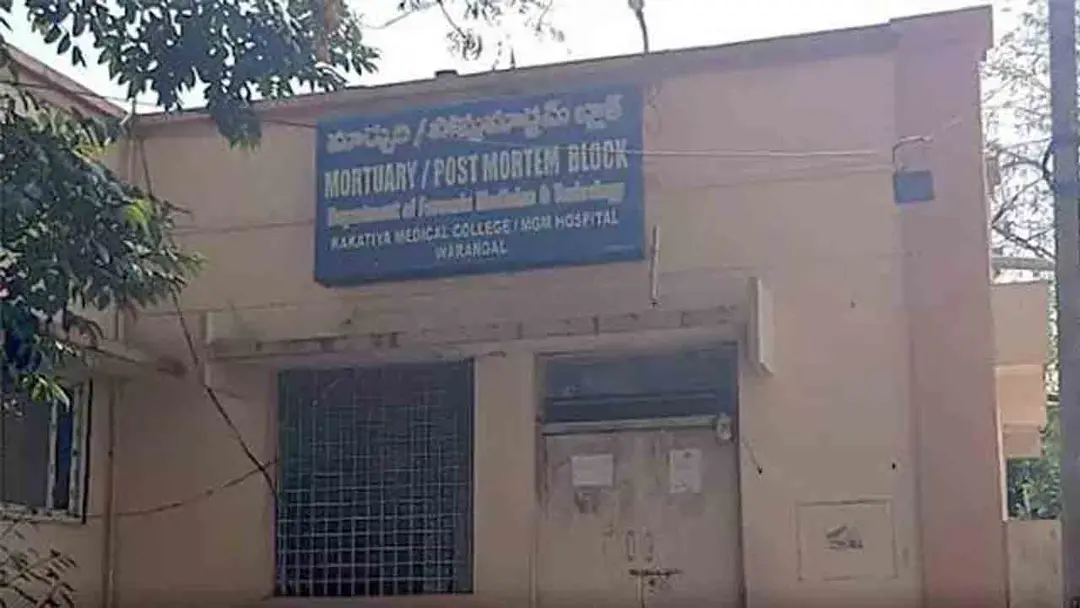
Rights panel takes up Wardhannapet mortuary incident suo motu
The State Human Rights Commission has taken suo motu cognisance of an incident in which rats gnawed a man's body in the government area hospital mortuary at Wardhannapet in Warangal district. Chairperson Justice Shameem Akther acted on a Namasthe Telangana report. Gare Veeraiah (58) of Rayaparthi mandal died in a road accident and his body was kept in the mortuary overnight. The report cited no freezer, cold storage or power, sanitation lapses and a rat menace. The Collector must report by October 27.
Source
Namasthe Telangana · read the original report ↗
Desk check · compared with the source
What the desk checked (5)
- Rats gnawed the body of a man kept in the Wardhannapet government area hospital mortuary in Warangal district. — Attributed in the source to a Namasthe Telangana news report that prompted commission action; not independently verified.
- The deceased is Gare Veeraiah (58) of Rayaparthi mandal, who died in a road accident. — Name, age and cause of death appear in the source text without further attribution.
- Commission chairperson Dr Justice Shameem Akther took up the incident suo motu. — Attributed to the State Human Rights Commission in the source.
- The mortuary lacked a freezer, cold storage and power supply, with sanitation problems and a rat menace. — Explicitly sourced to the Namasthe Telangana report, not to an official finding.
- The Warangal Collector must submit a comprehensive report by October 27. — Deadline figure appears in the source as a commission directive.
Analysts’ view opinion
The Vardhannapet mortuary case has stopped being a purely local negligence story: once the State Human Rights Commission takes it up suo motu, it becomes a question of state-level accountability. The allegation that a government hospital mortuary had no freezer, no cold storage and no power supply points straight at the delivery of public health services, which makes it easy political ammunition for the opposition. At the same time, the government retains an escape route — the report ordered by the Commission can locate blame in local maintenance failures rather than in policy.
- A suo motu inquiry means the scrutiny exists without any complainant, which makes it politically harder for the government to dismiss as motivated.
- The October 27 deadline creates a fixed political clock, and statements and counter-charges are likely to cluster around that date.
- The condition of rural and mandal-level government hospitals is a theme that travels well in electoral politics, and the opposition could fold this into a broader health-system failure narrative.
- The standard administrative response — quick repairs and action at staff level — may read as damage control without settling the systemic questions raised.
- The story shows the Commission acting on a newspaper report, underlining how media-driven accountability loops are doing the triggering work here.
What to watch — Watch whether the Collector's report lands by October 27, and whether it confines responsibility to local staff or concedes a shortfall in basic infrastructure.
The story establishes only that the Commission has taken up the matter and sought a report; the allegations are not yet verified, and no action against anyone or any party's formal reaction is recorded here.
Deep dive
Research brief · 8 facts · 5 dates · exam-readyThe brief
Context
A man's body kept overnight in the mortuary of the government area hospital at Wardhannapet in Telangana's Warangal district was found with rat bite marks the next morning. A Namasthe Telangana newspaper report said the mortuary had no freezer, no cold storage and no power supply, along with sanitation lapses and a rat menace. The Telangana State Human Rights Commission has taken suo motu cognisance of the incident and directed the Warangal Collector to submit a detailed report. The case tests whether basic dignity-of-the-dead standards are being maintained in small government hospitals.
Key facts
- The State Human Rights Commission took suo motu cognisance of rats gnawing a body in the mortuary of the government area hospital at Wardhannapet, Warangal district.
- Commission Chairperson Dr Justice Shameem Akther acted on a news report published in the Telugu daily Namasthe Telangana.
- The deceased was Gare Veeraiah, 58, of Rayaparthi mandal, who died in a road accident.
- His body was kept in the Wardhannapet hospital mortuary through the night; by next morning rat bite marks were seen on his eye and the area above it.
- The Namasthe report said the mortuary had no freezer, no cold storage and no electricity, along with sanitation lapses and a rat menace.
- The Commission directed the Warangal Collector to submit a comprehensive report on the incident.
- The report must cover the circumstances that led to the rats gnawing the body, management lapses, and precautions to prevent recurrence.
- The deadline set for submitting the report is October 27; the Commission's order was reported from Sultan Bazar on September 21.
Timeline
- Date not stated in the sourceGare Veeraiah (58) of Rayaparthi mandal dies in a road accident; his body is kept overnight in the Wardhannapet area hospital mortuary.
- Next morningRat bite marks are found on the deceased's eye and the area above it.
- Before September 21Namasthe Telangana publishes a report citing absence of freezer, cold storage and power, sanitation lapses and rat menace at the mortuary.
- September 21 (reported from Sultan Bazar)SHRC Chairperson Dr Justice Shameem Akther takes the incident up suo motu and orders the Warangal Collector to submit a detailed report.
- By October 27Deadline for the Warangal Collector to submit the comprehensive report to the Commission.
Who has a stake
- Telangana State Human Rights Commission — Must establish the facts and, if the reported lapses are true, decide on appropriate action.
- Dr Justice Shameem Akther, Commission Chairperson — Took suo motu cognisance on the basis of the press report and issued the directions.
- Family of Gare Veeraiah (58), Rayaparthi mandal — Received the body of their kin with rat bite marks; dignity of the deceased at stake.
- Warangal District Collector — Directed to submit a comprehensive report by October 27 on circumstances, management lapses and preventive steps.
- Wardhannapet government area hospital administration — Faces scrutiny over the absence of freezer, cold storage and power, and sanitation failures in its mortuary.
- Namasthe Telangana daily — Its news report triggered the Commission's suo motu proceedings.
Why it matters
A mortuary without a freezer, cold storage or electricity points to basic infrastructure failure in a government area hospital, and the desecration of a body raises questions of dignity for the dead and their families. The Commission's suo motu action shows how press reporting can trigger accountability, with a district Collector now answerable within a fixed deadline. The directions also ask for preventive measures, making this a test of whether systemic fixes follow a single reported lapse.
UPSC angle
Prelims pointers
- Suo motu cognisance: a commission or court initiating proceedings on its own, here based on a newspaper report.
- Telangana State Human Rights Commission Chairperson named in the story: Dr Justice Shameem Akther.
- Incident site: government area hospital mortuary, Wardhannapet, Warangal district; deceased from Rayaparthi mandal.
- Deceased: Gare Veeraiah, aged 58, died in a road accident.
- Commission directed the Warangal Collector to submit a comprehensive report by October 27.
- Reported deficiencies: no freezer, no cold storage, no electricity, sanitation lapses and rat menace.
Mains framing
The Wardhannapet mortuary incident illustrates how the absence of elementary facilities in lower-tier public health institutions translates into a violation of human dignity: the source records that a 58-year-old road accident victim's body, kept overnight, was found with rat bite marks in a mortuary reported to lack a freezer, cold storage and even power supply, alongside sanitation failures. The causes flagged in the report are infrastructural (no cold chain for bodies) and managerial (poor sanitation, unchecked rodent presence), and the Commission's order seeks precisely this distinction by asking for the circumstances, the management lapses and future precautions. The implications extend beyond one hospital: dignity of the dead is an aspect of the right to life and dignity that human rights commissions can enforce through suo motu powers, and the media report acted as the trigger for institutional accountability, with the district Collector made responsible within a deadline of October 27. The way forward, as suggested by the Commission's own directions rather than any assumption, is fact-finding followed by action if the reported lapses are confirmed, and documented preventive measures so such incidents are not repeated; the source does not specify any wider policy or funding response.
Key terms
- Suo motu cognisance
- When a body takes up a matter on its own initiative, here on a newspaper report, without a formal complaint.
- State Human Rights Commission (SHRC)
- State-level rights body that inquires into rights violations; here it ordered a report from the Warangal Collector.
- Area hospital
- A government hospital serving a cluster of mandals; the Wardhannapet facility where the mortuary lapses were reported.
- Mortuary cold storage/freezer
- Refrigerated facility to preserve bodies; reported to be absent at the Wardhannapet mortuary along with power supply.
- District Collector
- Head of district administration, directed here to file a comprehensive report on the incident by October 27.
Practice questions
- Discuss how suo motu powers of State Human Rights Commissions, exercised on media reports, strengthen accountability in public health institutions. Illustrate with the Wardhannapet mortuary case.
- The dignity of the dead is an extension of the right to life and dignity. Examine this in the light of infrastructure gaps such as the absence of mortuary cold storage in government hospitals.
- What administrative and infrastructural failures does the Wardhannapet incident reveal, and what preventive framework should a district administration put in place?
Grounded only in the source report — figures and dates are the source's, not inferred.