
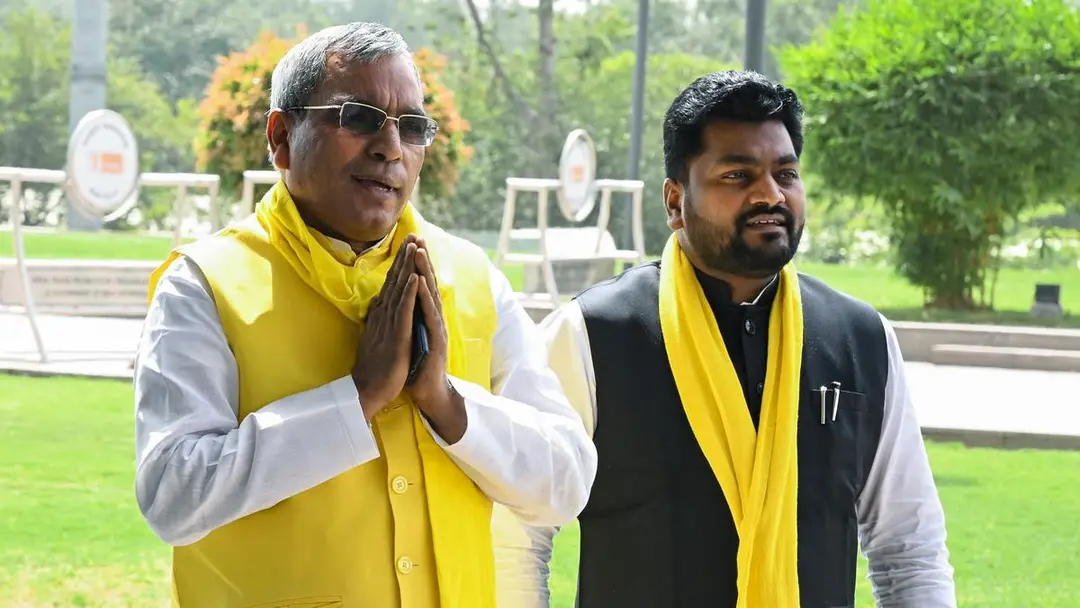
Rajbhar says U.P. will be split into four states after caste census
Uttar Pradesh minister and Suheldev Bharatiya Samaj Party chief Om Prakash Rajbhar said on Monday at a public meeting in Ambedkarnagar that the State would be divided into Purvanchal, Madhyanchal, Bundelkhand and Harit Pradesh after the caste census, and that Purvanchal's first Chief Minister would be from the Rajbhar community. He said Prime Minister Narendra Modi told him this. BJP leaders declined to comment. Congress alleged double-speak; the Samajwadi Party called it divide-and-rule politics.
Source
The Hindu — National · read the original report ↗
Desk check · some claims need care
What the desk checked (5)
- U.P. will be divided into four parts — Purvanchal, Madhyanchal, Bundelkhand and Harit Pradesh — soon — Attributed to SBSP chief Om Prakash Rajbhar at a public meeting in Ambedkarnagar; no official confirmation in source.
- PM Modi told Rajbhar the division could happen after the caste census — Rajbhar's own claim about a private conversation; no corroboration, and BJP leaders declined to comment.
- The first Chief Minister of a separate Purvanchal will be from the Rajbhar community — Speculative assertion attributed to Rajbhar; not a verified fact.
- BSP-led U.P. government passed an assembly proposal before the 2012 election to split the State into four parts but did not get Central approval — Stated as background in the source without a named source or document reference.
- Rajbhar community supported the INDIA alliance in the 2024 Lok Sabha elections — Attributed to Congress national secretary Shahnawaz Alam; a political claim, not independent data.
Analysts’ view opinion
This reads less like a serious statehood proposal and more like an attempt to rebuild a caste-based vote base. By bundling "Purvanchal statehood" with "a Rajbhar Chief Minister", Om Prakash Rajbhar is offering his community maximum political payoff while remaining inside the ruling alliance. Invoking the Prime Minister lends the claim weight, but the silence of BJP leaders suggests the party is not ready to own it.
- Creating a new State is constitutionally Parliament's prerogative, so a State minister's announcement carries symbolic rather than policy weight.
- With the Congress arguing that the Rajbhar community leaned towards the INDIA alliance in 2024, the statement can be read as an attempt to recover lost ground.
- The BJP's refusal to comment — neither endorsing nor denying — lets an ally work caste arithmetic while the party avoids backlash in western U.P. and Madhyanchal.
- The precedent of the BSP government's pre-2012 division resolution, which never got Central clearance, shows how reliably this demand resurfaces before elections and then fades.
- Linking the caste census to division fuses two separate political demands into one frame, handing rivals the "divide and rule" line that the SP promptly used.
What to watch — Watch whether the BJP formally distances itself or stays silent, and whether Purvanchal and Bundelkhand regional outfits convert this into a broader campaign.
The story does not establish what Prime Minister Modi actually said, nor does it show any official proposal, timeline or government decision on dividing the State.
Deep dive
Research brief · 8 facts · 4 dates · exam-readyThe brief
Context
Uttar Pradesh Cabinet Minister and Suheldev Bharatiya Samaj Party (SBSP) president Om Prakash Rajbhar, an ally of the BJP in the State, claimed at a public meeting in Ambedkarnagar that U.P. would be divided into four States — Purvanchal, Madhyanchal, Bundelkhand and Harit Pradesh — once the caste census is completed, attributing this to a conversation with Prime Minister Narendra Modi. He also claimed the first Chief Minister of a separate Purvanchal would be from the Rajbhar community, which he said has the largest vote base in the region. Demands for splitting India's most populous State are long-standing: before the 2012 Assembly election, the BSP government passed a proposal in the State Assembly to divide U.P. into four parts, but it did not receive Central government approval. The BJP declined to comment, while the Congress and Samajwadi Party attacked the remarks.
Key facts
- On Monday, September 21, 2026, U.P. Cabinet Minister and SBSP chief Om Prakash Rajbhar said U.P. will be divided into four parts soon, after the caste census.
- The four proposed units named by him: Purvanchal, Madhyanchal, Bundelkhand and Harit Pradesh.
- Rajbhar claimed Prime Minister Narendra Modi told him the division could happen after the caste census.
- He said the first Chief Minister of a separate Purvanchal would be 'a son of the Rajbhar community', which he said has the largest vote base in Purvanchal.
- The statement was made at a public meeting in Ambedkarnagar district.
- Before the 2012 Assembly election, the BSP-led U.P. government passed a proposal in the State Assembly to divide U.P. into four parts, but failed to get Central government approval.
- Congress National Secretary Shahnawaz Alam said the Rajbhar social group supported the INDIA alliance in the 2024 Lok Sabha elections and is now backing the SP-Congress alliance.
- SP spokesperson Sunil Singh Yadav 'Sajan' said the party is fundamentally against the division of Uttar Pradesh; BJP leaders declined to comment.
Timeline
- Before the 2012 Assembly electionBSP-led U.P. government passed a proposal in the State Assembly to divide U.P. into four parts; Central government approval was not obtained.
- 2024 Lok Sabha electionsAccording to the Congress, the Rajbhar social group supported the INDIA alliance.
- September 21, 2026 (Monday)Om Prakash Rajbhar, at a public meeting in Ambedkarnagar, claims U.P. will be split into four States after the caste census, with a Rajbhar CM for Purvanchal.
- September 22, 2026Report published; BJP declines comment, Congress alleges double-speak by the PM, SP calls it divide-and-rule politics.
Who has a stake
- Om Prakash Rajbhar / SBSP — Seeks to retain relevance and consolidate the Rajbhar vote base in Purvanchal as a BJP ally in U.P.
- BJP — Faces questions over its ally's claim attributed to the PM; its leaders declined to speak on the comment.
- Prime Minister Narendra Modi — Cited by Rajbhar as having linked State division to the caste census; targeted by Congress for alleged double-speak.
- Congress — Alleges the claim is born of Rajbhar's diminished political stake and frustration; points to Rajbhar community support for SP-Congress.
- Samajwadi Party — Opposes division of U.P. and frames the remark as BJP-alliance divide-and-rule politics.
- Purvanchal Vikas Parishad (Devesh Chaubey) — Backs a separate Purvanchal, citing different economic and social dynamics of Eastern versus Western U.P.
- Rajbhar community and Purvanchal voters — Promised political primacy, including the first CM post, in a proposed Purvanchal State.
Why it matters
A serving Cabinet Minister and BJP ally has linked two politically charged demands — a caste census and the reorganisation of India's most populous State — and attributed the linkage to the Prime Minister. With the BJP silent and the SP and Congress on the attack, the claim revives long-pending statehood demands for Purvanchal, Bundelkhand, Harit Pradesh and Madhyanchal ahead of electoral contests in eastern U.P.
UPSC angle
Prelims pointers
- Om Prakash Rajbhar: U.P. Cabinet Minister and president of the Suheldev Bharatiya Samaj Party (SBSP), a BJP ally in U.P.
- Four proposed States from U.P. as named in the story: Purvanchal, Madhyanchal, Bundelkhand, Harit Pradesh.
- Before the 2012 Assembly election, the BSP government got a four-way division proposal passed in the U.P. Assembly; Centre's approval did not come.
- Purvanchal Vikas Parishad supports a separate Purvanchal State, citing distinct Eastern U.P. economic and social dynamics.
- Congress claims the Rajbhar social group backed the INDIA alliance in the 2024 Lok Sabha elections.
- Statement venue: public meeting in Ambedkarnagar district, September 21, 2026.
Mains framing
Om Prakash Rajbhar's claim that Uttar Pradesh will be split into Purvanchal, Madhyanchal, Bundelkhand and Harit Pradesh after the caste census reopens two intertwined debates: the demand for smaller States on grounds of governance and regional disparity, and the use of caste enumeration as a basis for political bargaining. Proponents such as the Purvanchal Vikas Parishad argue that Eastern U.P.'s economic and social dynamics differ fundamentally from Western U.P., making administrative reorganisation a development question; the 2012 precedent, when a BSP-era Assembly proposal for a four-way split failed to secure Central approval, shows that reorganisation requires Union-level political will rather than State resolutions alone. Critics see the timing differently: the Congress reads it as an attempt by a leader with diminished political stake to regain traction among Rajbhars who moved to the INDIA alliance in 2024, while the Samajwadi Party calls it divide-and-rule messaging substituting for a development record. The BJP's refusal to comment leaves the claimed prime ministerial endorsement unverified. A credible way forward would require separating the technical case for reorganisation — assessed on administrative viability, fiscal capacity and regional backwardness — from identity-based promises such as reserving a chief ministership for a single community, and pursuing any change through transparent, consultative constitutional processes rather than campaign rhetoric.
Key terms
- Suheldev Bharatiya Samaj Party (SBSP)
- Party led by Om Prakash Rajbhar, an alliance partner of the BJP in Uttar Pradesh.
- Purvanchal
- Eastern Uttar Pradesh region for which a separate State has long been demanded; Rajbhar promises its first CM from his community.
- Harit Pradesh
- Proposed State from western Uttar Pradesh, one of the four units named in the division demand.
- Caste census
- Caste-wise enumeration exercise that Rajbhar says must be completed before the State's division can proceed.
- INDIA alliance
- Opposition grouping which, per the Congress, the Rajbhar social group supported in the 2024 Lok Sabha elections.
- Purvanchal Vikas Parishad
- Outfit backing a separate Purvanchal State on grounds of distinct economic and social conditions in Eastern U.P.
Practice questions
- Critically examine the case for and against reorganising Uttar Pradesh into smaller States, using the 2012 Assembly proposal and current demands as reference points.
- Discuss how caste enumeration has become a bargaining instrument in coalition politics, with reference to the linkage drawn between the caste census and State division in Uttar Pradesh.
- 'Smaller States improve governance but sharpen identity politics.' Analyse this statement in the light of the demands for Purvanchal, Bundelkhand, Harit Pradesh and Madhyanchal.
Grounded only in the source report — figures and dates are the source's, not inferred.