
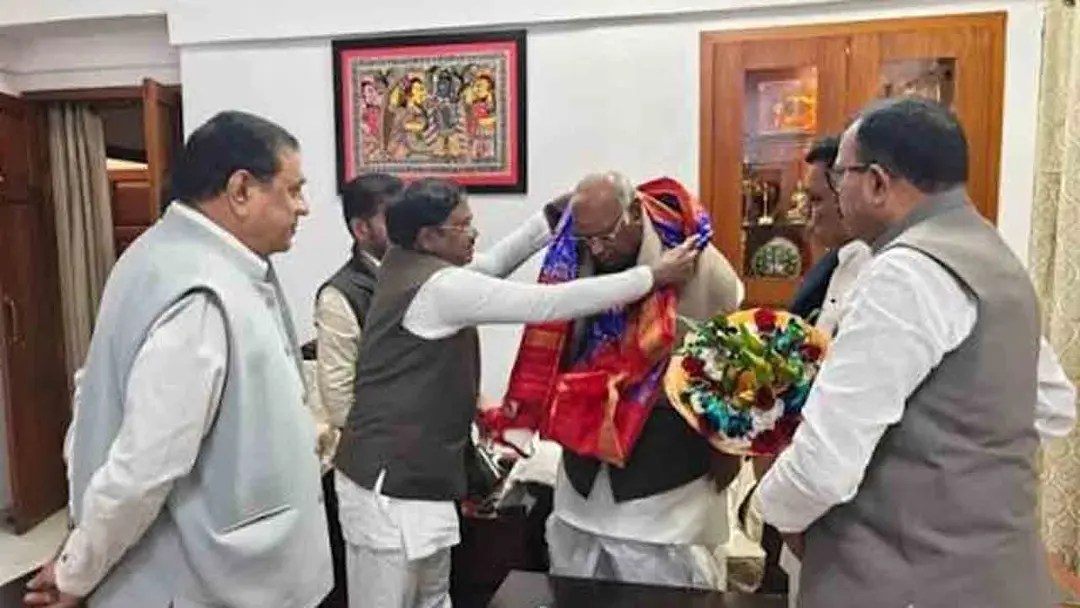
Telangana Minister Gaddam Vivek meets AICC chief Kharge
Telangana Labour Minister Gaddam Vivek met AICC president Mallikarjun Kharge on Monday. The minister, who was on a visit to Delhi, made a courtesy call on Kharge at his residence in the capital on Monday morning. According to information, the two discussed the political situation in Telangana, the Assembly sessions and issues relating to 22A. No official statement was issued on these matters.
Source
Namasthe Telangana · read the original report ↗
Desk check · some claims need care
What the desk checked (4)
- Telangana Labour Minister Gaddam Vivek met AICC president Mallikarjun Kharge on Monday. — Stated directly in the source; no named official source or quote given.
- The meeting was a courtesy call at Kharge's residence in Delhi on Monday morning. — Appears in source as reported detail; no attribution provided.
- They discussed Telangana's political situation, Assembly sessions and 22A issues. — Source hedges this with 'as per information' — unattributed, treat as unconfirmed.
- Vivek was on a Delhi visit at the time. — Figure/detail appears in source; dateline is Hyderabad, September 21.
Analysts’ view opinion
Though described as a courtesy call, a state minister meeting the AICC president at his Delhi residence usually carries a political signal as well. With Telangana's political situation, the upcoming assembly session and the 22A issue reportedly on the table, it suggests continuing coordination between the state government and the party high command. The absence of an official statement leaves room for interpretation about the meeting's purpose.
- By meeting the AICC president directly, Minister Gaddam Vivek signals his access to and standing with the party leadership.
- That the assembly session came up points to an attempt to align on floor strategy and how to handle the opposition.
- Land-related matters such as 22A touch citizens directly, so whatever line the government takes carries clear political upside or risk.
- Given the recurring chatter around state leadership questions, opposition parties could frame such Delhi visits as evidence of internal friction.
- Equally, state ministers briefing the high command on governance matters is routine practice within the Congress structure.
What to watch — Watch the government's stance on 22A during the assembly session, and whether any official clarification or opposition reaction follows this meeting.
The content of the discussion is not officially confirmed, and the story establishes no decision, change or disagreement of any kind.
Deep dive
Research brief · 8 facts · 3 dates · exam-readyThe brief
Context
Telangana's Labour Minister Gaddam Vivek, on a visit to Delhi, called on All India Congress Committee (AICC) president Mallikarjun Kharge at the latter's residence in the capital on Monday. The source describes it as a courtesy call during which, according to information available, the political situation in Telangana, the Assembly sessions and matters relating to "22A" came up. No official statement was issued on the subjects discussed, so the details remain unconfirmed. Telangana is governed by the Congress, which makes ministerial visits to the party's national leadership in Delhi a routine channel of state-centre party coordination.
Key facts
- Telangana Labour Minister Gaddam Vivek met AICC president Mallikarjun Kharge on Monday.
- The meeting took place at Kharge's residence in Delhi on Monday morning.
- The minister was in Delhi on a visit at the time of the meeting.
- The source describes the meeting as a courtesy call (maryadapoorvakam).
- Topics reportedly discussed: the political situation in Telangana, the Assembly sessions and issues relating to 22A.
- The report is datelined Hyderabad, September 21, and carries a timestamp of September 22, 2026 / 04:08 AM IST.
- The report is attributed to Namaste Telangana.
- No official statement was issued on the matters discussed; the discussion is reported only as 'per information'.
Timeline
- Monday morning (report datelined September 21)Gaddam Vivek, in Delhi, makes a courtesy call on Mallikarjun Kharge at his Delhi residence.
- Same meetingTelangana's political situation, Assembly sessions and 22A issues are reportedly discussed; no official statement released.
- September 22, 2026, 04:08 AM ISTTimestamp on the published report.
Who has a stake
- Gaddam Vivek, Telangana Labour Minister — Conveying state political and policy matters to the party's national leadership; his Delhi visit signals engagement with the high command.
- Mallikarjun Kharge, AICC president — As Congress national chief, he oversees the party's state units and arbitrates on state political matters.
- AICC (Congress national leadership) — Managing coordination with its Telangana government and unit ahead of Assembly sessions.
- Telangana government and Assembly — Assembly sessions and the 22A issue reportedly figured in the discussion, indicating pending legislative and administrative matters.
- Telangana public — Outcomes of the 22A issue and Assembly business affect governance, but no official detail was disclosed.
Why it matters
In a Congress-ruled state, ministers' calls on the AICC president are a key, if informal, channel through which state political issues and legislative agendas are cleared with the national leadership. The reported agenda — the political situation, Assembly sessions and 22A — suggests matters of governance and legislative business are in play, though the absence of any official statement means the substance remains unverified.
UPSC angle
Prelims pointers
- AICC = All India Congress Committee, the national apex body of the Indian National Congress.
- Mallikarjun Kharge is the AICC president named in the report.
- Gaddam Vivek is Telangana's Labour Minister in this report.
- The meeting was a courtesy call at Kharge's Delhi residence on a Monday.
- Reported topics: Telangana political situation, Assembly sessions, 22A issues.
- Report source: Namaste Telangana, datelined Hyderabad, September 21; timestamp September 22, 2026.
Mains framing
Party-level coordination between a state government and its national leadership is an underexamined feature of Indian federal politics, and this meeting illustrates it: a serving Telangana minister travelling to Delhi to brief the AICC president on the state's political situation, the Assembly sessions and issues relating to 22A. Such courtesy calls double as consultation mechanisms in which legislative calendars, intra-party equations and contentious administrative questions are discussed outside formal government channels. The implication is twofold: it strengthens intra-party cohesion and centre-state party alignment, but because no official statement was issued, it also underlines a transparency gap — citizens learn that policy-relevant matters were discussed without learning what was decided. A way forward consistent with the source's limits would be greater institutional disclosure, with substantive decisions on Assembly business and land or legal classification matters such as 22A placed before the legislature and the public rather than remaining in unattributed reports.
Key terms
- AICC
- All India Congress Committee, the Indian National Congress's national organisational body, headed by its president.
- Mallikarjun Kharge
- AICC president with whom the Telangana minister held the courtesy meeting in Delhi.
- Gaddam Vivek
- Telangana's Labour Minister, who was on a Delhi visit and called on Kharge.
- 22A
- An issue reportedly discussed in the meeting; the source does not explain what it refers to — not stated in the source.
- Courtesy call
- A formal, non-agenda visit to a senior leader, often used for informal political consultation.
Practice questions
- Examine the role of national party leaderships in shaping state-level legislative and political agendas in India. Illustrate with recent examples.
- Informal party channels often substitute for formal institutional consultation in Indian politics. Discuss the implications for transparency and accountability.
- Why are state ministers' visits to the national capital politically significant in a federal parliamentary system? Analyse.
Grounded only in the source report — figures and dates are the source's, not inferred.