
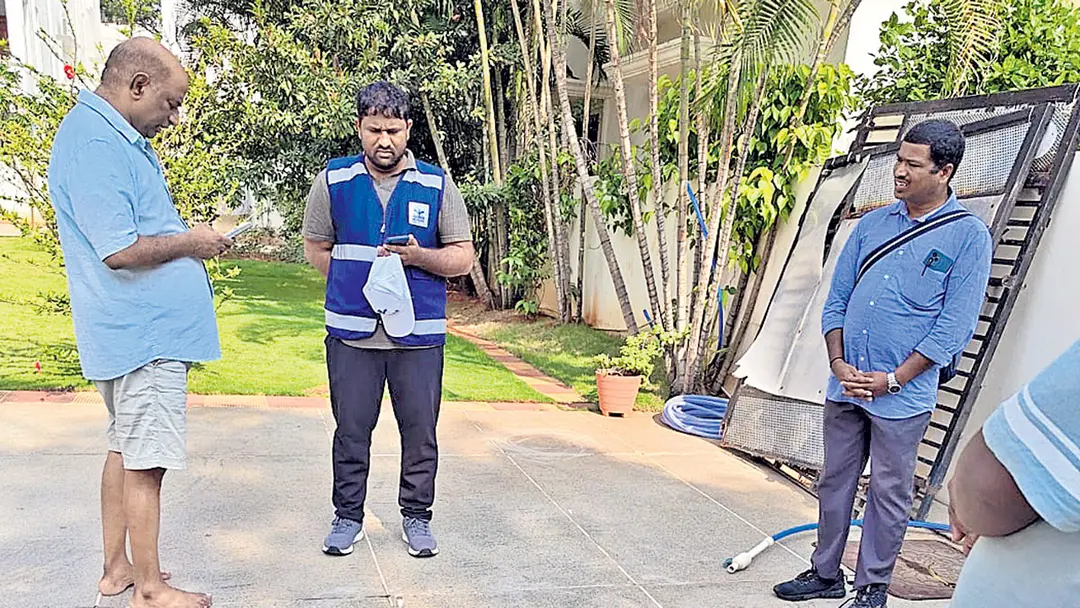
Five fined for wasting drinking water in Jubilee Hills
Water Board Managing Director Ashok Reddy expressed concern that valuable drinking water is being wasted by washing floors and vehicles, leaving taps open unnecessarily and ignoring overflowing overhead tanks. Citing the El Nino effect, he advised economical use of water. Officials carried out surprise field inspections in the Jubilee Hills area, identified five consumers wasting drinking water and imposed fines. Officials were directed to conduct surprise inspections citywide during water supply hours.
Source
Namasthe Telangana · read the original report ↗
Desk check · compared with the source
What the desk checked (5)
- Water Board MD Ashok Reddy expressed concern over drinking water being wasted by washing floors and vehicles, leaving taps open and ignoring overflowing overhead tanks. — Attributed to the Water Board Managing Director in the source.
- He advised economical use of water citing the El Nino effect. — Attributed to the same official; no supporting data given in source.
- Officials conducted surprise field inspections in the Jubilee Hills area. — Stated in source as reported action by Water Board officials.
- Five consumers were identified wasting drinking water and fined. — Figure appears in source; fine amount not specified.
- Surprise inspections have been ordered citywide during water supply hours. — Attributed to instructions issued to officials; no timeline given.
Analysts’ view opinion
Fining five households is numerically trivial, but politically it is a signalling act — with El Nino raising the risk of a squeeze, the water board, and by extension the ruling establishment, needs to be seen acting early. The choice of Jubilee Hills is notable: starting in an affluent locality helps pre-empt the charge that enforcement targets the poor. The harder test comes when inspections spread citywide, especially into colonies where supply itself is irregular, where pushback from local representatives is likely.
- Framing the issue as consumer wastage before any shortage builds a political narrative that shares the blame if cuts follow later.
- The message coming from the water board MD rather than an elected leader is the familiar pattern of routing unpopular enforcement through the bureaucracy.
- Beginning in a wealthy area signals even-handedness, but five fines are closer to publicity than to behaviour change.
- As inspections widen, the opposition is likely to counter-ask what is being done about pipeline leakages and uneven supply.
- Checks timed to supply hours raise the odds of friction between staff and consumers, which corporator-level pressure will have to absorb.
What to watch — Watch whether citywide inspections are applied evenly across localities and whether penalty numbers scale up, and how sharply the opposition sharpens the leakage-and-supply counter-argument.
The story does not state the fine amount, whether any government policy or political directive sits behind the drive, the actual extent of the city's shortage, or any political reaction to it.
Deep dive
Research brief · 8 facts · 4 dates · exam-readyThe brief
Context
The Hyderabad Metropolitan Water Supply and Sewerage Board (Jalamandali) has begun penalising consumers who waste treated drinking water. Board Managing Director Ashok Reddy flagged practices such as washing floors and vehicles with drinking water, leaving taps running and letting overhead tanks overflow. Citing the El Nino effect, he urged economical use of water. Following this, Water Board officials conducted surprise field inspections in Jubilee Hills and fined five consumers.
Key facts
- Water Board (Jalamandali) MD Ashok Reddy expressed concern over wastage of valuable drinking water in Hyderabad.
- Five consumers found wasting drinking water in the Jubilee Hills area were identified and fined during surprise inspections.
- Wasteful practices cited: washing floors and vehicles with drinking water, leaving taps open unnecessarily, ignoring overflowing overhead tanks.
- The MD advised economical use of water citing the El Nino effect.
- During the drive, officials used pamphlets to explain how much water is wasted in a single minute.
- Officials were directed to carry out surprise inspections across the city during water supply hours.
- The Water Board warned it will deal strictly with drinking water wastage from now on.
- The report is datelined City Bureau, September 21 (Namasthe Telangana); story timestamp September 22, 2026, 03:15 AM IST.
Timeline
- September 21 (dateline)Water Board MD Ashok Reddy voices concern over drinking water wastage and advises economical use citing El Nino.
- September 21 (same day)Water Board officials hold surprise field inspections in Jubilee Hills, identify five consumers wasting water and impose fines; pamphlets distributed.
- After the driveOfficials directed to conduct surprise inspections citywide during water supply hours.
- September 22, 2026, 03:15 AM ISTReport published.
Who has a stake
- Water Board (Jalamandali) Managing Director Ashok Reddy — Leading the enforcement and awareness push against drinking water wastage in the city.
- Water Board field officials — Directed to run surprise inspections citywide during supply hours and impose fines.
- Jubilee Hills consumers — Five were fined; others face scrutiny for wasteful use of treated drinking water.
- Hyderabad city water consumers at large — Face surprise inspections and penalties; depend on conserved supply amid El Nino-linked concerns.
Why it matters
Treated drinking water is costly to source and supply, and using it to wash floors and vehicles diverts a scarce resource from essential household needs. With the El Nino effect raising worries about water availability, the Water Board's shift from appeals to fines signals that conservation is being enforced rather than merely advised. The Jubilee Hills drive is a template for citywide inspections during supply hours.
UPSC angle
Prelims pointers
- Jalamandali (Water Board) MD Ashok Reddy led the anti-wastage drive; five consumers fined in Jubilee Hills.
- El Nino effect cited as the reason for urging economical use of drinking water.
- Wastage listed: washing floors/vehicles, taps left open, overhead tanks overflowing unattended.
- Awareness method used: pamphlets showing how much water is wasted in one minute.
- Surprise inspections to be conducted citywide during water supply hours.
- Story datelined September 21; published September 22, 2026.
Mains framing
Urban drinking water management in Indian cities is strained by both supply-side scarcity and demand-side misuse; the Hyderabad Water Board's Jubilee Hills action illustrates this. The source identifies specific demand-side wastage such as washing floors and vehicles with treated drinking water, taps left open unnecessarily, and overhead tanks allowed to overflow, and links the urgency to the El Nino effect on water availability. The Board's response combines deterrence (surprise field inspections and fines on five consumers) with awareness (pamphlets illustrating per-minute wastage) and scaling up (inspections citywide during supply hours). Implications include better equity in distribution and reduced pressure on treatment and pumping systems, but effective enforcement across a large city requires sustained manpower, consistent inspection during supply hours, and public cooperation. A way forward grounded in the report is to continue the combined penalty-plus-awareness approach and extend surprise inspections beyond one locality; broader policy measures are not stated in the source.
Key terms
- Jalamandali (Water Board)
- The water supply body for Hyderabad whose MD ordered inspections and fines for drinking water wastage.
- El Nino effect
- Climate phenomenon cited by the Water Board MD as a reason to use water economically; details not stated in the source.
- Surprise inspections (aakasmika tanikhilu)
- Unannounced field checks by Water Board officials during water supply hours to catch wastage.
- Overhead tank overflow
- Water spilling from a filled rooftop tank left unattended, listed as a key form of drinking water wastage.
- Managing Director, Water Board
- Post held by Ashok Reddy, who issued the warning and directed citywide enforcement.
Practice questions
- Examine how demand-side measures such as fines and awareness drives can complement supply-side augmentation in urban drinking water management, with reference to the Hyderabad Water Board's action.
- Discuss the challenges in enforcing penalties for domestic water wastage in large metropolitan areas during limited supply hours.
- How do climate phenomena such as El Nino influence urban water planning and conservation messaging in Indian cities?
Grounded only in the source report — figures and dates are the source's, not inferred.