
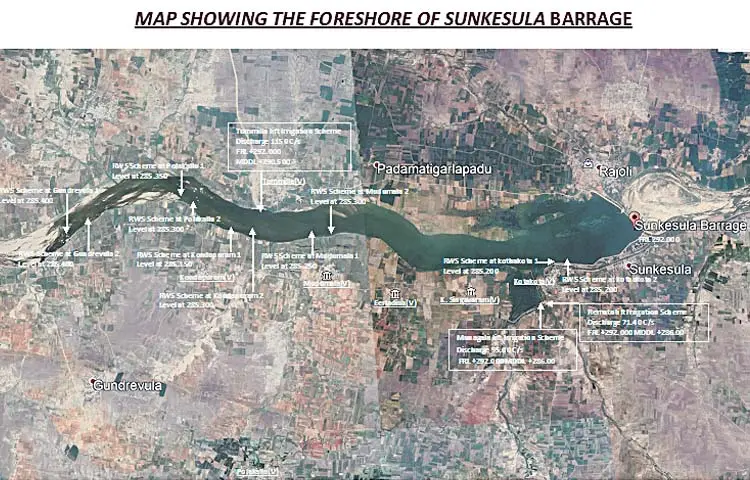
Gundrevula project pending; 2.65 lakh acres seen benefiting
The proposed Gundrevula reservoir on the Tungabhadra river, 15 km upstream of Sunkesula in C. Belagal mandal with 20.15 TMC storage, remains unbuilt, Sakshi reported. The detailed project report reached the government on April 30, 2011, and GO 154 of February 21, 2019 gave administrative sanction for Rs 2,890 crore. If completed, the project is projected to irrigate 2.65 lakh acres and supply drinking water to Kurnool city and nearby villages.
Source
Kurnool — నీరు · సాగునీరు · read the original report ↗
Desk check · some claims need care
What the desk checked (5)
- Proposed Gundrevula reservoir would have 20.15 TMC storage, 15 km upstream of Sunkesula on the Tungabhadra in C. Belagal mandal — Figures and location appear in source; no official document cited beyond the DPR reference.
- DPR was submitted to the government on 30 April 2011 by then EE Subbarayudu; Rs 53 lakh was sanctioned for the DPR in 2009 — Dates, amount and official named in source; not independently verifiable here.
- GO 154 of 21 February 2019 gave administrative sanction for Rs 2,890 crore — GO number, date and amount specified in source; attributed to the then government.
- Over 200 TMC on average flows yearly from Sunkesula into the Krishna, and 341.99 TMC was released downstream last year — Figures appear in source with no issuing agency named.
- Project would irrigate 2.65 lakh acres and solve drinking water problems in Kurnool city and nearby villages — Presented as projected benefit; partly echoed by retired deputy superintending engineer Srinivasa Reddy, no official study cited.
Analysts’ view opinion
Gundrevula is essentially a cost-benefit question: against the Rs 2,890 crore administrative sanction issued in 2019, the projected return is irrigation for 2.65 lakh acres plus drinking water for Kurnool city and nearby villages. That works out to well under a lakh rupees of capital cost per acre served — usually an attractive ratio in a basin where, per the report, over 200 TMC flows downstream from Sunkesula in an average year (341.99 TMC last year). Yet the DPR reached the government in 2011 and the GO came in 2019 with no start on the ground; that delay is itself the real cost, because construction and resettlement bills rise with time.
- The benefit is twofold: yield stability for farmers currently dependent on rainfed cultivation, and assured municipal supply for Kurnool — both reduce income volatility rather than simply adding output.
- In a region the report describes as facing drought in eight years out of ten, storage functions like insurance, potentially lowering crop-loan distress and migration pressure.
- A 2019 estimate of Rs 2,890 crore should not be read as today's price; the story does not give a revised figure reflecting higher material and labour costs.
- Resettlement costs may be comparatively contained, since the report says the YS government paid R&R compensation to some submergence villages after the 2007 floods — though the outstanding liability for remaining villages is not quantified.
- Sunkesula's capacity of just 1.2 TMC, and its post-bifurcation status as an inter-state project, is the core economic argument for investing in storage upstream.
What to watch — Watch for a revised cost estimate, an actual budget line and tendering progress — administrative sanction without allocated funds typically means another budget cycle lost.
The 2.65 lakh acres and Rs 2,890 crore are proposal-stage estimates; the story does not establish an independent benefit-cost appraisal, the current revised cost, environmental clearances, inter-state allocation status, or the governments' own stated reasons for the delay.
Deep dive
Research brief · 8 facts · 7 dates · exam-readyThe brief
Context
The Gundrevula reservoir is a long-pending irrigation proposal on the Tungabhadra river in Andhra Pradesh's Kurnool district, 15 km upstream of the Sunkesula reservoir, in Gundrevula and Rangapuram of C. Belagal mandal in Kodumuru constituency. Sakshi reports that over 200 TMC of water on average flows annually from Sunkesula into the Krishna and on to the sea, even as drought-prone Rayalaseema — Kurnool and YSR districts — faces acute irrigation and drinking water shortages. The idea originated under the late Chief Minister Y.S. Rajasekhara Reddy, a detailed project report (DPR) reached the government on April 30, 2011, and administrative sanction came through GO 154 in February 2019, but construction has not begun.
Key facts
- Proposed Gundrevula reservoir capacity: 20.15 TMC, located 15 km upstream of Sunkesula reservoir in C. Belagal mandal (Gundrevula and Rangapuram), Kodumuru constituency.
- If built, the project would irrigate an ayacut of 2.65 lakh acres and supply drinking water to Kurnool city corporation and nearby villages.
- On average over 200 TMC flows annually from Sunkesula into the Krishna; last year over 341.99 TMC was released downstream.
- The DPR was submitted to the government on April 30, 2011 by the then Executive Engineer Subbarayudu; Rs 53 lakh had been sanctioned for the DPR in 2009.
- GO 154 dated February 21, 2019, issued by the Chandrababu Naidu government during the election period, gave administrative sanction for Rs 2,890 crore.
- Sunkesula barrage has a storage capacity of only 1.2 TMC, and its water is being drawn by Telangana through the Tummila lift scheme; post-bifurcation it became an inter-State project.
- Rayalaseema faces drought in eight out of every ten years and has the lowest irrigation resources in the State, with mostly rain-fed cultivation.
- The YSR government paid compensation to some submergence villages under an R&R package after the 2007 Tungabhadra floods, so fresh submergence compensation would be needed for only a few villages.
Timeline
- 2007Tungabhadra floods submerge riverside villages; the YS Rajasekhara Reddy government pays compensation to some villages under an R&R package and asks them to shift to safer areas.
- 2009The then government sanctions Rs 53 lakh for preparation of the Gundrevula project DPR.
- April 30, 2011Then Executive Engineer Subbarayudu submits the Gundrevula project DPR to the government.
- After 2011Kiran Kumar Reddy and later Chandrababu Naidu governments neglect the construction of Gundrevula.
- After State bifurcationThe project proposal is set aside; Sunkesula becomes an inter-State project.
- February 21, 2019GO 154 issued granting administrative sanction for the project with Rs 2,890 crore, ahead of the 2019 elections.
- Last year (as reported)Over 341.99 TMC of water released downstream from Sunkesula.
Who has a stake
- Farmers of Kurnool district (Emmiganur, Mantralayam, Adoni and western areas) — Assured irrigation for 2.65 lakh acres instead of rain-fed, drought-hit cultivation.
- YSR district ayacut farmers and KC Canal — Tungabhadra-dependent ayacut; the source says abundant KC Canal supply in future requires Gundrevula.
- Kurnool Municipal Corporation and nearby villages — Drinking water security from the proposed reservoir.
- Andhra Pradesh Irrigation Department — Prepared the DPR in 2011 and must execute the Rs 2,890 crore sanctioned work.
- Successive State governments (YSR, Kiran Kumar Reddy, Chandrababu Naidu) — Credited with initiating, neglecting, or sanctioning the project; accountable for non-execution.
- Submergence villages in Gundrevula–Rangapuram area — Land acquisition and R&R; some already compensated after 2007 floods, so only a few remain.
- Telangana — Draws Sunkesula water through the Tummila lift scheme; Sunkesula is now an inter-State project.
Why it matters
Rayalaseema is the State's most drought-prone region with the weakest irrigation base, yet over 200 TMC of Tungabhadra water flows past Sunkesula each year to the sea for want of storage. A 20.15 TMC reservoir at Gundrevula would convert that surplus into irrigation for 2.65 lakh acres and drinking water for Kurnool city, making the 14-year delay between DPR and execution a case study in how sanction without construction leaves water benefits on paper.
UPSC angle
Prelims pointers
- Gundrevula reservoir: proposed on the Tungabhadra river, 15 km upstream of Sunkesula, C. Belagal mandal, Kurnool district; 20.15 TMC storage.
- GO 154 of February 21, 2019 granted administrative sanction of Rs 2,890 crore for the Gundrevula project.
- Gundrevula DPR submitted to the government on April 30, 2011; Rs 53 lakh sanctioned for the DPR in 2009.
- Sunkesula barrage capacity is just 1.2 TMC; it became an inter-State project after the bifurcation of Andhra Pradesh.
- Tummila lift scheme: Telangana's scheme drawing water linked to Sunkesula, as stated in the source.
- Projected benefit: 2.65 lakh acres of ayacut plus drinking water to Kurnool city corporation and nearby villages.
Mains framing
The Gundrevula case illustrates how inadequate storage, not merely inadequate flows, drives water scarcity in Rayalaseema: despite over 200 TMC flowing annually from Sunkesula into the Krishna and 341.99 TMC released last year, Kurnool and YSR districts remain drought-hit in eight of every ten years with predominantly rain-fed cultivation. The proximate causes of the delay, as the source records, are institutional and political — the project was conceived under Y.S. Rajasekhara Reddy, its DPR reached the government in 2011, was neglected by successive governments, shelved after State bifurcation, and finally accorded administrative sanction of Rs 2,890 crore through GO 154 just before the 2019 elections without construction following. Bifurcation compounded the problem by turning Sunkesula, with only 1.2 TMC storage, into an inter-State project whose water Telangana draws through the Tummila lift scheme. The way forward suggested by the reported facts is straightforward: act on the existing sanction, since submergence compensation was already paid to several villages under the R&R package after the 2007 floods, and the 20.15 TMC reservoir would secure 2.65 lakh acres of ayacut, stabilise the KC Canal and meet Kurnool city's drinking water needs, with lift irrigation possible from the backwater.
Key terms
- TMC
- Thousand million cubic feet, the standard unit for reservoir storage and river flows used throughout the report.
- DPR (Detailed Project Report)
- The technical and financial blueprint of a project; Gundrevula's DPR was submitted on April 30, 2011.
- Administrative sanction / GO 154
- Government order of February 21, 2019 approving Gundrevula at Rs 2,890 crore, a prerequisite for taking up works.
- Ayacut
- The command area served by an irrigation source; Gundrevula is projected to serve 2.65 lakh acres.
- KC Canal
- Kurnool–Cuddapah canal dependent on Tungabhadra water; the source says Gundrevula is needed for its abundant future supply.
- R&R package
- Resettlement and rehabilitation compensation; paid to some Tungabhadra submergence villages after the 2007 floods.
Practice questions
- Examine how the absence of adequate storage infrastructure, rather than water availability alone, sustains agrarian distress in drought-prone regions such as Rayalaseema, using the Gundrevula project as an illustration.
- Discuss the implications of State reorganisation for irrigation projects that become inter-State in character, with reference to Sunkesula and the Tungabhadra basin.
- "Administrative sanction is not execution." Critically analyse the reasons for long delays between project approval and construction in Indian irrigation, and suggest correctives.
Grounded only in the source report — figures and dates are the source's, not inferred.