
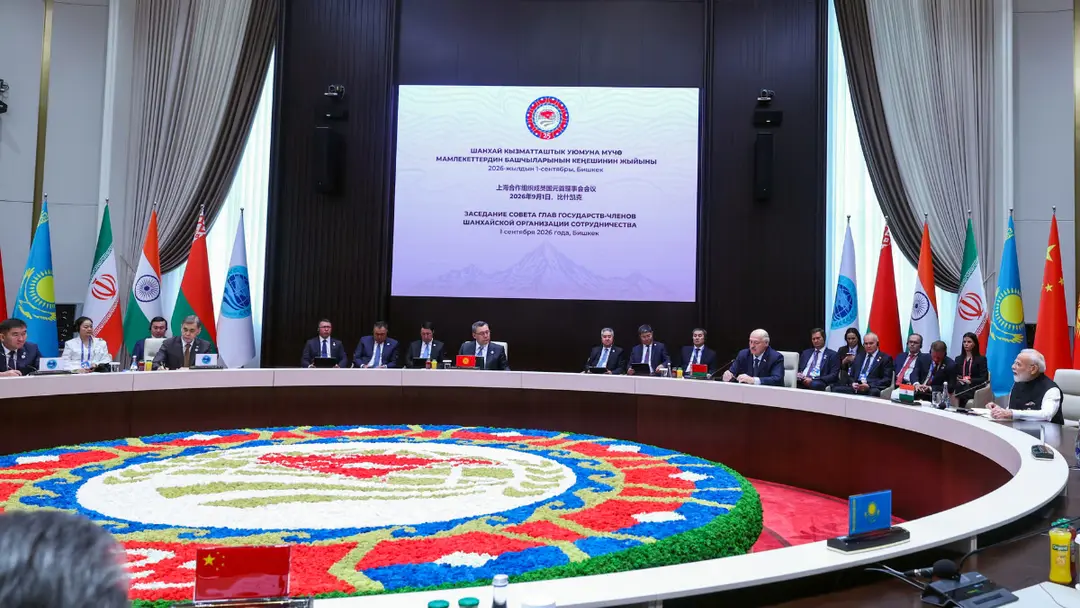
Indian delegation in Islamabad for three-day SCO planning meeting
Days after trading barbs at the UN General Assembly, India and Pakistan are sharing a conference room in Islamabad. The first meeting of the Shanghai Cooperation Organisation's Council of National Coordinators began Monday and runs through Wednesday. India's delegation is led by Ministry of External Affairs Joint Secretary Alok Dimri, who is also India's National Coordinator for the SCO. Pakistan, which took over the chairship from Kyrgyzstan on 1 September, will host the Heads of State Summit in August 2027.
Source
BRICS / G20 / SCO / Quad · read the original report ↗
Desk check · compared with the source
What the desk checked (5)
- An Indian delegation led by MEA Joint Secretary Alok Dimri is in Islamabad for the first meeting of the SCO Council of National Coordinators. — Stated in source with named official and designation; no direct quote or document cited.
- Pakistan assumed the SCO chairship from Kyrgyzstan on 1 September and will host the Heads of State Summit in August 2027. — Figures and dates appear in the source; scheduling attributed to Pakistan's plans, not to a named document.
- Pakistan's Foreign Office has said invitations will go to all member leaders, including PM Narendra Modi. — Attributed in source only to unspecified 'news reports' — second-hand sourcing.
- India and Pakistan have not held substantive bilateral talks in roughly a decade, the last attempt being Sushma Swaraj's December 2015 Islamabad visit. — Background claim in source with no source given; internally consistent with the Pathankot 2016 reference.
- The source says the 2025 SCO Summit adopted the Tianjin resolution, but also that this year's summit was held in Bishkek and 'last year' Modi went to Tianjin. — Internal inconsistency in the source's summit chronology; requires editorial verification.
Analysts’ view opinion
India sending an official delegation to Islamabad days after trading barbs at the UN is not a thaw — it is a calculated decision not to cede multilateral space to Pakistan. With China and Russia as the SCO's anchor members, absence would cost Delhi more than attendance does. The awkward part is that Pakistan's chairship comes alongside its leadership of the bloc's anti-terror structure, a body India has long viewed with scepticism. Read this as presence, not engagement.
- Sending a Joint Secretary-level delegation rather than a political-level one is itself a carefully calibrated signal from Delhi.
- With no substantive bilateral talks in roughly a decade, multilateral platforms like the SCO are now almost the only rooms where Indian and Pakistani officials sit together.
- Pakistan's current leadership of the SCO's Regional Anti-Terrorist Structure, set against the 2025 Tianjin resolution condemning the Pahalgam attack, gives Delhi a reason to press its 'no double standards on terrorism' argument from inside the tent.
- Staying away from a Beijing-headquartered bloc where Russia is a key player would risk letting definitions on connectivity and counter-terrorism settle in ways unhelpful to Indian interests.
- Reports say Pakistan will invite PM Modi to the August 2027 Summit, but attendance is a long way off — as the 2016 Pathankot episode showed, a single incident can redirect the whole track.
What to watch — Watch how India handles the language of connectivity and counter-terrorism documents drafted under Pakistan's chairship, and at what level India is represented at the 2027 Summit.
The story does not establish that this meeting opens any bilateral channel or that India-Pakistan talks are planned, nor whether PM Modi will attend the 2027 Summit.
Deep dive
Research brief · 8 facts · 10 dates · exam-readyThe brief
Context
India and Pakistan, both full members of the Shanghai Cooperation Organisation (SCO) since 2017, have had no substantive bilateral talks for about a decade, but continue to engage within multilateral SCO formats. Pakistan took over the SCO chairship from Kyrgyzstan on 1 September and will host the Heads of State Summit in Islamabad in August 2027. The first meeting of the bloc's Council of National Coordinators — the body that prepares the summit agenda — began in Islamabad on Monday for three days, with an Indian delegation attending days after India and Pakistan exchanged barbs at the UN General Assembly in New York.
Key facts
- India's delegation at the first Council of National Coordinators meeting is led by MEA Joint Secretary (Multilateral Economic Relations) Alok Dimri, also India's National Coordinator for the SCO.
- The meeting began Monday in Islamabad and runs three days, through Wednesday; the Indian delegation landed earlier on Monday.
- Pakistan assumed the SCO chair from Kyrgyzstan on 1 September, for the 2026-27 chairship.
- Pakistan is scheduled to host the SCO Heads of State Summit in August 2027, with the theme 'Turning Vision into Action: Connectivity, Innovation and Shared Prosperity'.
- Pakistan's Foreign Office has said invitations will go to all member leaders, including PM Narendra Modi, according to news reports.
- The SCO was founded in Shanghai on 15 June 2001 by China, Russia, Kazakhstan, Kyrgyzstan, Tajikistan and Uzbekistan to fight the 'three evils' of terrorism, separatism and extremism.
- The SCO now has 10 permanent members, including Iran and Belarus; it spans roughly 60 percent of Eurasia and over 40 percent of the world's population.
- The SCO is headquartered in Beijing; its Regional Anti-Terrorist Structure (RATS), currently headed by Pakistan, operates from Tashkent.
Timeline
- 15 June 2001SCO founded in Shanghai by China, Russia, Kazakhstan, Kyrgyzstan, Tajikistan and Uzbekistan.
- 2005India joins the SCO as an observer.
- December 2015Then EAM Sushma Swaraj visits Islamabad; the two countries attempt to revive the 'Comprehensive Bilateral Dialogue' — the last attempt at bilateral talks.
- January 2016Terrorist attack on the Pathankot airbase derails the dialogue process.
- 2017India and Pakistan become full SCO members at the Astana summit in Kazakhstan.
- October 2024EAM S. Jaishankar visits Islamabad for the SCO heads of government summit — first trip to Pakistan by an Indian foreign minister in nearly nine years.
- 2025 (Tianjin summit)SCO adopts the Tianjin resolution condemning the 2025 Pahalgam terrorist attack; agrees to set up a universal centre for countering security threats and an anti-drug centre; PM Modi holds bilateral talks with Xi Jinping.
- July 2026India attends the 12th meeting of heads of SCO border services, hosted in Islamabad.
- August (this year)SCO Heads of State Summit held in Bishkek, Kyrgyz Republic; PM Modi attended.
- 1 SeptemberPakistan assumes the SCO chairship from Kyrgyzstan.
Who has a stake
- India (Ministry of External Affairs) — Maintaining multilateral engagement in the SCO while pressing its case against cross-border terrorism; decisions on level of participation in Pakistan-hosted events.
- Pakistan — As 2026-27 chair and 2027 summit host, it seeks diplomatic prestige and attendance by all member leaders, including PM Modi.
- Alok Dimri, MEA Joint Secretary (Multilateral Economic Relations) — Leads India's delegation as National Coordinator, shaping India's positions in summit preparation.
- SCO Secretariat (Beijing) and RATS (Tashkent) — Institutional agenda on security, counter-terrorism, trade and connectivity; RATS chairship currently with Pakistan, which India views with scepticism.
- Kyrgyzstan — Outgoing chair that hosted the Bishkek Heads of State Summit before handing over on 1 September.
- China and Russia — Founding members and principal drivers of the bloc, often described as a counterweight to NATO.
Why it matters
With no substantive India-Pakistan bilateral dialogue for about a decade, multilateral platforms like the SCO remain one of the few venues where officials of the two sides sit in the same room. India's attendance in Islamabad signals it will not vacate a Eurasian grouping covering 60 percent of Eurasia and over 40 percent of the world's population, even as it presses for accountability on cross-border terrorism. The preparations also raise the question of India's level of representation at the August 2027 summit in Islamabad.
UPSC angle
Prelims pointers
- SCO founded in Shanghai on 15 June 2001 by China, Russia, Kazakhstan, Kyrgyzstan, Tajikistan, Uzbekistan.
- India: observer in 2005, full member in 2017 at the Astana summit along with Pakistan; bloc now has 10 permanent members including Iran and Belarus.
- SCO headquarters: Beijing; Regional Anti-Terrorist Structure (RATS) headquarters: Tashkent, Uzbekistan.
- SCO's 'three evils': terrorism, separatism and extremism.
- Pakistan's chairship began 1 September; Heads of State Summit due in Islamabad in August 2027 with theme 'Turning Vision into Action: Connectivity, Innovation and Shared Prosperity'.
- 2025 Tianjin summit adopted the Tianjin resolution condemning the Pahalgam terror attack and approved a universal security threats centre and an anti-drug centre.
Mains framing
India's participation in the first SCO Council of National Coordinators meeting in Islamabad illustrates the compartmentalisation that now defines its Pakistan policy: bilateral dialogue has been frozen since the December 2015 Comprehensive Bilateral Dialogue attempt collapsed after the January 2016 Pathankot attack, yet multilateral engagement continues because the SCO serves wider Indian interests in Eurasian connectivity, security and counter-terrorism. The tension is structural — Pakistan chairs the Regional Anti-Terrorist Structure, a body India views sceptically given its accusations that Islamabad harbours anti-India terrorists, while India used the 2025 Tianjin summit to demand no 'double standards' on terrorism and accountability for cross-border terror. Precedent suggests functional engagement without normalisation: EAM Jaishankar's October 2024 Islamabad visit for the heads of government summit and repeated Indian attendance at border-service chiefs' meetings, including in July 2026. The way forward likely involves India continuing technical and ministerial-level engagement, using SCO documents to embed counter-terror language, and deciding representation for the August 2027 Islamabad summit on the basis of substantive outcomes rather than optics.
Key terms
- Shanghai Cooperation Organisation (SCO)
- Eurasian grouping founded on 15 June 2001, headquartered in Beijing, now with 10 permanent members, covering security, trade, economic and cultural cooperation.
- Council of National Coordinators
- SCO body of member states' national coordinators that prepares the groundwork and agenda for the Heads of State Summit.
- RATS (Regional Anti-Terrorist Structure)
- SCO's counter-terrorism arm based in Tashkent, currently headed by Pakistan; India has long viewed it with scepticism.
- Tianjin resolution
- Document adopted at the 2025 SCO Summit in Tianjin which condemned the 2025 Pahalgam terrorist attack.
- Comprehensive Bilateral Dialogue
- India-Pakistan dialogue framework attempted during Sushma Swaraj's December 2015 Islamabad visit; derailed by the January 2016 Pathankot airbase attack.
- Three evils
- Terrorism, separatism and extremism — the threats the SCO was largely created to combat.
Practice questions
- Multilateral platforms have become the primary channel of India-Pakistan official contact. Examine this with reference to India's engagement with the SCO since 2017.
- Discuss the significance of the Shanghai Cooperation Organisation for India's Eurasian and counter-terrorism objectives, and the constraints it faces within the grouping.
- How does hosting the SCO chairship and the 2027 Heads of State Summit serve Pakistan's diplomatic interests, and what dilemmas does it create for India?
Grounded only in the source report — figures and dates are the source's, not inferred.