
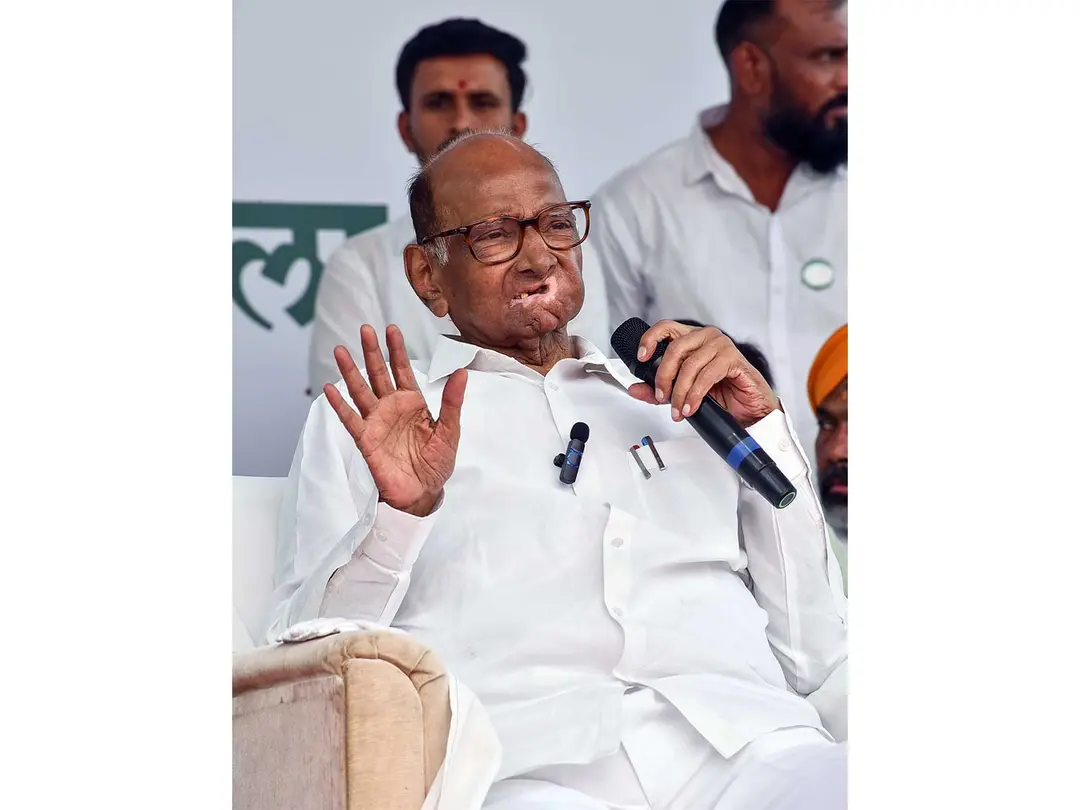
Pawar gives Fadnavis 17-point demand list for drought relief
NCP (SP) chief Sharad Pawar submitted a letter to Maharashtra Chief Minister Devendra Fadnavis listing 17 demands for immediate relief to drought-affected farmers, agricultural labourers and rural citizens. He sought complete waiver of agricultural loans, land revenue and farm pump electricity bills, 25 kg free food grain per family, Rs 1 lakh per hectare for farmers and Rs 25,000 for labourers. Pawar also demanded powers for Tehsildars to approve water tankers, waiver of student fees and a special three-day legislature session.
Source
NCP-SP (Sharad Pawar) · read the original report ↗
Desk check · compared with the source
What the desk checked (5)
- Sharad Pawar submitted a letter with 17 demands to CM Devendra Fadnavis for drought relief — Attributed to Pawar's letter as described in the source; figure of 17 demands appears in source
- Demand for Rs 1 lakh per hectare for farmers and Rs 25,000 for agricultural labourers — Figures appear in the source and are supported by a direct quote from the letter
- Demand for complete waiver of agricultural loans, land revenue and farm pump electricity bills — Quoted directly from the letter; no government response recorded in source
- Demand for 25 kg free food grain per family and Tehsildars empowered to approve water tankers — Both appear in quoted passages of the letter
- Demand for a special three-day session of the Maharashtra Legislature and aid before Dussehra-Diwali — Attributed to Pawar; source gives no dates or official confirmation
Analysts’ view opinion
Sharad Pawar's 17-point letter is more than a relief appeal — it is a clear attempt to convert rural distress into an opposition agenda. Demands like full loan waivers, scrapping electricity bills and Rs 1 lakh per hectare are fiscally heavy; if the government concedes, Pawar's pressure looks effective, and if it refuses, the opposition gains an 'anti-farmer' storyline. By seeking help before Dussehra-Diwali and asking for a three-day special session, the opposition is trying to control both the timing and the stage.
- Pawar is using the agrarian crisis to re-anchor himself in the rural and cooperative base that has always been his political strength.
- The sheer breadth of the 17 demands means even partial acceptance leaves the opposition free to ask 'what about the rest?'
- Total waivers of farm loans, land revenue and power bills place Fadnavis squarely in the fiscal-discipline versus political-necessity bind.
- The special session demand is the most strategic ask, since a floor debate would hand the opposition a statewide platform.
- Empowering Tehsildars on water tankers works as a pointed critique of administrative delay — a small detail with strong local resonance.
What to watch — Watch whether the government agrees to a special session, what scale of relief it announces before the festival period, and whether other opposition parties line up behind the same 17 demands.
The story does not establish the government's response, any official assessment of the drought's severity, or the fiscal cost of meeting these demands.
Deep dive
Research brief · 8 facts · 3 dates · exam-readyThe brief
Context
Sharad Pawar, chief of the Nationalist Congress Party (Sharadchandra Pawar), has submitted a letter to Maharashtra Chief Minister Devendra Fadnavis setting out 17 demands for immediate relief to farmers, agricultural labourers and rural citizens hit by drought in the state. The demands span loan waivers, land revenue and electricity bill waivers, free food grain, direct cash transfers, drinking water tankers, MGNREGA relaxations and student fee waivers. Pawar has also asked for a special three-day session of the state legislature to debate the drought and for relief to reach beneficiaries before Dussehra-Diwali. The source does not state the government's response.
Key facts
- Pawar's letter to CM Devendra Fadnavis contains 17 demands for drought relief in Maharashtra.
- Demand for complete waiver of agricultural and allied-activity loans from cooperative banks, nationalised banks, urban cooperative banks and credit societies.
- Waiver sought also for personal loans from Social Justice, Minority and Tribal Welfare departments, orchard loans and women's SHG loans taken since the date of the earlier loan waiver.
- Demand for complete waiver of land revenue and of all electricity bills for farmers' agricultural pumps.
- Demand for 25 kg of free food grain per family for farmer and agricultural labourer families dependent on agriculture.
- Demand for immediate bank transfer of Rs 1,00,000 per hectare to farmers and Rs 25,000 to agricultural labourers.
- Demand that Tehsildars be empowered to approve water tankers for drinking water for people and livestock.
- Demand for a special three-day session of the Maharashtra Legislature and relief disbursal before Dussehra-Diwali.
Timeline
- Not dated in the sourceSharad Pawar submits a letter with 17 demands to Maharashtra CM Devendra Fadnavis seeking immediate drought relief.
- Sought before Dussehra-DiwaliPawar urges the government to deliver assistance to farmers and agricultural labourers ahead of the festival period.
- Demanded, date not fixedConvening of a special three-day session of the Maharashtra Legislature to discuss the drought situation.
Who has a stake
- Drought-affected farmers — Seek loan and land revenue waivers, free electricity for pumps, Rs 1 lakh per hectare aid and compensation for crop and orchard damage.
- Agricultural labourers — Demand Rs 25,000 direct assistance, 25 kg free food grain per family and relaxed MGNREGA criteria for work.
- Sharad Pawar / NCP (SP) — Positioning as the voice of rural distress by pressing a 17-point relief charter on the state government.
- CM Devendra Fadnavis and the Maharashtra government — Must weigh fiscal cost of waivers and cash transfers against political pressure for urgent drought relief.
- Tehsildars (revenue officials) — Would gain authority to sanction drinking water tankers for people and livestock if the demand is accepted.
- Students in drought-hit areas — Seek complete waiver of school and college fees and of hostel and mess charges.
- Banks, credit societies and women's SHGs — Loan waiver demand covers their agricultural, orchard, welfare-department and SHG lending portfolios.
Why it matters
Drought relief in Maharashtra touches the state's largest occupational group and carries a heavy fiscal price, making the demand list a test of both governance capacity and political will. The call for a special legislature session and pre-festival disbursal converts agrarian distress into an immediate parliamentary and electoral pressure point for the Fadnavis government.
UPSC angle
Prelims pointers
- Sharad Pawar heads the NCP (Sharadchandra Pawar); Devendra Fadnavis is Maharashtra Chief Minister.
- Pawar's letter lists 17 demands for drought relief.
- Demanded relief quantum: Rs 1 lakh per hectare for farmers, Rs 25,000 for agricultural labourers, 25 kg free grain per family.
- Tehsildar is a taluka-level revenue officer; Pawar wants tanker approval powers vested in Tehsildars.
- MGNREGA criteria relaxation sought to start water conservation works in drought areas.
- A special three-day session of the Maharashtra Legislature has been demanded to debate the drought.
Mains framing
Recurrent drought in Maharashtra exposes the fragility of rain-dependent agriculture, the debt burden of farm households and the weak last-mile delivery of drinking water and wage employment. Pawar's 17-point charter is essentially a demand for blanket relief — full waiver of crop, orchard, welfare-department and SHG loans, land revenue and farm pump electricity dues, plus direct transfers of Rs 1 lakh per hectare and Rs 25,000 for labourers, and 25 kg free grain per family — alongside institutional fixes such as decentralising tanker sanction to Tehsildars and relaxing MGNREGA norms for water conservation works. The implications cut both ways: broad waivers offer immediate consumption relief and political credibility but strain state finances and can weaken credit discipline for cooperative and nationalised lenders, while decentralisation of tanker approval and MGNREGA relaxation address delay rather than entitlement. A balanced way forward, as suggested by the letter itself, lies in sequencing — urgent, verifiable relief before the festival season, transparent assessment of crop and orchard losses, expanded water conservation works, and a legislature session where the fiscal cost and targeting of each measure can be debated rather than announced.
Key terms
- NCP (SP)
- Nationalist Congress Party (Sharadchandra Pawar), the faction led by Sharad Pawar.
- Tehsildar
- Taluka-level revenue officer; Pawar wants tanker approval powers delegated to this level for speed.
- MGNREGA
- Employment Guarantee Scheme under which Pawar seeks relaxed criteria to start water conservation works.
- Land revenue
- Tax levied on agricultural land by the state; Pawar demands its complete waiver in drought areas.
- Women's self-help groups (SHGs)
- Small women's credit-and-savings collectives whose loans Pawar wants waived along with farm loans.
- Special legislature session
- A three-day sitting of the Maharashtra Legislature demanded solely to discuss drought and decide measures.
Practice questions
- Farm loan waivers provide immediate relief but may undermine credit discipline. Critically examine with reference to drought relief demands in Maharashtra.
- Discuss how decentralising administrative powers, such as empowering Tehsildars to sanction water tankers, can improve disaster response in drought-prone regions.
- Evaluate the role of MGNREGA and water conservation works in building resilience against recurrent drought in rain-fed agricultural regions.
Grounded only in the source report — figures and dates are the source's, not inferred.