
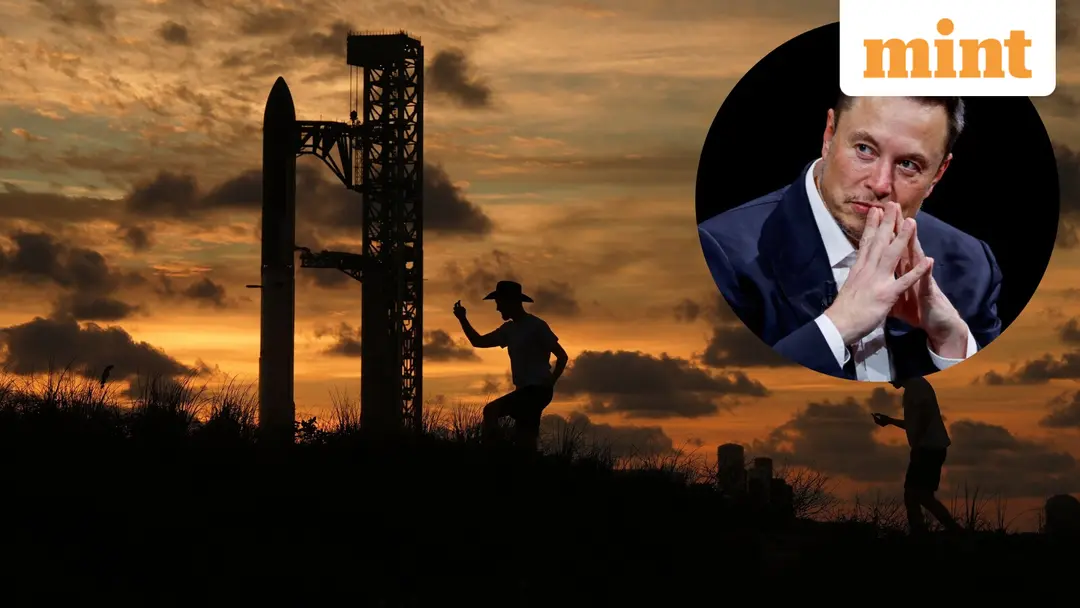
SpaceX Starship attempts first orbital flight on Monday
SpaceX will attempt to send its Starship rocket to orbit for the first time on Monday, lifting off at 7:15 a.m. ET (4:45 pm IST) within a 75-minute window. The flight carries 23 Starlink V3 satellites and targets a circular orbit 275 km above Earth, requiring a speed of about 28,000 km/hour. SpaceX said Flight 14 begins orbital missions, including the first orbital propellant transfer test.
Source
Livemint — Companies · read the original report ↗
Desk check · some claims need care
What the desk checked (5)
- Starship Flight 14 lifts off at 7:15 a.m. ET Monday (4:45 pm IST) in a 75-minute window, deploying 23 Starlink V3 satellites. — Figures appear in source; consistent throughout, timing conversion stated by source.
- SpaceX aims for a circular orbit 275 km above Earth, requiring about 28,000 km/hour. — Figures appear in source; no independent technical attribution given.
- The second burn needs more force and more complex calculations due to differing gravity levels. — Attributed in source to an unnamed expert cited by news agency AFP.
- Flight 14 begins orbital missions including the first orbital propellant transfer. — Directly quoted from a SpaceX blogpost.
- SpaceX shares trade near $148.75, about 34% below an all-time high of $225.64 on 16 June 2026. — No source given for the market data; date sits in the future relative to typical reporting and needs editorial verification.
Analysts’ view opinion
Starship's 14th flight is less a test than an attempted graduation: from experimental vehicle to working launch system. Reaching orbit, releasing 23 Starlink V3 satellites and beginning orbital propellant transfer tests together touch the core of SpaceX's business logic. Success would strengthen its position across satellite internet, the NASA Moon contract and the heavy-lift market; failure would simply push that transition further out.
- The real technical hurdle is the second burn — moving from a suborbital trajectory to a circular 275 km orbit at roughly 28,000 km/h demands engine relight and more complex handling in different gravity regimes.
- Starting orbital propellant transfer testing matters most in the long run, since in-space refuelling is a prerequisite technology for lunar and deep-space missions.
- For users, Starlink V3 effectively means more bandwidth lifted per launch — but that only works if a vehicle large enough to carry those heavier satellites is operational.
- For competitors, a working heavy-payload Starship would reset cost-per-kilogram expectations and squeeze rival launch providers and satellite-internet operators.
- The story notes SpaceX is now publicly traded at about $148.75, roughly 34% below its high, meaning technical milestones are now also judged by markets.
What to watch — Watch whether the second burn and the 23-satellite deployment succeed inside Monday's 75-minute window, and how quickly Starship shifts from test flights to routine operational missions.
The outcome is not yet known, and the story does not establish the detail of the refuelling tests, any timeline for the orbital data centres, or what this means for NASA's lunar schedule.
Deep dive
Research brief · 8 facts · 4 dates · exam-readyThe brief
Context
SpaceX's Starship, the largest rocket built by Elon Musk's company, has so far flown only test flights on suborbital trajectories from Starbase, Texas. On Monday, with Flight 14, the company will attempt for the first time to place Starship in orbit and deploy a payload of 23 next-generation Starlink V3 internet satellites. SpaceX says this begins an "exciting new phase" of orbital missions that will also include the first test of transferring propellant between vehicles in orbit — a capability central to its NASA contract to return astronauts to the Moon. SpaceX is now a publicly listed company, so the flight's outcome also matters to its investors.
Key facts
- Liftoff is set for 7:15 a.m. ET Monday (4:45 pm IST) within a 75-minute launch window.
- The flight will deploy 23 Starlink V3 satellites, the first batch of a new generation of internet satellites.
- SpaceX is targeting a circular orbit 275 km above Earth, requiring a speed of about 28,000 km/hour.
- Starship will first fly a suborbital trajectory, then perform a second burn to reach orbit if all systems perform as expected.
- SpaceX says Flight 14 begins orbital missions and will include the first orbital propellant transfer test.
- Starship holds a NASA contract worth billions of dollars to carry US astronauts to the Moon.
- SpaceX has three other launches lined up this week, including one carrying astronauts to the International Space Station.
- SpaceX shares trade at about $148.75, roughly 34% below the all-time high of $225.64 recorded on 16 June 2026.
Timeline
- 16 June 2026SpaceX shares hit their all-time high of $225.64.
- Present (before launch)Shares trading around $148.75, about 34% below the peak; Starship prepared at Starbase, Texas.
- Monday, 7:15 a.m. ET / 4:45 pm ISTFlight 14 liftoff attempt within a 75-minute window; suborbital trajectory followed by a second burn to reach 275 km orbit and deploy 23 Starlink V3 satellites.
- Same weekThree other SpaceX launches planned, one carrying a crew of astronauts to the International Space Station.
Who has a stake
- SpaceX — Success would move Starship from test flights into full operation mode and validate orbital satellite deployment and refuelling.
- Elon Musk — Hopes the new satellites will expand the internet constellation and orbital data centres to power AI models.
- NASA — Holds a multibillion-dollar contract with Starship to carry its astronauts to the Moon.
- Starlink users — Deployment of V3 satellites is meant to expand SpaceX's internet constellation.
- SpaceX investors — Shares are about 34% off their peak; a successful launch would give investors reason to cheer.
- United States and China — The Moon programme comes amid the US entering a space race with China.
Why it matters
Reaching orbit and transferring propellant in space are the two capabilities Starship needs before it can deploy large satellite batches, carry NASA astronauts to the Moon or move heavy cargo beyond Earth. SpaceX says the eventual outcome is a vehicle able to deploy hundreds of thousands of satellites and build a permanent lunar presence, making the flight a defining step rather than just another test. With the US in a space race with China and SpaceX now publicly traded, the result carries strategic and market consequences.
UPSC angle
Prelims pointers
- Starship Flight 14 launches from Starbase, Texas; liftoff 7:15 a.m. ET (4:45 pm IST), 75-minute window.
- Target: circular orbit at 275 km altitude, requiring a speed of about 28,000 km/hour.
- Payload: 23 Starlink V3 satellites; Flight 14 also tests the first orbital propellant transfer.
- Starship holds a NASA contract worth billions of dollars for crewed Moon missions.
- SpaceX share price about $148.75, about 34% below its 16 June 2026 high of $225.64.
Mains framing
Starship's first orbital attempt illustrates how heavy-lift reusable launch capability has become the pivot of both commercial space economics and state-level strategic competition. Technically, the mission's difficulty lies in the transition from a suborbital trajectory to orbit: the second burn demands more force and more complex calculations because the rocket behaves differently at different levels of gravity, and only then can 23 Starlink V3 satellites be deployed at 275 km. The mission's other novelty — the first orbital propellant transfer — is the enabling step for missions beyond low Earth orbit, which is why NASA has contracted Starship for billions of dollars to carry its astronauts to the Moon amid a space race with China. The commercial stakes are equally visible: SpaceX, now publicly listed, has seen its shares fall about 34% from their 16 June 2026 peak, and Musk links the new satellites to orbital data centres intended to power AI models. The way forward, on SpaceX's own framing, is graduating Starship from test status to full operations capable of deploying hundreds of thousands of satellites and a permanent lunar presence; the source does not detail regulatory, environmental or cost aspects.
Key terms
- Starship
- SpaceX's mega rocket, tested from Starbase, Texas, attempting its first orbital flight on Flight 14.
- Starlink V3
- New generation of SpaceX internet satellites; 23 are to be deployed on this flight.
- Orbital propellant transfer
- Refuelling a spacecraft while in orbit; being flight-tested for the first time with Flight 14.
- Suborbital trajectory
- A flight path that does not achieve orbit; Starship will fly this first, then burn again to reach orbit.
- Circular orbit at 275 km
- The mission's target orbit around Earth, needing a speed of roughly 28,000 km/hour.
- Orbital data centres
- Satellite-based computing capacity Musk hopes will power AI models, to be expanded by the new constellation.
Practice questions
- Why is in-orbit propellant transfer considered a prerequisite for crewed lunar missions? Discuss with reference to Starship's Flight 14 objectives.
- Examine how the commercialisation of heavy-lift launch and satellite internet constellations is reshaping the strategic space competition between the United States and China.
- What technical challenges distinguish an orbital insertion from a suborbital test flight? Explain in the context of Starship's second burn to a 275 km circular orbit.
Grounded only in the source report — figures and dates are the source's, not inferred.