
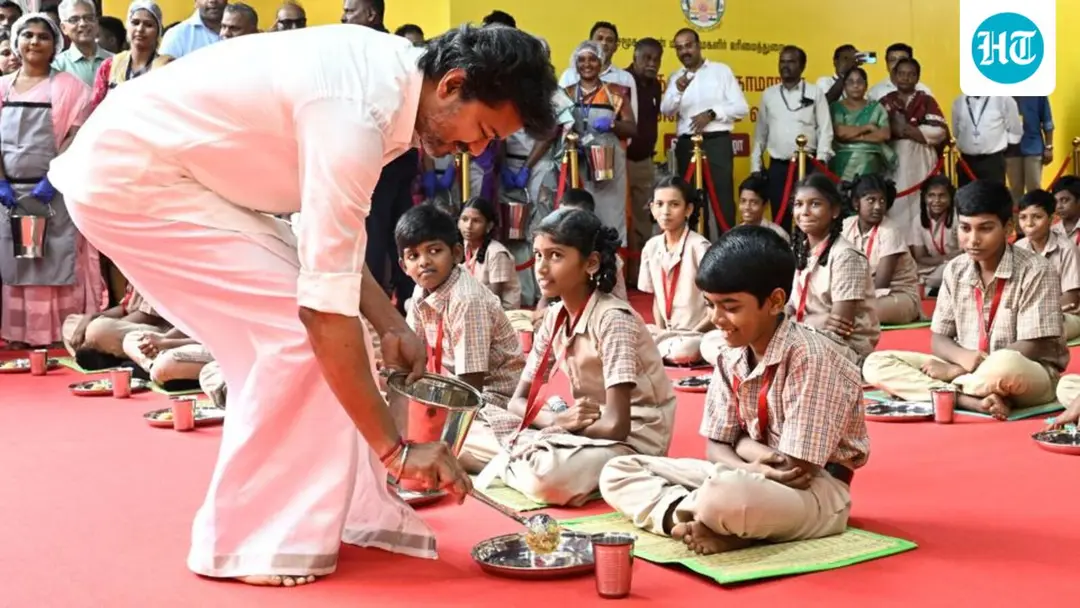
Vijay launches expanded breakfast scheme; schoolbag search draws DMK criticism
Tamil Nadu Chief Minister C Joseph Vijay on Tuesday launched an expanded school breakfast scheme in Chennai. Renamed the 'Perunthalaivar Kamarajar Breakfast Scheme' after K Kamaraj, it will now cover 1.53 million additional students across 15,454 government and government-aided schools. The government earmarked ₹217.63 crore this financial year, raising the total outlay to ₹724 crore. DMK criticised police for searching the bags of students attending the event, a video of which went viral.
Source
Hindustan Times — India · read the original report ↗
Desk check · compared with the source
What the desk checked (5)
- Tamil Nadu CM C Joseph Vijay launched the expanded breakfast scheme on Tuesday in Chennai. — Stated in source as reported fact; no direct quote from the CM.
- The scheme, renamed 'Perunthalaivar Kamarajar Breakfast Scheme', will now cover 1.53 million additional students across 15,454 schools. — Figures appear in the source; attributed to the government, not independently verifiable here.
- ₹217.63 crore earmarked this financial year and overall outlay raised to ₹724 crore. — Figures appear in source, attributed to the government.
- Police searched schoolchildren's bags before the event; a video went viral. — Reported in source; no official explanation or police statement given for the search.
- DMK spokesperson Saravanan Annadurai criticised the search on social media. — Directly quoted and attributed to a named spokesperson.
Analysts’ view opinion
Extending the breakfast scheme to Classes 6-8 is a low-risk policy move: it scales an existing delivery system rather than building a new one, leaning on kitchens and supply chains already in place. But the story does not establish whether ₹217.63 crore this year, within a ₹724 crore overall outlay, is enough to hold quality and regularity per child as the beneficiary base widens. Renaming the scheme after K Kamaraj and deferring rollout in two districts until after the by-polls both underline the political frame around an otherwise administrative decision.
- Moving from primary to middle school suggests a deliberate attempt to link nutrition with attendance at the stage where dropout risk typically rises.
- Because this is a scale-up rather than a new scheme, administrative overheads stay low — though the story says nothing about added burden on cooking staff or kitchen infrastructure.
- Continuity of the scheme across a change of government signals policy durability, while the renaming reflects the familiar Indian pattern of reclaiming ownership of inherited welfare programmes.
- Deferring implementation in Chengalpattu and Tiruppur until after the October 6 by-polls is routine under electoral norms, but it does delay the benefit for children in those districts.
- The bag-search row is not about scheme design but about event management and security protocol, raising the question of whether clear guidelines exist for official events involving children.
What to watch — Watch for independent data or audits on actual attendance, food quality and supply regularity under the expansion, and how quickly the two deferred districts are brought on board after October 6.
The story establishes nothing about nutritional standards, menus, staffing arrangements, per-child cost or past implementation gaps, and it carries no government explanation for the bag search.
Deep dive
Research brief · 8 facts · 5 dates · exam-readyThe brief
Context
Tamil Nadu's school breakfast scheme, which provides a free morning meal to government school students, has been expanded by the state government led by Chief Minister C Joseph Vijay. The scheme has been renamed the 'Perunthalaivar Kamarajar Breakfast Scheme' after Congress stalwart K Kamaraj, and now extends from Classes 1-5 to Classes 6-8. The launch event in Chennai became a political flashpoint after police searched the schoolbags of children attending it, prompting criticism from the opposition DMK.
Key facts
- The expanded scheme was launched by Tamil Nadu CM C Joseph Vijay in Chennai on Tuesday (date of the week as stated in the source).
- The scheme has been renamed the 'Perunthalaivar Kamarajar Breakfast Scheme' after Congress stalwart K Kamaraj.
- It was initially launched for 114,095 students in Classes 1 to 5 in government primary schools.
- The expanded scheme aims to benefit 1.53 million additional students across 15,454 government and government-aided schools.
- The government earmarked ₹217.63 crore in the current financial year, raising the overall outlay to ₹724 crore.
- In June, Vijay directed that the scheme be extended to students in Classes 6 to 8.
- At the Chennai school where it was launched, 199 students of Classes 1-5 were already covered; 127 students of Classes 6-8 will now be covered.
- The scheme will be implemented in Chengalpattu and Tiruppur districts after the by-polls there on October 6.
Timeline
- Initial launch (date not stated in the source)Breakfast scheme launched for 114,095 students in Classes 1 to 5 in government primary schools.
- SubsequentlyScheme expanded to cover students in urban areas, including corporations, municipalities and town panchayats.
- JuneCM Vijay directed that the scheme be extended to students in Classes 6 to 8.
- Tuesday (as stated in the source)Expanded and renamed scheme launched in Chennai; police searched students' schoolbags, video went viral; DMK criticised the government.
- October 6By-polls in Chengalpattu and Tiruppur; scheme to be implemented in these districts after the polls.
Who has a stake
- Students of Classes 1 to 8 in government and government-aided schools — 1.53 million additional students to receive a free school breakfast, described by the government as support for their educational journey.
- Tamil Nadu government / CM C Joseph Vijay (TVK) — Flagship welfare scheme expansion and its political credit; faces criticism over the schoolbag search at the launch.
- DMK (Opposition) — Attacking the government over the police search of children's bags; spokesperson Saravanan Annadurai called it 'cruelty'.
- Police — Conducted the bag checks of children before the launch event; action captured in a viral video.
- 15,454 government and government-aided schools — Implementation responsibility for serving breakfast to newly covered Classes 6-8 students.
- Chengalpattu and Tiruppur districts — Implementation deferred until after the October 6 by-polls.
Why it matters
School breakfast schemes address classroom hunger, attendance and learning outcomes, and extending it from primary to upper primary classes widens that safety net to 1.53 million more children. At the same time, the ₹724 crore outlay and renaming underline how nutrition programmes double as political currency in Tamil Nadu. The controversy over police searching children's bags raises questions about child dignity and security practices at government events.
UPSC angle
Prelims pointers
- The Tamil Nadu breakfast scheme has been renamed the 'Perunthalaivar Kamarajar Breakfast Scheme' after K Kamaraj.
- Coverage expanded from Classes 1-5 to Classes 6-8; 1.53 million additional students in 15,454 schools.
- Allocation: ₹217.63 crore in the current financial year; total outlay raised to ₹724 crore.
- Initial beneficiaries: 114,095 students of Classes 1-5 in government primary schools.
- By-polls in Chengalpattu and Tiruppur are scheduled for October 6; scheme rollout there follows the polls.
- TVK = Tamilaga Vettri Kazhagam, the party of CM C Joseph Vijay; DMK is the Opposition.
Mains framing
Tamil Nadu's expansion of its school breakfast scheme to Classes 6-8, covering 1.53 million additional students in 15,454 government and government-aided schools with a total outlay of ₹724 crore, reflects the state's long tradition of school nutrition interventions as instruments of educational access and social equity. The stated rationale is that a morning meal strengthens the foundation of school education and supports students' educational journey and social progress, particularly relevant as children move into upper primary classes where dropout pressures intensify. Yet the story also illustrates two persistent tensions in welfare delivery: the politicisation of schemes, visible in the renaming after Congress stalwart K Kamaraj and the deferral of implementation in Chengalpattu and Tiruppur until after the October 6 by-polls, and the question of administrative sensitivity, seen in the police search of schoolchildren's bags at the launch that the DMK called 'cruelty'. A way forward lies in insulating implementation timelines from electoral calendars, ensuring transparent budgeting and outcome monitoring against the ₹217.63 crore earmarked this year, and framing event-security protocols that do not subject children to intrusive checks.
Key terms
- Perunthalaivar Kamarajar Breakfast Scheme
- The renamed Tamil Nadu school breakfast scheme, now covering Classes 1 to 8 in government and government-aided schools.
- K Kamaraj
- Congress stalwart after whom the breakfast scheme has been renamed; 'Perunthalaivar' is the honorific used for him.
- TVK (Tamilaga Vettri Kazhagam)
- The party of Tamil Nadu Chief Minister C Joseph Vijay, criticised by the DMK in this episode.
- DMK (Dravida Munnetra Kazhagam)
- The Opposition party in Tamil Nadu that attacked the government over the search of students' schoolbags.
- Government-aided school
- A privately managed school receiving government financial aid; such schools are included among the 15,454 covered.
- Town panchayat
- An urban local body tier in Tamil Nadu; the scheme was earlier expanded to corporations, municipalities and town panchayats.
Practice questions
- Discuss the role of school nutrition programmes such as Tamil Nadu's breakfast scheme in improving educational access and outcomes. What implementation challenges do such schemes face?
- Welfare schemes in India are frequently renamed and timed around elections. Critically examine the implications of such political branding for programme continuity and accountability.
- The search of schoolchildren's bags at a government event drew criticism as 'cruelty'. Examine how event-security protocols should balance VIP security with child dignity and rights.
Grounded only in the source report — figures and dates are the source's, not inferred.