
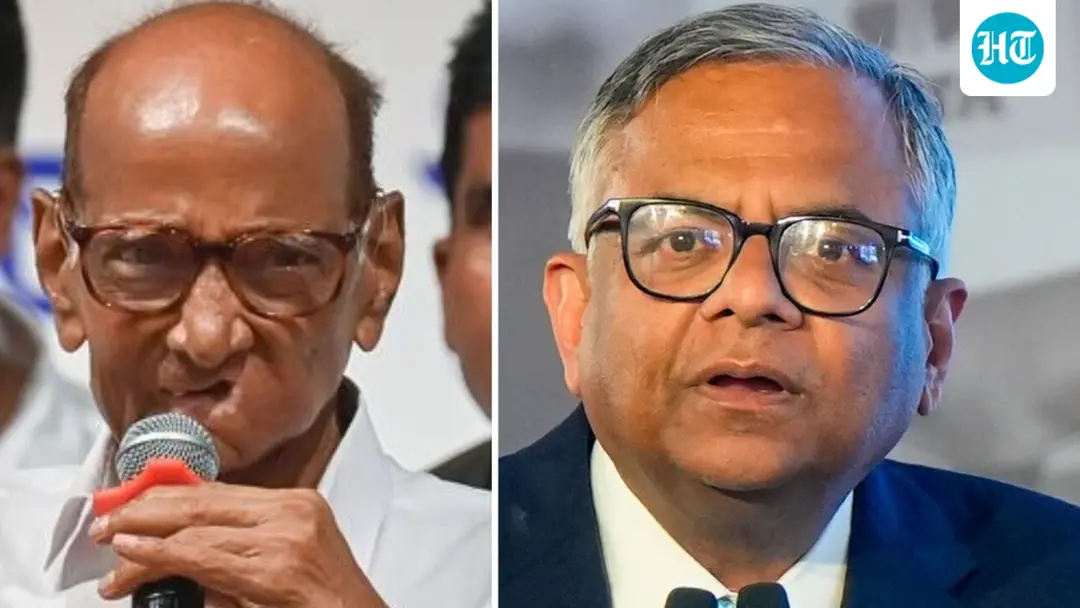
Pawar questions Tata Sons board decisions, backs Trusts' rights
NCP (SP) chief Sharad Pawar on Tuesday said the affirmative voting rights of Tata Trusts must be respected, raising concerns over recent Tata Sons board decisions. In a post on X, he noted the Trusts hold about 66% equity in Tata Sons. At a September 17 meeting, the board voted 4-1 to reappoint N Chandrasekaran as Executive Chairman for five years from February and moved toward a possible listing. Noel Tata opposed both; Venu Srinivasan backed them.
Source
Hindustan Times — India · read the original report ↗
Desk check · compared with the source
What the desk checked (5)
- Tata Trusts, including Sir Ratan Tata Trust and Sir Dorabji Tata Trust, hold about 66% equity in Tata Sons — Figure appears in source, attributed to an image shared by Sharad Pawar.
- At a September 17 board meeting, Tata Sons decided by 4-1 to reappoint N Chandrasekaran as Executive Chairman for five years from February and began steps toward a possible listing — Date, vote split and decisions stated in source; sourced to Pawar's post, no company confirmation cited.
- Noel Tata voted against both proposals while nominee director Venu Srinivasan voted in favour — Attributed to Pawar in the source; no independent corroboration given.
- Articles of Association require affirmative consent of a majority of trust-nominated directors present for a chairman's appointment — Presented as Pawar's reading of the company bylaws; document not quoted directly.
- The Supreme Court had previously recognised affirmative voting rights of trust-nominated directors — Attributed to Pawar; no case name, date or citation provided in source.
Analysts’ view opinion
This is not just a boardroom spat — it touches the ownership architecture of one of India's largest business groups and the question of where its profits ultimately flow. Because philanthropic trusts hold roughly 66 per cent of Tata Sons, the dividend stream feeds hospitals and research institutions directly, so any dispute over control raises questions about the stability of that funding. On the other side, moves toward a public listing could mean value discovery, greater disclosure and easier access to capital — but how that squares with the trusts' affirmative voting rights is unresolved.
- Dividends from the 66 per cent holding underwrite the trusts' spending, so governance uncertainty can indirectly touch that social outlay.
- The objection that the 4-1 vote sits awkwardly with the Articles of Association is procedural in nature, and if it hardens into a legal question, delay itself becomes a cost.
- Likely gainers from a listing: minority shareholders seeking value discovery, investors wanting liquidity, and group companies looking for capital.
- Those with most to lose: trusts wanting to protect a long-horizon, non-profit-first outlook that may sit uneasily with quarterly public-market pressure.
- Ambiguity over leadership continuity is generally a short-term negative for investor confidence and for group companies' capital plans.
What to watch — Watch whether the term starting in February and the listing process proceed smoothly, and whether the dispute over the trusts' affirmative voting rights is settled internally or escalates to courts or regulators.
The story reports Pawar's assertions only — no authority has ruled the resolution invalid, and it carries no response from Tata Sons or the Trusts, no listing timeline and no financial detail.
Deep dive
Research brief · 8 facts · 3 dates · exam-readyThe brief
Context
Tata Sons, the holding company of the Tata Group, is about 66 per cent owned by philanthropic trusts, chiefly the Sir Ratan Tata Trust and the Sir Dorabji Tata Trust, whose dividends fund institutions such as Tata Memorial Hospital, TIFR, TISS and NCPA. At a Tata Sons board meeting on September 17, the board voted 4-1 to reappoint N Chandrasekaran as Executive Chairman for a further five-year term from February and to initiate steps toward a possible public listing of Tata Sons. Tata Trusts Chairman Noel Tata voted against both proposals while nominee director Venu Srinivasan voted in favour. NCP (SP) chief Sharad Pawar has now publicly questioned the process, arguing that the affirmative voting rights of trust-nominated directors under Tata Sons' Articles of Association were not respected.
Key facts
- Philanthropic trusts, including the Sir Ratan Tata Trust and Sir Dorabji Tata Trust, hold approximately 66 per cent of equity in Tata Sons, as noted by Sharad Pawar.
- At the September 17 Tata Sons board meeting, the board voted 4-1 to reappoint N Chandrasekaran as Executive Chairman for another five-year term beginning in February.
- The same meeting initiated steps toward a potential public listing of Tata Sons.
- Tata Trusts Chairman Noel Tata voted against both proposals; nominee director Venu Srinivasan voted in favour.
- Pawar said that under Tata Sons' Articles of Association, appointment of the Chairman requires affirmative consent of a majority of trust-nominated directors present.
- Only two trust-nominated directors were present at the meeting, so, Pawar argued, unanimity between both was required, making the resolution questionable.
- Pawar said the Supreme Court had previously recognised the affirmative voting rights vested in trust-nominated directors to protect stakeholder interests.
- Tata Sons dividends fund institutions based in Maharashtra including Tata Memorial Hospital, TIFR, TISS and the NCPA.
Timeline
- September 17Tata Sons board votes 4-1 to reappoint N Chandrasekaran as Executive Chairman for five years from February and initiates steps toward a potential public listing; Noel Tata votes against, Venu Srinivasan in favour.
- Tuesday (date of story)Sharad Pawar posts on X, in Marathi, titled 'Preserving the Tata Group's Legacy is the Need of the Hour', questioning the board decisions and backing the Trusts' affirmative voting rights.
- February (upcoming)Chandrasekaran's new five-year term as Executive Chairman is to begin.
Who has a stake
- Tata Trusts (Sir Ratan Tata Trust, Sir Dorabji Tata Trust) — Hold about 66 per cent of Tata Sons equity; their affirmative voting rights and institutional role in leadership decisions are at issue.
- Tata Sons board — Validity of its 4-1 resolutions on the chairman's reappointment and a possible listing is being questioned on governance grounds.
- N Chandrasekaran — Reappointed Executive Chairman for five years from February; the resolution's validity is contested.
- Noel Tata, Chairman, Tata Trusts — Voted against both proposals as a trust-nominated director asserting the Trusts' role.
- Venu Srinivasan, nominee director — Voted in favour, creating the split among trust-nominated directors central to Pawar's objection.
- Sharad Pawar, NCP (SP) chief — Publicly pressing for preservation of the Trusts' statutory role and the group's philanthropic governance model.
- Institutions funded by Tata dividends (Tata Memorial Hospital, TIFR, TISS, NCPA) — Depend on dividends flowing from Tata Sons through the Trusts.
Why it matters
The dispute goes to the heart of a unique Indian ownership model in which a large corporate group is majority-owned by charitable trusts whose dividends fund public-interest institutions in health, science, social sciences and the arts. If the affirmative rights of trust-nominated directors can be bypassed by a board majority, both the governance of India's best-known conglomerate and the funding pipeline of those institutions come into question. A possible public listing of Tata Sons would further reshape control and disclosure in the group.
UPSC angle
Prelims pointers
- Tata Sons is the holding company of the Tata Group; philanthropic trusts hold about 66 per cent of its equity.
- Sir Ratan Tata Trust and Sir Dorabji Tata Trust are the principal trusts named as Tata Sons shareholders.
- Tata Memorial Hospital, TIFR, TISS and NCPA are cited as Maharashtra-based institutions funded by Tata dividends.
- September 17: Tata Sons board voted 4-1 to reappoint N Chandrasekaran as Executive Chairman for five years from February.
- Articles of Association: the constitutional document of a company governing internal rules such as chairman appointment.
- Noel Tata is Chairman of Tata Trusts; Venu Srinivasan is a nominee director on the Tata Sons board.
Mains framing
The Tata Sons episode illustrates the tension between formal board majorities and specially protected minority or shareholder rights embedded in a company's Articles of Association. Because charitable trusts own roughly 66 per cent of Tata Sons, their nominee directors were given affirmative voting rights — a protection Pawar says the Supreme Court has previously recognised as safeguarding stakeholder interests — yet a 4-1 board vote reappointed the Executive Chairman and moved toward a listing even as the Trusts' chairman dissented and a second trust nominee broke ranks. The causes lie in divided voting among trust-nominated directors and differing readings of whether "a majority of trust-nominated directors present" requires unanimity when only two attend. The implications are significant: the legitimacy of leadership decisions at India's largest conglomerate, the predictability of dividend flows to institutions like Tata Memorial Hospital, TIFR, TISS and NCPA, and the credibility of trust-based philanthropic capitalism as a governance model. The way forward, as urged in the source, is strict adherence to company bylaws and institutional processes when leadership and structural decisions such as a public listing are taken, so that the Trusts' role is preserved rather than diluted.
Key terms
- Tata Sons
- The holding company of the Tata Group, about 66 per cent owned by philanthropic Tata trusts.
- Affirmative voting rights
- Special consent rights that require designated directors' approval before certain board resolutions can pass.
- Articles of Association
- A company's internal rulebook governing matters such as the appointment of the Chairman and directors' rights.
- Trust-nominated directors
- Directors placed on the Tata Sons board by the Tata Trusts to represent their majority shareholding.
- Public listing (IPO)
- Offering a company's shares to the public on a stock exchange; Tata Sons' board initiated steps toward a possible listing.
- NCP (SP)
- Nationalist Congress Party (Sharadchandra Pawar), the party led by Sharad Pawar.
Practice questions
- Examine the governance implications of a conglomerate being majority-owned by charitable trusts, using the Tata Sons case to discuss the role of affirmative voting rights.
- Discuss how a company's Articles of Association can protect shareholder interests, and what happens when board majorities and such protections conflict.
- What would a potential public listing of Tata Sons mean for the philanthropic institutions funded by its dividends? Analyse critically.
Grounded only in the source report — figures and dates are the source's, not inferred.