
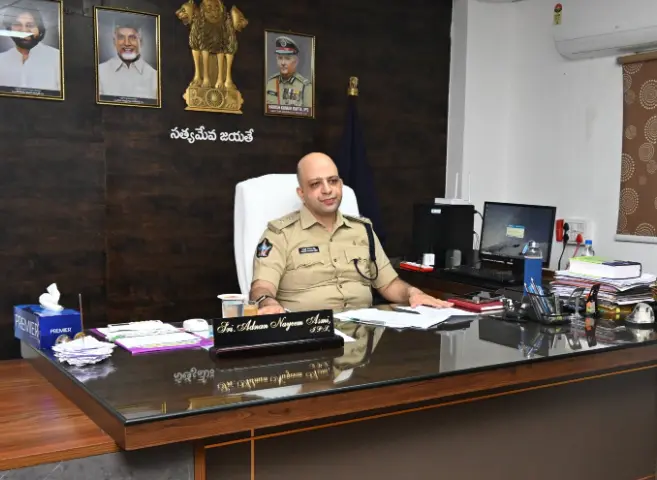
Bhimavaram police bust 'digital arrest' scam network, 13 held
Bhimavaram police have uncovered an international cybercrime network running 'digital arrest' scams. Fraudsters posing as CBI officials told retired professor Sharma his SIM card showed a discrepancy, threatened him with digital arrest and obtained his Aadhaar and bank details, transferring ₹78 lakh over 13 days. Seven special teams identified 14 accused and arrested 13; prime accused Rahtay Jay Nayan of Mumbai is absconding. West Godavari SP Adnan Nayeem Asmi said ₹42 lakh was recovered and ₹19 lakh frozen.
Source
West Godavari — crime · read the original report ↗
Desk check · compared with the source
What the desk checked (5)
- Retired professor Sharma lost ₹78 lakh over 13 days to callers posing as CBI officials. — Figure and timeline appear in source; victim named only by surname, no further attribution given.
- Police identified 14 accused and arrested 13; prime accused Rahtay Jay Nayan of Mumbai is absconding. — Attributed to police/SP briefing in source; internally consistent.
- ₹42 lakh recovered and ₹19 lakh frozen across bank accounts. — Figures appear in source, attributed to police; claim of 'one of the highest recoveries' is unquantified.
- Seven of the accused had earlier worked in Cambodia; the call originated in Bengaluru. — Stated by SP Adnan Nayeem Asmi in source; no supporting documentation cited.
- SP said there is no such thing as a 'digital arrest'. — Direct quote attributed to the SP in source.
Analysts’ view opinion
The legal significance of this case lies less in the size of the fraud than in the speed of asset action: recovering ₹42 lakh and freezing ₹19 lakh is the part victims almost never see, because cyber-fraud money typically moves through layered accounts within hours. The SP's blunt statement that there is no such thing as a 'digital arrest' is legally accurate and worth underlining — no Indian investigating agency can place a person under arrest or custody by phone or video call, and no lawful process requires a citizen to surrender Aadhaar or bank credentials to a caller. With 13 of 14 identified accused in custody and the prime accused absconding, the matter now shifts from detection to the harder terrain of proving a coordinated conspiracy across states and, on the story's account, across borders.
- Impersonating a central agency official to extract money engages offences of cheating, criminal intimidation and impersonation alongside cyber-fraud provisions — the impersonation element is usually what elevates sentencing exposure.
- Freezing and recovery are distinct from restitution: frozen funds normally stay under court control until entitlement is decided, so the victim's actual repayment depends on a judicial order, not the police action alone.
- The absconding prime accused shapes the procedural path — expect proclamation or warrant steps, and possibly split or supplementary charge-sheets so trial against the arrested accused is not stalled.
- Multi-state accused and, per the story, seven with prior work in Cambodia raise jurisdictional and evidence-gathering questions, including whether any leads require formal cross-border cooperation channels.
- The profile of the accused — including reportedly a software engineer at a well-known company — cuts against any assumption that such networks are unsophisticated, and strengthens the case for treating these as organised rather than opportunistic crimes.
What to watch — Watch whether the charge-sheet is filed within statutory custody timelines, how courts treat bail for the arrested accused, and what steps follow to trace the absconding prime accused and release the frozen funds to the victim.
The story does not set out the specific sections charged, the court's stance on bail or the frozen money, or any evidence of a foreign operational base beyond the stated past employment of some accused — and all 14 remain accused, not convicted.
Deep dive
Research brief · 8 facts · 4 dates · exam-readyThe brief
Context
"Digital arrest" scams are a form of cyber fraud in which callers impersonate law-enforcement agencies such as the CBI, allege a legal violation, and threaten the victim with immediate "arrest" over video or phone until money is transferred. Bhimavaram police in West Godavari district, Andhra Pradesh, cracked one such international network after a retired professor identified as Sharma lost ₹78 lakh. The gang first told him there was a discrepancy with his SIM card, posing as a telecom verification call, then extracted his Aadhaar and bank details. Police formed seven special teams, identified 14 accused, arrested 13 and recovered or froze a large part of the money.
Key facts
- Retired professor Sharma was defrauded of ₹78 lakh, transferred out of his account over a period of 13 days.
- Fraudsters posed as CBI officials, cited a discrepancy with his SIM card and threatened him with a "digital arrest".
- The victim was coerced into sharing his Aadhaar and bank account details.
- Crime Branch police registered a case and formed seven special teams for a coordinated operation.
- Police identified 14 accused and arrested 13; prime accused Rahtay Jay Nayan of Mumbai remains absconding.
- West Godavari SP Adnan Nayeem Asmi said ₹42 lakh was recovered and ₹19 lakh frozen across various bank accounts - among the highest recoveries in such scam cases.
- The call to the victim originated from Bengaluru, disguised as a telecom verification call.
- Seven of the accused had previously worked in Cambodia; the accused include people from the Telugu states and Karnataka, and a software engineer with a reputed company.
Timeline
- Over 13 days (dates not stated in the source)Fraudsters posing as CBI officials contact retired professor Sharma over a SIM card "discrepancy", threaten digital arrest and transfer ₹78 lakh from his account.
- After the fraudSharma files a complaint; Crime Branch police register a case and form seven special teams.
- Following the operationPolice identify 14 accused, arrest 13, recover ₹42 lakh and freeze ₹19 lakh; prime accused Rahtay Jay Nayan of Mumbai remains on the run.
- On disclosure of the caseWest Godavari SP Adnan Nayeem Asmi reveals details and warns that there is no such thing as a 'digital arrest'.
Who has a stake
- Retired professor Sharma (victim) — Lost ₹78 lakh; stands to recover part of it from the ₹42 lakh recovered and ₹19 lakh frozen.
- Bhimavaram Crime Branch police / seven special teams — Led the investigation, identified 14 accused and arrested 13.
- West Godavari District SP Adnan Nayeem Asmi — Disclosed case details and issued a public warning that no 'digital arrest' exists in law.
- Accused persons (14, including Rahtay Jay Nayan of Mumbai) — Face prosecution; 13 arrested, prime accused absconding; seven had worked in Cambodia.
- Retired and elderly people living alone — SP said many victims in similar cases are retired individuals or those living alone - the group most targeted.
- Banks holding the routed money — Accounts across which ₹19 lakh was frozen and ₹42 lakh traced, central to recovery of defrauded funds.
- Central Bureau of Investigation (CBI) — Its identity was impersonated by the fraudsters to intimidate the victim.
Why it matters
"Digital arrest" frauds exploit fear of central agencies and target retired people and those living alone, and this case shows how a single call disguised as telecom verification can drain ₹78 lakh in under two weeks. The recovery of ₹42 lakh and freezing of ₹19 lakh - described as one of the highest in such cases - shows that fast complaint-filing and coordinated police action can claw back money. The Cambodia link among seven accused and the involvement of educated professionals point to organised, cross-border cyber-fraud operations rather than lone offenders.
UPSC angle
Prelims pointers
- 'Digital arrest' has no legal existence in India - police in this case explicitly stated there is no such thing.
- Case location: Bhimavaram, West Godavari district, Andhra Pradesh; SP Adnan Nayeem Asmi.
- Amount defrauded: ₹78 lakh over 13 days; ₹42 lakh recovered, ₹19 lakh frozen.
- 14 accused identified, 13 arrested; prime accused Rahtay Jay Nayan is from Mumbai.
- The fraudulent call originated from Bengaluru, disguised as a telecom (SIM verification) call; seven accused had worked in Cambodia.
- Fraudsters impersonated CBI officials and obtained the victim's Aadhaar and bank account details.
Mains framing
The Bhimavaram case illustrates the anatomy of India's fast-growing 'digital arrest' fraud: impersonation of a central investigating agency, a plausible pretext (a SIM card discrepancy dressed up as telecom verification), psychological coercion through the threat of arrest, and extraction of identity and banking credentials that allow serial transfers - here ₹78 lakh over 13 days. The causes lie in low awareness among vulnerable groups, particularly retired persons and those living alone, the ease of spoofing official identities over telephone and video, mule bank accounts that disperse proceeds, and transnational scam operations - seven of the accused had worked in Cambodia - that recruit even educated professionals, including a software engineer. Implications include erosion of trust in genuine agency communication and large, often irrecoverable, losses to pensioners. The way forward suggested by the case itself is operational: immediate complaint registration, multi-team coordinated investigation across states, rapid tracing and freezing of accounts (₹42 lakh recovered, ₹19 lakh frozen), and sustained public messaging that, as the SP put it, no 'digital arrest' exists and such calls must be reported to police at once.
Key terms
- Digital arrest
- A fraud technique where callers impersonating officials claim the victim is under 'arrest' remotely and extort money; police confirm no such legal process exists.
- CBI (Central Bureau of Investigation)
- India's central investigating agency, whose identity the fraudsters falsely used to intimidate the victim.
- Crime Branch
- The specialised police wing that registered this case and formed seven special teams to investigate.
- Freezing of accounts
- Police action blocking operation of bank accounts holding defrauded money; ₹19 lakh was frozen in this case.
- Telecom verification call
- The disguise used by the gang - a call claiming to check a SIM card discrepancy - to win the victim's trust.
Practice questions
- What is a 'digital arrest' scam, and what does the Bhimavaram case reveal about the methods used to target retired and isolated individuals?
- Examine the challenges in investigating transnational cyber-fraud networks, with reference to the Cambodia link among the accused in the Bhimavaram case.
- Recovery of ₹42 lakh and freezing of ₹19 lakh out of ₹78 lakh is described as one of the highest in such cases. What does this suggest about the importance of prompt reporting and inter-state police coordination in cyber fraud?
Grounded only in the source report — figures and dates are the source's, not inferred.