
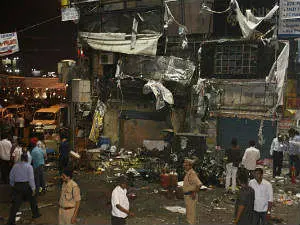
Dilsukhnagar blasts: tributes paid on first anniversary
Politicians, voluntary organisations and students laid floral wreaths and lit candles at Konark Theatre in Hyderabad's Dilsukhnagar on the first anniversary of the twin bomb blasts. BJP leader Bandaru Dattatreya demanded strict measures to prevent a recurrence. Former minister Komatireddy Venkatreddy and LB Nagar MLA Sudheer also paid tribute. The February 21, 2013 blasts killed 18 people, injured 138 and left 76 without limbs.
Source
Dilsukhnagar — స్థానికం · read the original report ↗
Desk check · compared with the source
What the desk checked (5)
- The February 21, 2013 twin blasts killed 18, injured 138 and left 76 without limbs. — Figures appear in the source; no official or agency cited.
- Politicians, NGOs and students paid tribute at the site near Konark Theatre with wreaths and candles. — Reported as observed events; internally consistent.
- Bandaru Dattatreya demanded strict measures and said terrorism has no link to caste, religion, region or language. — Attributed directly to Dattatreya speaking to media.
- Manmohan Singh visited the site two days after the blasts and promised justice. — Stated in the source without documentary attribution.
- Promises made to some victims remain unfulfilled. — Unattributed assertion by the source.
Analysts’ view opinion
The first anniversary of the Dilsukhnagar blasts falls just ahead of the 2014 general election, which is why the tribute at Konark Theatre carried political signalling alongside genuine mourning. BJP senior leader Bandaru Dattatreya's demand for "tough action" fits his party's familiar national-security framing, while the story's note that some victims are still waiting on promises made by Prime Minister Manmohan Singh leaves an uncomfortable question for the incumbents. The presence of Congress's Komatireddy Venkat Reddy and MLA Sudheer shows no party can afford to cede this space to rivals.
- An anniversary landing in election season inevitably acquires political weight beyond commemoration.
- Dattatreya's line that terror has no caste, religion, region or language signals toughness while insulating him from charges of communal polarisation.
- Unfulfilled assurances on relief and rehabilitation are the politically vulnerable flank for the ruling side, made sharper by the 76 people who lost limbs.
- Congress leaders showing up rather than staying away suggests a strategy of not surrendering the security issue entirely to the opposition.
- Rallies by students and voluntary groups indicate the issue can travel beyond party lines into civil-society territory.
What to watch — Watch whether compensation and rehabilitation delivery becomes a campaign talking point, and how sharply parties trade blame on internal security in the weeks ahead.
The story does not establish which promises remain unmet or to what extent, the current status of the investigation, or how any of this moves voters.
Deep dive
Research brief · 8 facts · 3 dates · exam-readyThe brief
Context
On February 21, 2013, twin bomb blasts tore through Dilsukhnagar, a crowded commercial area of Hyderabad, near the Konark Theatre. The explosions killed 18 people, injured 138 and left 76 persons without limbs. On February 21, 2014, the first anniversary, politicians, voluntary organisations, students and families of the victims gathered at the blast site to pay tributes with floral wreaths and candles. The occasion also became a moment to ask why some promises made to victims after the attack remain unfulfilled.
Key facts
- The twin blasts at Dilsukhnagar, Hyderabad, occurred on February 21, 2013.
- The blasts killed 18 people and injured 138 others.
- 76 of the injured were left without limbs (lost body parts) in the explosions.
- Tributes on the first anniversary were paid at the site of the blasts, the Konark Theatre in Dilsukhnagar.
- BJP senior leader Bandaru Dattatreya demanded strict measures so that such an incident does not recur.
- Dattatreya said terrorism has no link with caste, religion, region or language, and its aim is to create anarchy in the country.
- BJP city president Venkat Reddy, former minister Komatireddy Venkatreddy and LB Nagar MLA Sudheer paid tributes at the site.
- Students carried the national flag in a rally at the site, raising slogans against terrorism.
Timeline
- February 21, 2013Twin bomb blasts at Dilsukhnagar, Hyderabad, kill 18, injure 138 and leave 76 without limbs.
- Two days after the blasts (February 2013)Prime Minister Manmohan Singh visits the blast site, condoles the deaths and promises justice to victims.
- February 21, 2014First anniversary: political leaders, voluntary organisations and students lay wreaths and light candles at Konark Theatre; students hold an anti-terrorism rally.
Who has a stake
- Families of the 18 deceased — Relatives who came to the site recalled the incident with deep anguish; they seek justice and closure.
- The 138 injured, including 76 who lost limbs — Long-term disability and rehabilitation; some promised assistance remains undelivered.
- Bandaru Dattatreya and BJP leaders (incl. city president Venkat Reddy) — Demanded strict measures to prevent recurrence and framed terrorism as beyond caste, religion, region or language.
- Former minister Komatireddy Venkatreddy and LB Nagar MLA Sudheer — Elected representatives of the area paying tribute and answerable to victims' demands.
- Union government / then PM Manmohan Singh — Had promised justice to victims after visiting the site; credibility tied to fulfilment of those assurances.
- Students and voluntary organisations — Mobilised public sentiment against terrorism through a national-flag rally and candle tributes.
Why it matters
The Dilsukhnagar blasts remain one of the deadliest attacks on an Indian city's public space, and the anniversary highlighted that relief and rehabilitation promises to some victims were still unmet after a year. For the state, it raises the twin tests of urban counter-terrorism preparedness in crowded markets and of time-bound compensation for victims. The anti-terror rally by students also underlined how such attacks shape public sentiment in a city.
UPSC angle
Prelims pointers
- Dilsukhnagar twin blasts: February 21, 2013, Hyderabad; site near Konark Theatre.
- Casualty figures as reported: 18 dead, 138 injured, 76 left without limbs.
- Prime Minister Manmohan Singh visited the blast site two days after the incident.
- Bandaru Dattatreya was the senior BJP leader who demanded strict preventive measures at the first anniversary event.
- Komatireddy Venkatreddy (former minister) and Sudheer (LB Nagar MLA) paid tributes at the site.
- First anniversary observance date: February 21, 2014.
Mains framing
The Dilsukhnagar blasts of February 21, 2013 illustrate the vulnerability of crowded urban commercial spaces — bus stops, cinemas and markets — to low-cost, high-casualty attacks, and the long tail of harm they leave: 18 dead, 138 injured and 76 persons permanently without limbs. The first anniversary, marked by wreaths, candles and a students' rally at Konark Theatre, also exposed a governance gap: despite the Prime Minister's visit within two days and his assurance of justice, the report notes that promises to some victims remained unfulfilled a year later, leaving families to voice anguish at the site. Political responses ranged from BJP leader Bandaru Dattatreya's demand for strict preventive measures to his framing of terrorism as having no caste, religion, region or language, its purpose being to create anarchy. The way forward suggested by the episode lies in two directions: strengthening preventive policing, surveillance and crowd-place security in metropolitan areas, and institutionalising time-bound, monitored compensation, prosthetic support and rehabilitation for blast victims so that relief does not depend on political attention around anniversaries.
Key terms
- Dilsukhnagar
- A busy commercial locality in Hyderabad where the twin bomb blasts of February 21, 2013 occurred.
- Konark Theatre
- The cinema hall at the blast site in Dilsukhnagar where anniversary tributes were paid.
- Twin blasts
- Two explosions timed close together at nearby points, a tactic that maximises casualties and panic.
- Bandaru Dattatreya
- Senior BJP leader who paid tribute and demanded strict measures to prevent a recurrence.
- LB Nagar
- Assembly constituency in Hyderabad whose MLA, Sudheer, visited the blast site to pay tribute.
Practice questions
- The Dilsukhnagar blasts of 2013 showed that crowded urban spaces remain soft targets. Discuss the measures needed to secure such public places without over-policing citizens.
- "Relief and rehabilitation of terror victims must be time-bound and institutionalised, not event-driven." Examine in the light of unfulfilled promises to Dilsukhnagar blast victims.
- How do commemorative events such as anniversary tributes and student rallies shape public and political responses to terrorism in India?
Grounded only in the source report — figures and dates are the source's, not inferred.