
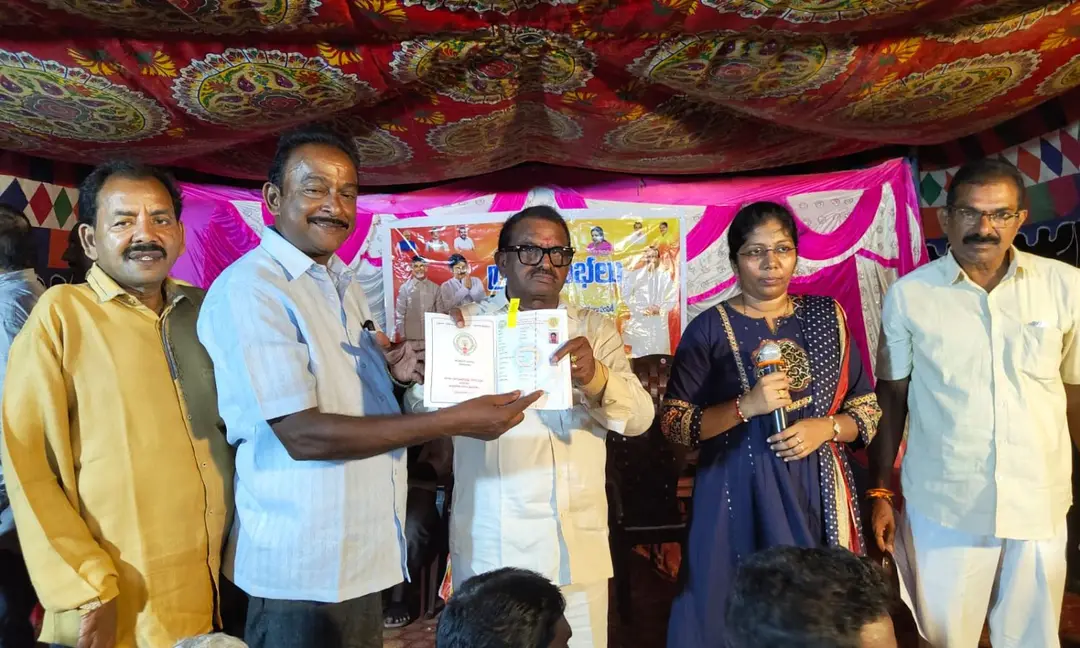
MLA Pitani distributes pattadar passbooks in Penumantra mandal
Pattadar passbooks bearing the royal seal were distributed in Neggipudi and Koyyetipadu villages of Penumantra mandal on Wednesday under the state government's 'Mee Bhoomi–Mee Hakku' programme. Achanta MLA, Assembly privileges committee chairman and former minister Pitani Satyanarayana handed over the passbooks. In Neggipudi, 274 farmers received them, while in Koyyetipadu 480 of 496 farmers did. He said the coalition government was prioritising farmer welfare and ensuring transparent land records.
Source
Achanta — MLA & నియోజకవర్గం · read the original report ↗
Desk check · compared with the source
What the desk checked (4)
- Royal-seal pattadar passbooks were distributed in Neggipudi and Koyyetipadu villages of Penumantra mandal on Wednesday under the 'Mee Bhoomi–Mee Hakku' programme. — Appears in source as event reporting; no official document cited.
- 274 farmers in Neggipudi received passbooks; the village total is given as '30 7', a garbled figure. — Figure 274 appears in source; the total is internally inconsistent and was omitted from the summary.
- In Koyyetipadu, 480 of 496 farmers received passbooks. — Both figures appear in source and are internally consistent.
- Achanta MLA and former minister Pitani Satyanarayana said the coalition government is prioritising farmer welfare and ensuring transparent land records. — Directly attributed to the MLA's remarks at the event.
Analysts’ view opinion
A passbook handover looks routine, but economically it is the issue of a title document — clear land records make crop loans, insurance, subsidies and sale or lease transactions far easier. With 274 of 307 farmers covered in Neggipudi and 480 of 496 in Koyyetipadu, coverage is high, and the residual cases are typically the harder ones involving disputes or inheritance and partition issues. The government's cost here is mainly administrative — survey and digitisation — while the gain accrues to farmers as lower transaction costs and better credit access.
- A clear ownership document converts land from a dormant asset into collateral, which can shift borrowing towards formal institutions and reduce interest burden.
- Transparent records lower the incidence of land disputes and the litigation costs and time losses that come with them, supporting confidence in local land transactions.
- Timely delivery of schemes and subsidies depends on accurate beneficiary identification, so sound passbook data can cut leakage and improve the efficiency of public spending.
- The farmers left out carry the greater economic risk, as absence of a document can hold back loan access and insurance claims.
- The programme generates no direct revenue; its payoff shows up indirectly and over time through credit flow, investment and clearer land valuation.
What to watch — Watch whether bank crop loans and insurance enrolment actually rise among farmers who received passbooks, and how quickly the remaining cases are resolved.
The story establishes only the distribution numbers — it does not set out why some farmers were left out, what the programme costs, or any measured effect on credit access.
Deep dive
Research brief · 8 facts · 2 dates · exam-readyThe brief
Context
The Andhra Pradesh government is running a programme called 'Mee Bhoomi–Mee Hakku' (My Land–My Right) aimed at strengthening farmers' legal title to their land by issuing pattadar passbooks that carry the royal seal (rajamudra). As part of this, distribution events were held in Neggipudi and Koyyetipadu villages of Penumantra mandal on Wednesday. Achanta MLA, Assembly privileges committee chairman and former minister Pitani Satyanarayana handed over the passbooks to farmers. The programme is presented by the ruling coalition government as part of its push for transparent land records and farmer welfare.
Key facts
- Pattadar passbooks bearing the royal seal (rajamudra) were distributed in Neggipudi and Koyyetipadu villages of Penumantra mandal on Wednesday.
- The distribution was part of the Andhra Pradesh government's 'Mee Bhoomi–Mee Hakku' programme, aimed at strengthening farmers' rights over their land.
- In Koyyetipadu village, 480 of the total 496 farmers received pattadar passbooks.
- In Neggipudi village, 274 farmers received pattadar passbooks; the source gives the village's total farmer count as '30 7', which is unclear as printed.
- The passbooks were handed over by Achanta MLA, AP Assembly privileges (rights) committee chairman and former minister Pitani Satyanarayana.
- The MLA said the coalition government was giving top priority to farmer welfare and was acting to keep land rights and records transparent.
- He directed officials to work in coordination so that government schemes and subsidies reach farmers on time.
- Officials of various departments, local public representatives, coalition leaders and farmers attended the events.
Timeline
- Wednesday (date not stated in the source)Pattadar passbook distribution events held in Neggipudi and Koyyetipadu villages of Penumantra mandal under 'Mee Bhoomi–Mee Hakku'.
- Same dayMLA Pitani Satyanarayana hands over passbooks and directs officials to ensure timely delivery of schemes and subsidies to farmers.
Who has a stake
- Farmers of Neggipudi and Koyyetipadu — Receive pattadar passbooks with royal seal, giving documentary proof of land rights; 480 of 496 in Koyyetipadu and 274 in Neggipudi covered.
- Andhra Pradesh government (coalition government) — Implementing 'Mee Bhoomi–Mee Hakku' to strengthen land rights and show farmer welfare as a priority.
- Pitani Satyanarayana, Achanta MLA and Assembly privileges committee chairman — Political credit for delivering passbooks and for monitoring officials on scheme delivery.
- Revenue and other department officials — Asked to coordinate so that schemes, subsidies and record corrections reach farmers in time.
- Farmers left out of the distribution — 16 of 496 farmers in Koyyetipadu did not receive passbooks; reasons not stated in the source.
Why it matters
Clear, tamper-proof land records are the basis for a farmer's access to credit, crop insurance, subsidies and protection from disputes, so passbook distribution is more than a ceremonial exercise. The fact that some farmers in each village did not get passbooks shows that record-cleaning drives rarely achieve full coverage in one round. For aspirants, the case illustrates how state-level land record modernisation plays out at the village level.
UPSC angle
Prelims pointers
- 'Mee Bhoomi–Mee Hakku' is an Andhra Pradesh government programme to strengthen farmers' rights over their land.
- Pattadar passbooks distributed under the programme carry the royal seal (rajamudra).
- Venue: Neggipudi and Koyyetipadu villages, Penumantra mandal, Andhra Pradesh.
- Koyyetipadu: 480 of 496 farmers received passbooks; Neggipudi: 274 farmers received passbooks.
- Pitani Satyanarayana — Achanta MLA, chairman of the AP Assembly privileges committee and former minister.
- A pattadar passbook is the official record of a landholder's title and extent of holding.
Mains framing
Secure land titles are the foundation of agricultural credit, insurance and subsidy delivery, and the Andhra Pradesh 'Mee Bhoomi–Mee Hakku' programme, under which pattadar passbooks with the royal seal were given to 274 farmers in Neggipudi and 480 of 496 farmers in Koyyetipadu in Penumantra mandal, is an attempt to make these rights documentary and transparent. The underlying causes of such drives are decades of outdated, contested or manually maintained revenue records, which leave smallholders vulnerable to disputes and to exclusion from welfare schemes. The implications are twofold: beneficiaries gain a usable proof of title, but the residual group that does not receive passbooks in a given village risks being left in limbo unless the reasons — pending mutations, disputes or survey gaps — are resolved. The MLA's instruction that officials coordinate so that schemes and subsidies reach farmers on time points to the way forward: linking record updation with benefit delivery, grievance redress for excluded farmers, and periodic follow-up rounds rather than one-time distribution events. The source does not detail any grievance mechanism or the reasons for exclusion, which is itself a gap worth flagging in an answer.
Key terms
- Mee Bhoomi–Mee Hakku
- Andhra Pradesh government programme to strengthen and document farmers' rights over their land, under which pattadar passbooks are distributed.
- Pattadar passbook
- Official document issued to a landholder recording ownership/title details of agricultural land.
- Rajamudra (royal seal)
- The state emblem/seal printed on the newly distributed passbooks, signifying official authentication.
- Assembly privileges committee
- A committee of the Andhra Pradesh Legislative Assembly; Pitani Satyanarayana is its chairman as per the source.
- Mandal
- An administrative sub-district unit in Andhra Pradesh; Penumantra is the mandal in this story.
- Coalition government
- The term used in the source for the ruling government in Andhra Pradesh that is implementing the programme.
Practice questions
- How do clear and transparent land records improve a farmer's access to institutional credit, insurance and subsidies? Illustrate with the example of pattadar passbook distribution drives.
- Discuss the administrative challenges in achieving full coverage in land record updation drives, given that some farmers in each village remain without passbooks.
- Examine the role of state-level programmes such as 'Mee Bhoomi–Mee Hakku' in land record modernisation and dispute reduction in rural India.
Grounded only in the source report — figures and dates are the source's, not inferred.