
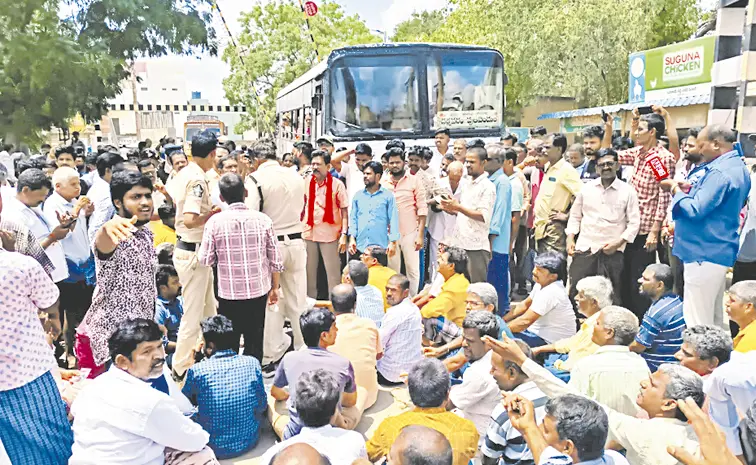
Handloom weavers block Dharmavaram–Anantapur road over scheme funds
Hundreds of handloom weavers staged a two-hour road blockade on the Dharmavaram–Anantapur main road in Sri Sathya Sai district on Monday, alleging they did not receive Netanna Sayam scheme funds. The protest caused heavy traffic congestion. Weavers said Rs 25,000 was promised per family but claimed over 4,000 ineligible people in the town received the money. They recalled Rs 24,000 annually under the previous government. Protest ended after CI Reddappa promised justice within five days.
Source
Dharmavaram — crime & civic · read the original report ↗
Desk check · some claims need care
What the desk checked (6)
- Hundreds of handloom weavers blocked the Dharmavaram–Anantapur main road for about two hours on Monday — Reported directly in the source as an observed event; no police or official figure given for crowd size.
- Netanna Sayam scheme offers Rs 25,000 per handloom family — Figure appears in source, stated by protesting weavers; not attributed to an official document.
- More than 4,000 ineligible people in Dharmavaram town received the scheme benefit — Allegation by protesting weavers; unattributed to any official record or audit.
- TDP alliance leaders added ineligible names in several wards — Political allegation by protesters; no response from the named parties or officials in the source.
- Under the previous YSRCP government all eligible weavers got Rs 24,000 a year under Netanna Nestham — Recalled by the affected weavers; figure appears in source but is not independently sourced.
- Town CI Reddappa promised justice to eligible weavers within five days, after which the protest was withdrawn — Attributed to a named police officer in the source.
Analysts’ view opinion
Because Dharmavaram is a handloom town, this protest is more than a local grievance — it points to a politically dangerous problem: eroding trust in beneficiary lists. The allegation that welfare money flowed to party workers rather than genuine weavers is awkward for the coalition government precisely because the dispute is about delivery, not about scrapping the scheme. Meanwhile, the weavers' reminder that the previous government paid Rs 24,000 a year hands the YSRCP a ready-made political line. The claims in the story are the protesters' own; no official confirmation is on record here.
- At Rs 25,000, Netanna Saayam invites direct comparison with the earlier Rs 24,000 payout, so a higher figure poorly delivered can cost more politically than it gains.
- "Ineligible people got it, eligible people didn't" is the most corrosive kind of welfare complaint because it can alienate the government's own supporters too.
- With TDP coalition leaders named directly by protesters, local leaders may be pushed onto the defensive, and visible corrective steps such as list revision or action against officials could follow.
- The story describes weavers turning out voluntarily rather than under a party banner, which makes it harder for the government to dismiss the anger as opposition-engineered.
- The protest ended on a police officer's assurance, meaning the grievance has been deferred with a deadline rather than resolved.
What to watch — Watch whether the five-day promise produces an actual re-verification and removal of ineligible names — if it does not, the agitation could spread to other weaving clusters and the opposition will likely make it a campaign plank.
The figure of over 4,000 ineligible beneficiaries is an allegation by protesters; the story carries no response from the government, the handloom department or the TDP coalition, and the claim is not independently verified.
Deep dive
Research brief · 8 facts · 4 dates · exam-readyThe brief
Context
Handloom weaving is the mainstay of Dharmavaram town in Andhra Pradesh's Sri Sathya Sai district, a centre known for its silk sarees. The state's "Netanna Sayam" scheme is meant to transfer financial assistance to handloom weaver families, succeeding the previous YSRCP government's "Netanna Nestham" scheme. On Monday, weavers from several localities in Dharmavaram blocked the Dharmavaram–Anantapur main road alleging that ineligible persons were enrolled while genuine loom-owning weavers were left out of the payout.
Key facts
- Hundreds of handloom workers held a roughly two-hour rasta roko on the Dharmavaram–Anantapur main road on Monday, near the weaver (Netanna) statue at Shivanagar Kadiri Gate.
- Protesters said the Netanna Sayam scheme promised Rs 25,000 to each handloom family.
- Weavers alleged more than 4,000 ineligible persons in Dharmavaram town received the scheme money.
- Under the previous YSRCP government's Netanna Nestham scheme, weavers said Rs 24,000 was paid every year to all eligible beneficiaries.
- Protesters came from Shivanagar, Keshavanagar, Shantinagar and the Gas Godown areas of the town.
- Weavers alleged TDP alliance leaders got ineligible names added in many wards, and that handloom officials credited money without verifying who owned looms.
- The blockade caused heavy traffic jams; weavers refused to disperse despite police persuasion.
- Town CI Reddappa spoke to handloom officials and promised justice to eligible weavers within five days, after which the protest was withdrawn.
Timeline
- Under the previous YSRCP governmentWeavers say Netanna Nestham assistance of Rs 24,000 per year reached all eligible beneficiaries.
- Recently (date not stated in the source)Weavers allege ineligible names were added in several wards and scheme money was credited to over 4,000 ineligible persons in Dharmavaram.
- MondayHundreds of weavers block the Dharmavaram–Anantapur main road for about two hours, causing heavy traffic congestion.
- Monday, after talksTown CI Reddappa assures justice within five days; protest called off.
Who has a stake
- Eligible handloom weavers of Dharmavaram — Loss of Rs 25,000 per family assistance during a crisis in the handloom sector.
- Handloom department officials — Accused of crediting money without verifying loom ownership; asked to fix the beneficiary list in five days.
- TDP-led alliance leaders — Alleged by protesters to have inserted ineligible names in ward-level beneficiary lists.
- Police / Town CI Reddappa — Handled the road blockade and brokered the assurance that ended the protest.
- Road users on the Dharmavaram–Anantapur route — Faced heavy traffic jams for the duration of the two-hour blockade.
- YSRCP — Cited by weavers for the earlier Netanna Nestham payments of Rs 24,000 a year, making the issue politically charged.
Why it matters
Welfare schemes delivered as direct cash transfers depend entirely on the accuracy of beneficiary lists; when verification fails, the intended poor are excluded while others gain. For Dharmavaram's weavers, already described as struggling in a crisis, the exclusion is both an income loss and a trust deficit that spills onto the streets as a road blockade.
UPSC angle
Prelims pointers
- Netanna Sayam: Andhra Pradesh scheme offering Rs 25,000 per handloom weaver family, as stated by protesters.
- Netanna Nestham: earlier scheme under the YSRCP government, cited as giving Rs 24,000 annually to eligible weavers.
- Dharmavaram is a handloom town in Sri Sathya Sai district of Andhra Pradesh.
- Protest site: Netanna statue at Shivanagar Kadiri Gate on the Dharmavaram–Anantapur main road.
- Weavers alleged over 4,000 ineligible beneficiaries in Dharmavaram town alone.
- Rasta roko lasted about two hours and ended on a five-day assurance by Town CI Reddappa.
Mains framing
The Dharmavaram protest illustrates how targeting errors, not scheme design alone, determine whether welfare reaches the intended group. Weavers allege that inclusion errors — reportedly over 4,000 ineligible beneficiaries in one town, added ward-wise allegedly at the behest of ruling alliance leaders — produced exclusion errors for loom-owning families entitled to Rs 25,000 under Netanna Sayam. Their comparison with Rs 24,000 paid annually under the earlier Netanna Nestham scheme shows that continuity and predictability of transfers matter as much as the amount, especially in an artisan economy described as being in crisis. The core administrative failure flagged is non-verification: handloom officials allegedly credited funds without checking who actually possesses a loom. The way forward suggested by the episode itself is verification at source — loom-level physical survey, transparent publication of ward-wise beneficiary lists, a time-bound grievance redress route (here compressed into a five-day police-brokered assurance), and recovery or correction where ineligible credits are established. Equally, the recourse to a highway blockade points to the absence of an accessible appeal mechanism before protest becomes the only leverage.
Key terms
- Netanna Sayam
- Current Andhra Pradesh assistance scheme for handloom weaver families, said by protesters to promise Rs 25,000 per family.
- Netanna Nestham
- Scheme of the previous YSRCP government under which weavers say Rs 24,000 was paid every year to eligible weavers.
- Rasta roko
- A protest method of sitting on and blocking a road to press demands; used here for about two hours.
- Ineligible beneficiaries
- Persons enrolled for a scheme without meeting its criteria — here, people without looms allegedly receiving weaver assistance.
- Sri Sathya Sai district
- Andhra Pradesh district in which the handloom town of Dharmavaram is located.
- CI
- Circle Inspector of police; here Town CI Reddappa, who negotiated an end to the blockade.
Practice questions
- Inclusion errors in welfare beneficiary lists cause exclusion of the genuinely eligible. Discuss with reference to the handloom weavers' protest over the Netanna Sayam scheme in Dharmavaram.
- Examine the role of field-level verification and transparent beneficiary lists in ensuring that direct benefit transfers reach artisan communities.
- Why do local grievances over welfare payments often escalate into road blockades? Suggest institutional grievance-redress measures at the district level.
Grounded only in the source report — figures and dates are the source's, not inferred.