
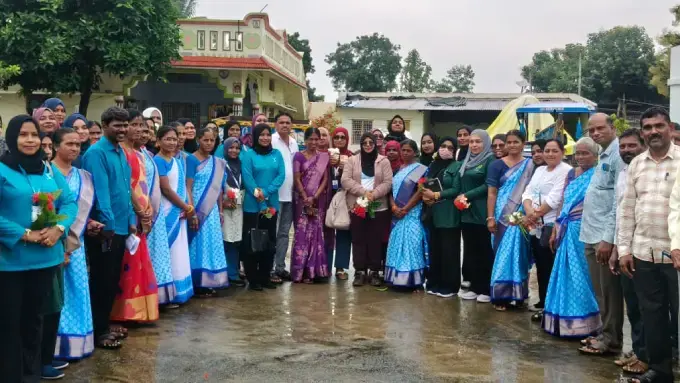
Maldives delegation visits Gangadevipalli village in Warangal
A delegation from the Maldives visited Gangadevipalli, a national model village in Geesugonda mandal of Warangal district, on Friday under the aegis of the rural development institute. Led by course director Anjan Kumar Banja, the team examined the functioning of women's groups, self-help groups and children's groups. DRDA officials explained women's role in village development. Members said the handful-of-rice scheme impressed them, that their country has no women's groups, and praised Telangana's women welfare efforts.
Source
Warangal — వార్తలు · read the original report ↗
Desk check · compared with the source
What the desk checked (4)
- A Maldives delegation visited Gangadevipalli in Geesugonda mandal, Warangal district, on Friday under the aegis of the rural development institute. — Stated in source with date reference 'Friday' and organising body named; no further documentation given.
- The delegation was led by course director Anjan Kumar Banja and examined the functioning of women's groups, self-help and children's groups. — Name and role appear in source as reported detail.
- Delegation members said there are no women's groups in their country and that groups here function very well. — Attributed to unnamed delegation members collectively; no direct quote verification possible.
- Officials present included Additional Project Director Srinivas, District Project Manager Anil, SERP APM Eswar, CC Suresh, sarpanch Koosam Swaroopa, and Maldivian representatives Risha, Shirin, Sheeyun and Reshma. — Names listed in source; spellings as given, not independently checked.
Analysts’ view opinion
On the surface this is a routine study visit, but politically it is a soft-power moment for Telangana. Putting a nationally recognised model village like Gangadevipalli on display before a foreign delegation lets the state showcase its women's collectives and self-help group model as a governance success. The delegation's praise is the kind of material that tends to migrate quickly into government messaging — though it is worth noting that no party leader or political statement appears anywhere in this story.
- Women's collectives and self-help groups have been a durable institutional and electoral base in Telangana and the erstwhile united Andhra Pradesh, so international validation of that model helps whoever is in office.
- Low-cost, participation-based schemes like the 'handful of rice' initiative are strong communication assets because they showcase community ownership rather than expenditure.
- The visit was run by the rural development institution and DRDA officials, so the immediate credit sits with the administrative machinery — but political dividends usually accrue to the government of the day.
- The presence of everyone from the village sarpanch to district project officers gives local-body leadership visibility on an international-facing platform.
- A standard opposition counter — that one showpiece village does not represent the whole state — is available, but no such reaction is recorded in this story.
What to watch — Watch whether the delegation's praise is picked up in official government or ruling-party messaging, and whether opposition voices respond.
The story establishes no party involvement, no electoral effect and no formal agreement between the state and the Maldives — it reports only a study visit.
Deep dive
Research brief · 8 facts · 2 dates · exam-readyThe brief
Context
Gangadevipalli, a village in Geesugonda mandal of Warangal district in Telangana, is recognised as a national model village and has long been a destination for study visits on community-led rural development. On Friday, a delegation from the Maldives visited the village under the aegis of the rural development institute, guided by DRDA officials. The visitors studied how women's collectives, self-help groups and children's groups function at the village level.
Key facts
- A Maldives delegation visited Gangadevipalli village, Geesugonda mandal, Warangal district, on Friday, organised under the aegis of the rural development institute.
- The visit was led by course director Anjan Kumar Banja.
- The delegation examined the working of women's associations, self-help groups (SHGs) and children's groups (bala sanghas) in the village.
- DRDA officials explained to the visitors the role of women in village development.
- The 'guppedu biyyam' (handful of rice) scheme drew particular appreciation from the delegation.
- Delegation members said their country has no women's associations and that the groups here function very well.
- The members credited the Telangana government with working for women's welfare and development.
- Those present included District Additional Project Director Srinivas, District Project Manager Anil, SERP APM Eswar, CC Suresh, Gangadevipalli sarpanch Koosam Swarupa, and Maldivian public representatives Risha, Shireen, Sheeyun and Reshma.
Timeline
- Friday (date not stated in the source)Maldives delegation tours Gangadevipalli, inspects women's groups, SHGs and children's groups; DRDA officials brief them on women's role in development.
- After the tour, same dayDelegation members speak to say their country lacks women's associations and praise Telangana's women welfare efforts.
Who has a stake
- Maldives delegation (Risha, Shireen, Sheeyun, Reshma and others) — Seeking replicable models of women's collectives and village-level development for a country that, they said, has no women's associations.
- Gangadevipalli village and sarpanch Koosam Swarupa — Its status as a national model village is validated by international study visits.
- DRDA, Warangal district officials (Srinivas, Anil) — Presenting and defending the district's rural development and women's empowerment record.
- SERP (APM Eswar, CC Suresh) — Institutional custodian of self-help group mobilisation whose field outcomes are on display.
- Women's self-help groups and children's groups of the village — Their functioning is the substance of the model being showcased internationally.
- Rural development institute and course director Anjan Kumar Banja — Runs the training/exposure programme that brought the foreign delegation to the field.
Why it matters
A single Telangana village hosting a foreign delegation shows how community institutions built around women — SHGs, village-level women's associations and children's groups — have become an exportable model of development learning. The delegation's remark that the Maldives has no women's associations underlines the comparative strength of India's SHG architecture. It also shows grassroots schemes like the handful-of-rice practice can carry more persuasive power than large outlays.
UPSC angle
Prelims pointers
- Gangadevipalli is in Geesugonda mandal, Warangal district, Telangana, and is designated a national model village.
- DRDA — District Rural Development Agency — is the district-level body that briefed the delegation on women's role in development.
- SERP (Society for Elimination of Rural Poverty) officials, including an APM, accompanied the visiting team.
- 'Guppedu biyyam' (handful of rice) is the village-level contribution scheme that impressed the Maldivian delegation.
- The village hosts women's associations, self-help groups and children's groups (bala sanghas).
- Village head designation involved: sarpanch (Koosam Swarupa of Gangadevipalli).
Mains framing
The Gangadevipalli visit illustrates how decentralised, women-led community institutions have become India's most visible rural development export. The village's model rests on layered collectives — women's associations, self-help groups and children's groups — supported institutionally by the DRDA and SERP, so that development is not delivered top-down but organised by residents themselves; the 'handful of rice' scheme, where households contribute small quantities in kind, shows that community ownership can be built with negligible cash outlay. The delegation's observation that the Maldives has no women's associations points to why such models attract international study tours: the binding constraint in many developing settings is not finance but the absence of durable local collectives that can plan, monitor and sustain village services. The implication for policy is that exposure visits should translate into documented, transferable protocols rather than ceremonial tours, and that model villages need continuous support so they do not decay into showpieces. The way forward lies in institutionalising such peer learning, strengthening the SHG-to-panchayat linkage under elected sarpanches, and ensuring that women's collectives retain decision-making authority, not merely implementation roles.
Key terms
- Gangadevipalli
- Village in Geesugonda mandal, Warangal district, Telangana, recognised as a national model village.
- DRDA
- District Rural Development Agency — district-level body implementing and coordinating rural development programmes.
- SERP
- Society for Elimination of Rural Poverty — the agency working through self-help groups; its APM joined the visit.
- Self-help group (SHG)
- Small savings-and-credit collective, usually of women, used as the base unit of rural poverty programmes.
- Guppedu biyyam
- 'Handful of rice' scheme — household-level in-kind contributions pooled for community purposes; it impressed the visitors.
- Bala sangham
- Children's group or collective at the village level, examined by the delegation.
Practice questions
- How do women's self-help groups strengthen local development outcomes, and what institutional support from agencies like DRDA and SERP makes them sustainable?
- Model villages are often showcased to visiting delegations. Critically examine whether such recognition translates into replicable rural development practice.
- Discuss the role of small, community-funded initiatives such as the 'handful of rice' scheme in building local ownership of development programmes.
Grounded only in the source report — figures and dates are the source's, not inferred.