
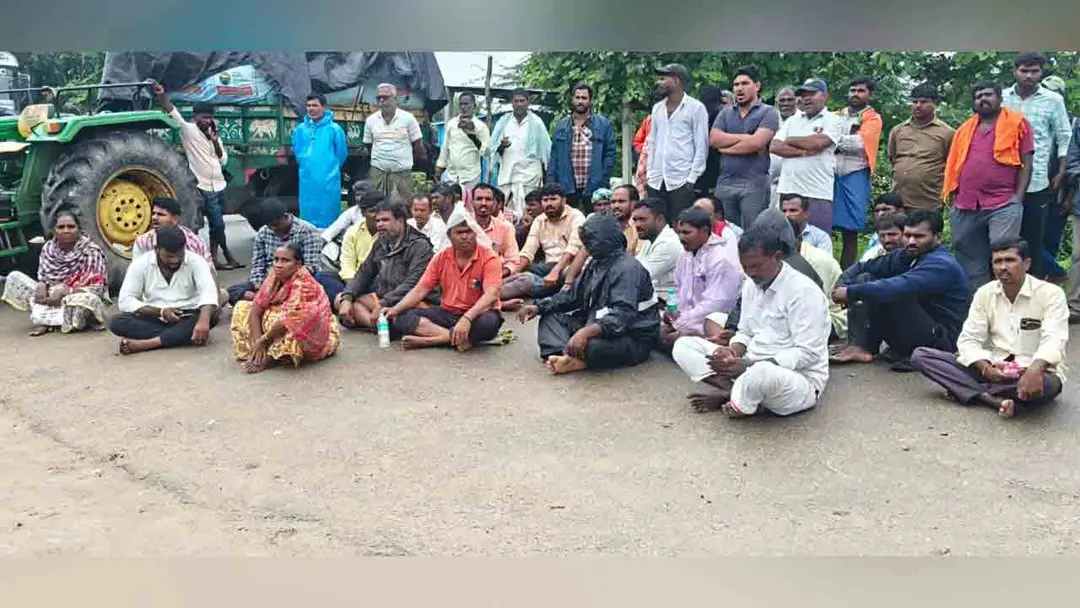
Cotton procurement halted in Ootkur, farmers block road
Officials on Wednesday halted CCI cotton procurement at Vijaya Cotton Industry in Ootkur mandal of Telangana's Narayanpet district, citing continuous rain since Tuesday night. Protesting farmers sat on the main road, stalling RTC buses and private vehicles for about three hours. Farmers demanded withdrawal of the 8-12% moisture norm, saying cotton with higher moisture was being refused. They ended the protest after officials promised to resume purchases after 12 noon.
Source
Narayanpet — crime & civic · read the original report ↗
Desk check · compared with the source
What the desk checked (5)
- Officials halted CCI cotton procurement at Vijaya Cotton Industry in Ootkur mandal on Wednesday, citing continuous rain since Tuesday night. — Attributed in source to officials' announcement; figure and reason appear in source text.
- Farmers blocked the main road, stalling traffic for about three hours, affecting RTC buses and private vehicles towards Narayanpet and Makthal. — Stated in source without independent attribution; duration 'about three hours' appears as reported.
- CCI applied an 8-12% moisture norm and refused cotton above 12% moisture. — Figures appear in source; the refusal claim is attributed to farmers.
- Protest ended after officials promised to resume procurement after 12 noon. — Reported in source; no direct quote or named official for the assurance.
- Makthal CI Ram Lal, Ootkur SI Ramesh, Tahsildar Chinta Ravi and market chairman Sadasiva Reddy reached the spot; BJYM district president M. Bharat and former BJP mandal chief Ramesh joined the protest. — Names appear in source as present; roles as described by the source.
Analysts’ view opinion
This is less a one-day protest story than a clash between quality norms, weather and farmers' cash flow in the cotton market. The CCI's 8–12% moisture rule has a technical logic — high-moisture cotton deteriorates in storage and gins poorly — but during continuous rain its entire burden falls on the grower. For a farmer who booked a time slot and paid for a vehicle and labourers, a sudden halt is not just a delayed sale; the day's cost becomes a straight loss.
- The core economic question is who carries the risk: the moisture norm shields CCI from quality risk, while the farmer absorbs it as transport, labour and return-haul costs.
- Closing the centre without prior notice creates an invisible cost, and the story mentions no mechanism to compensate it.
- Every day CCI purchases stop, the farmer's bargaining power weakens and private traders gain room to buy cheaper — which dilutes the very purpose of support-price procurement.
- Farmers say yields are already down; lower volume plus a weaker price together squeeze rural incomes and the ability to repay crop loans this season.
- The three-hour road blockade imposed costs on RTC buses, private vehicles and commuters — the indirect price a local economy pays for procedural friction.
What to watch — Watch whether the promised post-noon resumption actually held, and whether authorities allow above-12% moisture cotton to be bought with a price deduction instead of outright refusal.
The story covers one day at one procurement centre and does not establish how much cotton was stranded district- or state-wide, how far prices moved, the value of losses, or CCI's official explanation.
Deep dive
Research brief · 8 facts · 5 dates · exam-readyThe brief
Context
The Cotton Corporation of India (CCI) runs Minimum Support Price procurement centres during the cotton marketing season, buying seed cotton (kapas) that meets a prescribed moisture band of 8-12 per cent. In Telangana's Narayanpet district, CCI procurement is being done at the Vijaya Cotton Industry in Ootkur mandal, with farmers required to book advance time slots to bring their produce. On October 29, 2025, officials suspended buying there citing incessant drizzle since the previous night, triggering a road blockade by farmers who said they had already incurred transport and labour costs and that the moisture cap was keeping their damp cotton out of the market.
Key facts
- On Wednesday, October 29, 2025, officials halted CCI cotton procurement at Vijaya Cotton Industry in Ootkur mandal, Narayanpet district, Telangana.
- Officials cited incessant drizzle (musuru) rain continuing since Tuesday night as the reason for suspending purchases.
- Angry farmers sat on the main road; traffic on both sides was stalled for nearly three hours.
- RTC buses and private vehicles headed towards Narayanpet and Makthal were left queued up, stranding passengers.
- CCI is procuring cotton with a moisture norm of 8 to 12 per cent; farmers said cotton above 12 per cent moisture is being refused.
- Farmers said they had registered advance time slots as per government rules and were given no prior information about the halt, asking who would bear vehicle and labour costs.
- Makthal CI Ram Lal and Ootkur SI Ramesh reached the industry with forces; Ootkur Tahsildar Chinta Ravi and Narayanpet market chairman Sadasiva Reddy held talks with CCI officials.
- The protest was withdrawn after officials promised to start purchases after 12 noon; BJYM district president M. Bharath and former BJP mandal president Ramesh supported the dharna.
Timeline
- Tuesday night (October 28, 2025) onwardsContinuous drizzle-type rain begins in the Ootkur area.
- Wednesday morning, October 29, 2025Officials announce suspension of CCI cotton purchases at Vijaya Cotton Industry citing the rain.
- Same morningFarmers block the main road; vehicles including RTC buses stall for about three hours.
- During the protestPolice (Makthal CI, Ootkur SI), Tahsildar and the Narayanpet market chairman reach the spot and negotiate with CCI officials.
- After 12 noon assuranceFarmers call off the agitation on the promise that procurement will resume after noon.
Who has a stake
- Cotton farmers of Ootkur mandal — Reduced yields due to weather plus refusal of high-moisture cotton; they bear transport and labour costs when procurement stops without notice.
- Cotton Corporation of India (CCI) — Must enforce the 8-12% moisture norm and quality standards while running MSP purchases at the Vijaya Cotton Industry centre.
- District revenue and market officials — Ootkur Tahsildar Chinta Ravi and Narayanpet market chairman Sadasiva Reddy mediated between protesting farmers and CCI officials.
- Police — Makthal CI Ram Lal and Ootkur SI Ramesh deployed forces for precautionary measures at the procurement centre.
- Commuters and TGSRTC/private transport — Buses and private vehicles to Narayanpet and Makthal were held up for about three hours, causing hardship to passengers.
- BJP/BJYM local leaders — Extended political support to the farmers' dharna, with BJYM district president M. Bharath participating.
Why it matters
Moisture norms decide whether a farmer gets the assured MSP or must sell in the open market, so an unannounced halt in procurement during rains directly transfers weather risk onto the grower. The episode also shows the operational gap between time-slot-based procurement systems and ground realities, where a day's closure means wasted transport hire and wage payments for small farmers.
UPSC angle
Prelims pointers
- Cotton Corporation of India (CCI) undertakes MSP-based cotton procurement; centre here was at Vijaya Cotton Industry, Ootkur mandal.
- Moisture norm applied by CCI in this case: 8 to 12 per cent for cotton.
- Ootkur mandal lies in Narayanpet district, Telangana; nearby towns cited are Narayanpet and Makthal.
- Farmers must register an advance time slot under government rules to sell at the procurement centre.
- Protest on October 29, 2025 blocked the main road for about three hours, stalling RTC buses.
Mains framing
The Ootkur protest illustrates how procurement design, not just price support, determines whether MSP reaches the farmer. Unseasonal and continuous rain raises the moisture content of harvested cotton above the 8-12 per cent band that CCI enforces for quality and storage reasons, so produce that is physically available becomes ineligible for purchase; when procurement is additionally suspended without prior intimation, farmers who have booked time slots and hired vehicles and labour absorb sunk costs on top of already reduced yields. The immediate friction was resolved administratively, with the Tahsildar, market committee chairman and police mediating and CCI agreeing to resume buying after noon, but the underlying demands, withdrawal or relaxation of the moisture cap and advance notice of closures, remain policy questions. A grounded way forward suggested by the facts of this case lies in timely communication with slot-registered farmers, covered drying and storage space at centres so damp cotton can be brought within norms rather than turned away, and calibrated handling of weather-affected produce; the source does not state any such measures having been announced.
Key terms
- CCI (Cotton Corporation of India)
- Central agency that procures cotton from farmers, here running the purchase centre at Vijaya Cotton Industry, Ootkur.
- Moisture norm (8-12%)
- Permissible moisture range for cotton accepted at the CCI centre; produce above 12 per cent was being refused, farmers said.
- Time slot registration
- Government-mandated advance booking by farmers of a date and time to bring cotton to the procurement centre.
- Dharna
- Sit-in protest; here farmers sat on the main road for about three hours demanding resumption of purchases.
- Tahsildar
- Mandal-level revenue officer; Ootkur Tahsildar Chinta Ravi mediated with CCI officials during the protest.
- RTC buses
- State road transport corporation buses, which were among vehicles stalled on the Narayanpet-Makthal route.
Practice questions
- Moisture and quality specifications in public procurement are meant to protect storage and price integrity, but can exclude weather-hit farmers. Discuss with reference to the CCI cotton procurement dispute in Narayanpet district.
- How do operational features of MSP procurement, such as time-slot registration, centre closures and quality norms, affect the effective realisation of support prices by small farmers? Suggest remedies.
- Examine the role of district-level functionaries (Tahsildar, market committee, police) in defusing agrarian protests, using the October 2025 Ootkur cotton procurement episode as a case study.
Grounded only in the source report — figures and dates are the source's, not inferred.