
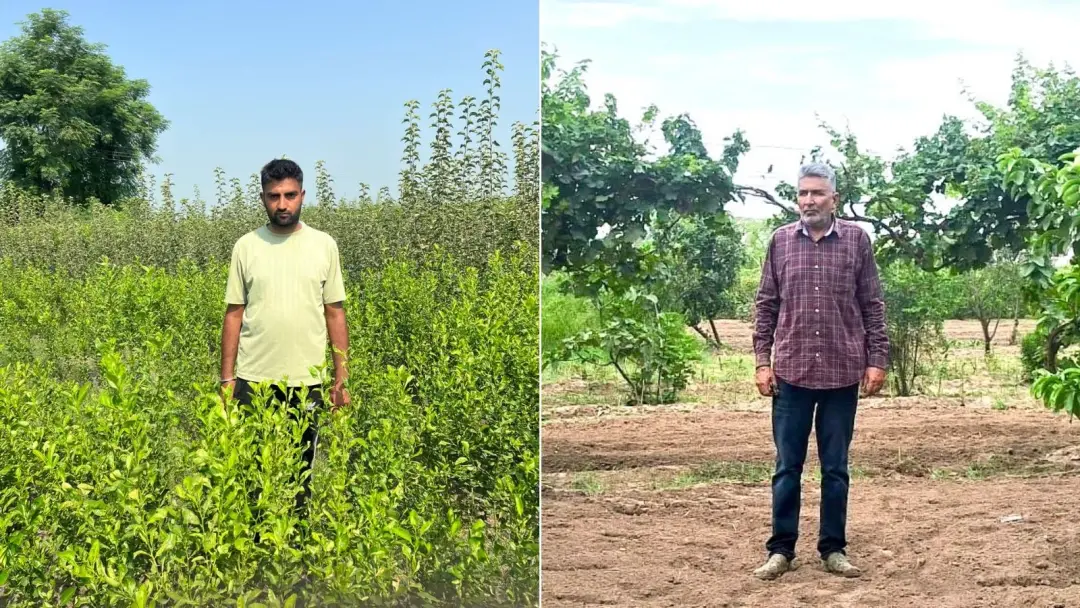
Punjab farmers promote 'gharelu bagichi' home orchard model
Marginal farmer and nursery grower Gurpreet Singh, 35, of Gholia Khurd village in Punjab's Moga district is promoting 'gharelu bagichi', a planned home fruit orchard model, with guidance from his mentor Jagdev Singh, 62, of Pohir village in Ludhiana. Varieties with staggered maturity periods provide fruit through the year. The two have helped set up hundreds of such orchards. Gurpreet estimates nursery farming yields Rs 3-5 lakh per acre per cycle against Rs 90,000-1 lakh annually from wheat-paddy.
Source
Indian Express — Cities · read the original report ↗
Desk check · compared with the source
What the desk checked (5)
- Nursery farming can generate Rs 3-5 lakh per acre in one cycle, with at least three cycles possible in a year. — Attributed in source to Gurpreet Singh as his own estimate; no independent data given.
- Annual profit from wheat-paddy cultivation is around Rs 90,000 to Rs 1 lakh per acre. — Presented as Gurpreet Singh's estimate in the source; unverified externally.
- Jagdev Singh has been developing the orchard model since 2005, starting on one kanal. — Attributed to Jagdev Singh in the source; figure appears in source.
- Gurpreet expanded his holding to about two acres and runs a 2.5-acre nursery, reducing leased land to about 15 acres in 2022. — Figures appear in the source, sourced to the farmer's account.
- Recommendations draw on Punjab Agricultural University and the Horticulture Department. — Attributed to Jagdev Singh; no direct comment from either institution in the source.
Analysts’ view opinion
With returns from Punjab's wheat-paddy cycle settled at an estimated Rs 90,000-Rs 1 lakh per acre a year, the nursery-based 'gharelu bagichi' model reads as a high-value, high-labour alternative. Gurpreet Singh estimates Rs 3-5 lakh per acre per cycle from nursery cultivation, with up to three cycles a year — a large gap, but one that demands daily supervision, grafting skill and the ability to sell. In other words, the extra income comes less from the land itself and more from labour, know-how and quality planting material.
- The model is attractive to small and marginal farmers because it can start on one kanal (an eighth of an acre), keeping the capital barrier low.
- Higher nursery income is labour-intensive income: watering, grafting, grading and disease management need daily attention, so it is not a like-for-like swap for mechanised, assured-procurement grain crops.
- At the household level, fruit grown at home cuts spending on bought fruit — not income, but a real saving, with promoters also arguing a nutrition benefit.
- Unlike wheat and paddy, fruit plants carry no procurement or support-price cushion, so demand and price risk sits entirely with the grower.
- Hundreds of orchards established is meaningful but still individual-initiative scale; state-level diversification impact would need far bigger planting-material supply, training and market linkage.
What to watch — Watch whether such nursery-and-orchard models stay confined to a few enterprising growers or whether supply, training and marketing systems emerge to turn them into broad-based farm income diversification.
The income figures in the story are Gurpreet Singh's own estimates and are not independently verified, and the story does not set out investment costs, risks or how many farmers have actually realised such returns.
Deep dive
Research brief · 8 facts · 4 dates · exam-readyThe brief
Context
'Gharelu bagichi' (domestic fruit orchard) is a planned home-orchard model being promoted in Punjab as an alternative to the dominant wheat-paddy cycle. It is driven by Gurpreet Singh, 35, a marginal farmer and nursery grower of Gholia Khurd village in Moga district, mentored by Jagdev Singh, 62, an engineer by profession from Pohir village in Ludhiana. Unlike planting a few random trees, the model matches rootstocks, grafted plants, land size and direction, tree growth patterns and the maturity periods of varieties so that one fruit follows another round the year. The pair have helped establish hundreds of such orchards in Punjab and elsewhere, combining household nutrition with a nursery-based income stream.
Key facts
- Gurpreet Singh, 35, of Gholia Khurd village, Moga district, runs the nursery model; mentor Jagdev Singh, 62, of Pohir village, Ludhiana, provides consultancy.
- Jagdev Singh has been developing the concept since 2005, beginning with one kanal at his home and observing fruiting behaviour for three to four years before recommending varieties.
- Gurpreet estimates nursery farming can earn Rs 3-5 lakh per acre in one cycle, with at least three cycles possible from an acre in a year.
- He estimates annual profit from wheat-paddy cultivation at only about Rs 90,000 to Rs 1 lakh per acre.
- Gurpreet started farming with his father at age 12-13 on leased land; his holding was initially five kanals, now around two acres plus a 2.5-acre nursery.
- He once cultivated 25-30 acres of leased land but cut it to around 15 acres in 2022 as the nursery demanded more time; he grows basmati, potato, mustard and summer moong there.
- The fruit calendar runs from March with ber, mulberry and loquat, then peach, plum, Satluj Purple, Kala Amritsari, apple, anjeer, phalsa, grapes, chikoo, and mangoes (Dussehri, Langra, Chausa, Amrapali, Ram Kela) into October.
- A gharelu bagichi can be set up on one kanal (one-eighth of an acre); urban households can adapt it to small spaces or pots.
Timeline
- 2005Jagdev Singh begins developing the gharelu bagichi concept, starting with one kanal at his home in Pohir village.
- Around 2014-15Gurpreet Singh begins learning nursery production, rootstock preparation and grafting from Jagdev Singh.
- Past five yearsGurpreet raises rootstock from seed using hardy indigenous or locally adapted material and grafts improved varieties onto it.
- 2022Gurpreet reduces leased land from 25-30 acres to around 15 acres as the nursery demands more of his time.
Who has a stake
- Gurpreet Singh, marginal farmer and nursery grower — Income diversification; expanded holding from five kanals to about two acres and built a 2.5-acre nursery from nursery earnings.
- Jagdev Singh, engineer and mentor — Provides consultancy on what, where and how to plant and stagger fruiting; seeks to address malnutrition and chemical-laced food.
- Marginal and small farmers in Punjab — A low-land-requirement option (one kanal upwards) to diversify beyond the wheat-paddy cycle.
- Urban households — Can adopt parts of the model in smaller spaces or containers for household fruit supply.
- Punjab Agricultural University and the Horticulture Department — Their information feeds Jagdev's variety recommendations alongside his own field observations.
Why it matters
Punjab's wheat-paddy monoculture offers thin margins, and this model shows a measurable alternative: Rs 3-5 lakh per acre per nursery cycle against Rs 90,000-1 lakh a year from wheat-paddy. It links farm income diversification with household nutrition, since staggered-maturity fruit varieties supply fresh fruit for several months at home. Because an orchard can start on just one kanal, it is accessible to marginal farmers and even urban households with pots.
UPSC angle
Prelims pointers
- Gharelu bagichi: planned domestic fruit orchard model promoted in Punjab's Moga and Ludhiana districts.
- One kanal equals one-eighth of an acre, the minimum area cited for a gharelu bagichi.
- Rootstock and grafting: nursery techniques central to the model; Gurpreet maintains his own mother plants.
- Fruit sequence begins in March (ber, mulberry, loquat) and extends to mango varieties into October.
- Punjab Agricultural University and the Horticulture Department are cited sources for variety recommendations.
- Soil-borne issues flagged in the source: fungal diseases and root-knot nematodes.
Mains framing
Punjab's entrenched wheat-paddy cycle delivers modest per-acre profit (about Rs 90,000-1 lakh annually by the farmer's own estimate) while leaving households dependent on purchased, often chemical-laced, food. The gharelu bagichi model offers a two-pronged response: a planned orchard that sequences varieties by maturity period so fruit is harvested successively from March to October, ensuring 'fruit security' for the family, and a nursery enterprise producing rootstocks and grafted plants that can yield Rs 3-5 lakh per acre per cycle with up to three cycles a year. Its strengths are low land requirement (from one kanal), adaptability to urban containers, and reliance on hardy indigenous or locally adapted rootstock. Its constraints are equally clear from the source: nursery farming needs continuous daily supervision of watering, grafting, grading, disease management and marketing; seedling cycles range from about 20 to 60 days; and soil-borne threats such as fungal diseases and root-knot nematodes require management skill. The way forward implied is extension and mentorship at scale, drawing on Punjab Agricultural University and the Horticulture Department, so that knowledge-intensive horticulture becomes a replicable diversification route rather than the achievement of a few individual innovators.
Key terms
- Gharelu bagichi
- Domestic fruit orchard planned around land size, direction, tree growth patterns and staggered fruit maturity so fruit is available through the year.
- Rootstock
- The root portion, here raised from seed using hardy indigenous or locally adapted material, onto which improved varieties are grafted.
- Grafting
- Joining an improved variety onto a suitable rootstock to produce planting material; done at Gurpreet's nursery.
- Kanal
- Land measure equal to one-eighth of an acre; the minimum size cited for a home orchard.
- Mother plants
- Plants maintained as the source of propagation material; weak or diseased material is removed.
- Root-knot nematodes
- Soil-borne pests affecting plant roots, cited as one of the problems the nursery must manage.
Practice questions
- Examine how knowledge-intensive horticulture models such as Punjab's 'gharelu bagichi' can address both farm income diversification and household nutrition.
- Crop diversification in Punjab has been discussed for decades but adoption remains limited. Discuss the enabling factors and constraints highlighted by nursery-based horticulture enterprises.
- 'Plan the land first, then select the plants.' Critically assess the role of farmer-innovators and mentorship networks, alongside institutions like agricultural universities, in agricultural extension.
Grounded only in the source report — figures and dates are the source's, not inferred.