
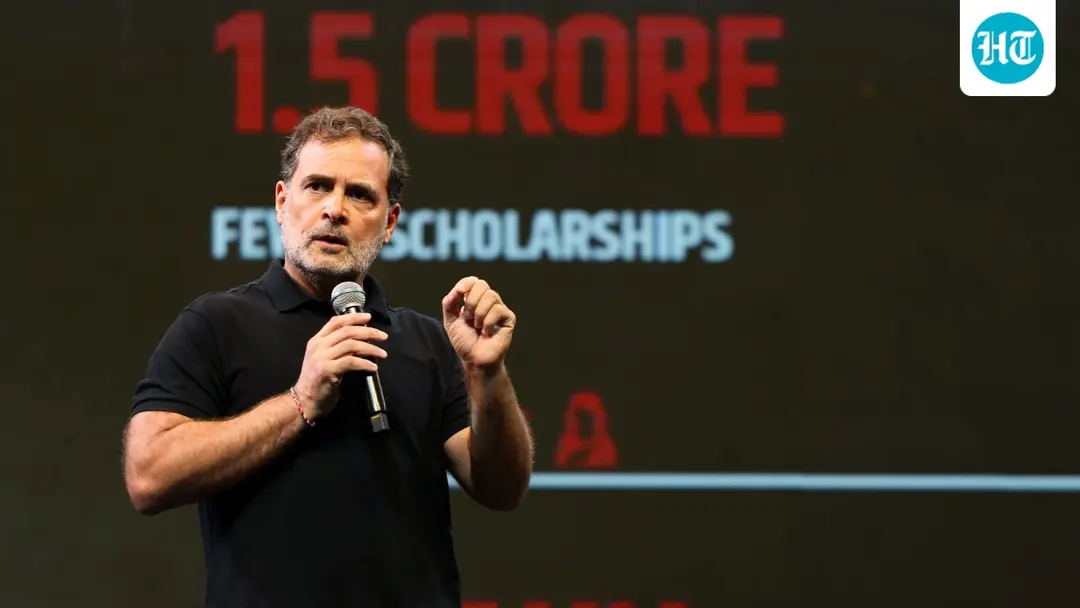
Rahul Gandhi targets education system in Indore; CM Yadav responds
At the 'Chhatron Ki Goonj' programme in Indore on Saturday, Lok Sabha opposition leader Rahul Gandhi alleged the "system" feared students who ask questions and promoted "andhbhakts". He cited paper leaks, recruitment irregularities and privatisation of education, and said education's share in the Union Budget fell from 4.6% in 2014 to 2.6%, with 10 lakh teacher posts vacant. Madhya Pradesh Chief Minister Mohan Yadav called it "Jhoot ki Goonj", saying Gandhi spoke without facts.
Source
Hindustan Times — India · read the original report ↗
Desk check · some claims need care
What the desk checked (5)
- The 'system' is afraid of students who ask questions and promotes 'andhbhakts'. — Opinion attributed to Rahul Gandhi at the 'Chhatron Ki Goonj' event in Indore.
- Education's share in the Union Budget fell from 4.6% in 2014 to 2.6%. — Figure appears in source as Gandhi's claim; no independent data or document cited.
- ₹7.7 lakh crore meant for education went to billionaires like Adani and Ambani; 1.5 crore scholarships snatched in 10 years; 10 lakh teacher posts vacant. — Unverified allegations attributed to Gandhi; no supporting source given.
- CM Mohan Yadav called the event 'Jhoot ki Goonj' and said Gandhi spoke without preparation or facts. — Direct quote attributed to the Madhya Pradesh chief minister.
- Students raised recruitment delays, exam irregularities, hostel shortages and withheld appointments amid OBC quota litigation. — Reported in source as student submissions at the event; specifics unattributed to named individuals.
Analysts’ view opinion
Rahul Gandhi's choice of venue is not incidental — in a state where the Congress machine is weak, the aim is to bypass the organisation and connect directly with students and jobless youth. Paper leaks, recruitment delays and vacant teaching posts are grievances that land with young voters regardless of party loyalty, and framing them as "system versus students" is an attempt to put the government in the dock. Chief Minister Mohan Yadav's response — dismissing it as "Jhoot ki Goonj" — is the safer counter-play: shift the argument to the credibility of the event rather than fight it out on the numbers.
- In a state where the Congress is organisationally thin, issue-based outreach is a way to reach young voters without needing strong local machinery.
- The references to Adani and Ambani and the charges against the judiciary and Election Commission continue Rahul's existing campaign narrative rather than opening a new political line.
- The OBC quota litigation and withheld appointments raised by students themselves touch a socially sensitive spot for the BJP in Madhya Pradesh.
- The fact that the chief minister himself responded suggests the BJP did not judge the event safe to ignore.
- By calling Gandhi unprepared, the BJP is choosing to reinforce an existing perception of him rather than contest his education figures point by point.
What to watch — Watch whether 'Chhatron Ki Goonj' expands to other states and hardens into a student mobilisation, or remains a series of standalone rallies — and whether the BJP eventually offers a detailed rebuttal on the budget numbers.
The budget share, scholarship and teacher vacancy figures cited by Gandhi are not independently verified here, and the story offers no evidence that the event shifted voter sentiment.
Deep dive
Research brief · 8 facts · 4 dates · exam-readyThe brief
Context
Congress MP and Leader of the Opposition in the Lok Sabha Rahul Gandhi held a 'Chhatron Ki Goonj' (Echo of Students) programme in Indore, Madhya Pradesh, on Saturday, themed "system versus students". He used the platform to allege that institutions across politics, business, judiciary, bureaucracy, education, media, entertainment and sports had been "captured", and that the education system was being deliberately weakened. Madhya Pradesh Chief Minister Mohan Yadav rejected the charges, renaming the event "Jhoot ki Goonj" and accusing Gandhi of speaking without facts or preparation. The exchange places student grievances — paper leaks, recruitment delays, hostels and OBC quota litigation — at the centre of a political contest in poll-relevant Madhya Pradesh.
Key facts
- Rahul Gandhi addressed the 'Chhatron Ki Goonj' programme in Indore on Saturday; the theme of the Indore edition was 'system versus students'.
- Gandhi alleged the share of education in the Union Budget fell from 4.6% in 2014 to 2.6% today.
- He claimed ₹7.7 lakh crore that should have gone to education instead went 'into the hands of billionaires like Adani and Ambani'.
- Gandhi said 1.5 crore scholarships had been 'snatched away' in the last 10 years.
- He said 10 lakh teacher posts lie vacant across the country.
- Gandhi alleged the 'system' does not want students but 'andhbhakts (blind followers)' who never ask questions.
- He alleged politics, business, judiciary, bureaucracy, education, media, entertainment and sports had been 'captured'.
- MP Chief Minister Mohan Yadav called the event 'Jhoot ki Goonj', saying Gandhi came 'without any preparation' and was spreading confusion.
Timeline
- 2014Gandhi's reference point: education accounted for 4.6% of the Union Budget when the Congress was in power.
- Last 10 yearsGandhi alleges 1.5 crore scholarships were withdrawn and education's budget share fell to 2.6%.
- Saturday (date not stated in the source)'Chhatron Ki Goonj' programme held in Indore; Gandhi addresses students on 'system versus students'.
- Same dayCM Mohan Yadav responds, terming the event 'Jhoot ki Goonj' and demanding facts and data.
Who has a stake
- Rahul Gandhi (Congress MP, LoP in Lok Sabha) — Building a student-centred opposition narrative on paper leaks, recruitment and privatisation of education.
- Mohan Yadav (Madhya Pradesh Chief Minister) — Defending the state and Union record on education; countering the charge as factually baseless.
- Students of Madhya Pradesh — Raised recruitment delays, examination irregularities, inadequate hostels and withheld appointments amid OBC quota litigation.
- Aspirants and teachers — Gandhi's claim of 10 lakh vacant teacher posts and 1.5 crore scholarships lost directly concerns jobs and support.
- Institutions named as 'captured' (judiciary, Election Commission, bureaucracy, media) — Their credibility and independence are at issue in Gandhi's allegations.
- Corporate groups named (Adani, Ambani) — Named in the allegation that funds meant for education benefited billionaires.
Why it matters
Education funding, teacher vacancies, exam integrity and OBC quota litigation are live grievances for lakhs of students and aspirants, and this event turns them into a direct political contest in Madhya Pradesh. The clash also reflects a wider argument about whether public institutions are functioning independently, with the opposition alleging 'capture' and the state government calling the charges unsubstantiated.
UPSC angle
Prelims pointers
- 'Chhatron Ki Goonj' — Congress outreach programme for students; Indore edition theme was 'system versus students'.
- Rahul Gandhi is a Congress MP and Leader of the Opposition in the Lok Sabha.
- Mohan Yadav is the Chief Minister of Madhya Pradesh; he termed the event 'Jhoot ki Goonj'.
- Claim cited: education's share of Union Budget down from 4.6% (2014) to 2.6%.
- Claims cited: 10 lakh vacant teacher posts; 1.5 crore scholarships withdrawn in 10 years; ₹7.7 lakh crore diverted.
- Student issues raised: paper leaks, recruitment delays, hostels, appointments withheld amid OBC quota legal proceedings.
Mains framing
The Indore exchange frames education as a governance and political accountability question rather than merely a sectoral one. Rahul Gandhi's charges — declining budgetary share (4.6% to 2.6%), 10 lakh vacant teacher posts, 1.5 crore scholarships lost, recurring paper leaks and privatisation — locate student distress in a broader claim that politics, business, judiciary, bureaucracy, media and sports have been 'captured', with the 'system' preferring 'andhbhakts' to questioning students. The counter-argument, articulated by CM Mohan Yadav, is that such sweeping claims are made without facts, data or preparation and serve a political agenda. The grievances voiced by students themselves in Madhya Pradesh — recruitment delays, examination irregularities, inadequate hostels and appointments withheld during OBC quota litigation — are concrete and administrative, and suggest the way forward lies in verifiable transparency: timely recruitment calendars, secure examination systems, published data on vacancies and scholarship disbursal, faster resolution of quota litigation and hostel capacity audits. The episode underlines that contested figures should be settled by official data rather than rhetoric, since credibility of both government claims and opposition allegations turns on evidence.
Key terms
- Chhatron Ki Goonj
- Congress-organised student outreach programme; its Indore edition was themed 'system versus students'.
- Jhoot ki Goonj
- Phrase used by CM Mohan Yadav to mock the event, implying it echoed falsehoods rather than student concerns.
- Andhbhakt
- Literally 'blind follower'; used by Gandhi for those who accept the system without asking questions.
- Leader of the Opposition (Lok Sabha)
- Head of the largest opposition party in the Lok Sabha; the post held by Rahul Gandhi.
- OBC quota proceedings
- Legal cases over Other Backward Classes reservation in Madhya Pradesh, cited as delaying government appointments.
- Paper leak
- Leakage of examination question papers before the exam, cited as a core grievance of aspirants.
Practice questions
- Critically examine the claim that declining budgetary allocation to education undermines equality of opportunity. Support your answer with the issues raised by students in Madhya Pradesh.
- Recurring paper leaks and recruitment delays have eroded trust in public examinations. Suggest institutional reforms to restore credibility.
- Allegations of 'institutional capture' are increasingly part of political discourse in India. How should constitutional bodies respond to sustain public confidence?
Grounded only in the source report — figures and dates are the source's, not inferred.