
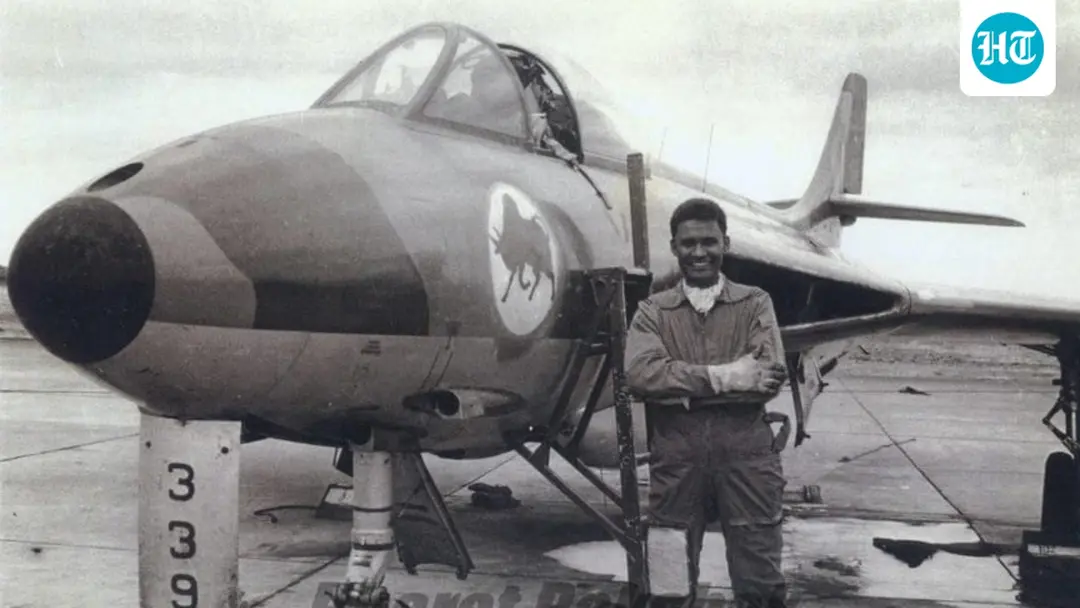
1965 war hero Alfred Tyrone Cooke dies at 87 in New Delhi
Vir Chakra awardee Flight Lieutenant Alfred Tyrone Cooke died on Friday at the Base Hospital in New Delhi at the age of 87. He was in the terminal stages of prostate cancer. On September 7, 1965, he turned his Hunter back to defend Kalaikunda, then under attack by six Sabres, and shot down one enemy aircraft, his Vir Chakra citation records. He had flown in from Australia, where he lived since 1969, for a squadron event at Ambala.
Source
Hindustan Times — India · read the original report ↗
Desk check · compared with the source
What the desk checked (5)
- Flt Lt Alfred Tyrone Cooke died on Friday at the Base Hospital, New Delhi, aged 87, in the terminal stages of prostate cancer. — Stated in source; circumstances partly attributed to La Martiniere bursar Adrian Michael.
- On September 7, 1965, Cooke flew his Hunter back to defend Kalaikunda, which was under attack by six Sabres, and shot down one enemy aircraft. — Attributed to the Vir Chakra citation quoted in the source.
- The downed pilot was PAF Flight Lieutenant Afzal Khan, whose Sabre fell on a hut near IIT Kharagpur, killing two people on the ground. — Attributed to historians PVS Jagan Mohan and Samir Chopra; Cooke's identification given in his 2015 HT account.
- Gun camera film showed he fired on four Sabres and hit three; a second Sabre loss remains disputed between Indian and Pakistani accounts. — Attributed to Jagan Mohan and Chopra; source itself notes the dispute.
- Cooke was commissioned on December 19, 1961, served with No. 14 Squadron and left in December 1968, living in Australia from 1969. — Dates appear in source; no separate documentary attribution given.
Analysts’ view opinion
Alfred Tyrone Cooke's death is first a story of military memory, but in the diamond-jubilee climate around the 1965 war it will almost certainly carry political resonance too. An Anglo-Indian Vir Chakra recipient who left uniform after seven years, settled in Australia from 1969, and still flew back for his old squadron's event while in the terminal stages of cancer is a powerful narrative of service that sits above community, region and faith. Tributes of this kind are usually claimed across the political spectrum; the difference lies only in emphasis — martial patriotism, or recognition of minority communities' contribution to the armed forces.
- Arriving amid 1965 anniversary commemorations, the death gives the government another natural occasion for military-heritage messaging.
- His Anglo-Indian middle-class background makes him an obvious reference point for arguments about smaller communities' service in the armed forces.
- The IAF's own description of the dogfight as a "masterclass" anchors institutional honour before any political tribute is offered.
- That he emigrated in 1969 yet stayed bound to his squadron fits the broader political narrative of diaspora attachment to India.
- The story itself notes Indian and Pakistani accounts have long disputed whether a second Sabre was lost — a reminder that such episodes can resurface in cross-border messaging.
What to watch — Watch the tone of tributes from the defence establishment and party leaders around the Ambala squadron event and the college's own commemoration.
The story establishes no political reaction, government commemoration decision or official ceremony — the political read here is inference, not reported fact.
Deep dive
Research brief · 8 facts · 10 dates · exam-readyThe brief
Context
Flight Lieutenant Alfred Tyrone Cooke, a Vir Chakra awardee of the 1965 India-Pakistan war, died on Friday at the Base Hospital in New Delhi at the age of 87, in the terminal stages of prostate cancer. On September 7, 1965, flying a Hawker Hunter of No. 14 Squadron, he turned back mid-sortie to defend his own airfield at Kalaikunda in Bengal, which was under attack by Pakistan Air Force Sabres, and shot down one enemy aircraft. He had been living in Australia since 1969 and had flown to India for an event his old squadron was holding at Ambala the day after he died.
Key facts
- Flt Lt Alfred Tyrone Cooke died on Friday at the Base Hospital, New Delhi, aged 87, in the terminal stages of prostate cancer.
- At about 10.30am on September 7, 1965, he was at 20,000 feet over Bengal on his third sortie of the day when told Kalaikunda was under attack.
- His Vir Chakra citation records Kalaikunda was under attack by six Sabres and that he 'shot down one of the enemy aircraft which disintegrated in midair'.
- The pilot he shot down was Flight Lieutenant Afzal Khan of the Pakistan Air Force, who was killed.
- Historians PVS Jagan Mohan and Samir Chopra record that Khan's Sabre came down on a hut near the IIT Kharagpur campus, killing two people on the ground.
- His gun camera film, examined that evening, showed he had fired on four different Sabres and hit three, per Jagan Mohan and Chopra.
- His wingman, Flying Officer SC Mamgain, was also awarded the Vir Chakra for the same action.
- Cooke was commissioned into the IAF on December 19, 1961, flew Hawker Hunters with No. 14 Squadron at Kalaikunda, and left in December 1968 after seven years in uniform.
Timeline
- 1950 to 1958Cooke is a resident scholar of Lyons House at La Martiniere College, Lucknow.
- December 19, 1961Commissioned into the Indian Air Force; flies Hawker Hunters with No. 14 Squadron at Kalaikunda.
- September 7, 1965, about 10.30amOn his third sortie, he turns back to defend Kalaikunda against six Sabres, shoots down one, and chases others with empty guns.
- Same day, after the combatLands at Dum Dum with a damaged wingtip and almost no fuel; engine cuts before parking and a ground crew member catches him as he jumps.
- December 1968Leaves the Indian Air Force after seven years in uniform.
- 1969Moves to Australia, where he lived thereafter.
- September 9, 2015Fifty years after the battle, he comes to Ambala, gives his Vir Chakra to No. 14 Squadron to keep, and speaks to HT.
- 2015La Martiniere College, Lucknow honours Cooke and other alumni who fought in the 1965 war.
- Founder's Day this yearHis brother Dr Bryan Cooke is chief guest at La Martiniere College, Lucknow.
- FridayCooke dies at Base Hospital, New Delhi, a day before his old squadron's event at Ambala.
Who has a stake
- Flt Lt Alfred Tyrone Cooke — Vir Chakra awardee of the 1965 war whose Kalaikunda dogfight became part of IAF combat lore; died at 87.
- Indian Air Force — Said his 'legendary dogfight over Kalaikunda remains a masterclass in aggressive air combat and unwavering resolve' and would inspire generations of air warriors.
- No. 14 Squadron, Ambala — Cooke's old squadron, custodian of his Vir Chakra since 2015; was holding the event he had flown in for.
- Flying Officer SC Mamgain — Cooke's wingman in the September 7, 1965 action; awarded the Vir Chakra for the same engagement.
- La Martiniere College, Lucknow — Cooke's school; honoured him in 2015 and lowered its flag to half-mast on his death; his brother taught there.
- Dr Bryan Cooke — Brother who flew in from the US to be with him; was the college's Founder's Day chief guest this year.
- Pakistan Air Force — Lost Flt Lt Afzal Khan in the engagement; Indian and Pakistani accounts still dispute whether a second Sabre was lost.
Why it matters
Cooke's death removes one of the last living voices of the 1965 air war, an action the IAF itself holds up as a teaching example of aggressive air combat. His story also records the human cost on both sides, including two civilians killed when the downed Sabre fell near IIT Kharagpur, and the fact that combat claims from 1965 remain contested between Indian and Pakistani accounts.
UPSC angle
Prelims pointers
- Vir Chakra is India's third-highest wartime gallantry award.
- Flt Lt A T Cooke flew Hawker Hunters with No. 14 Squadron based at Kalaikunda, West Bengal.
- The attacking aircraft on September 7, 1965 were six Pakistan Air Force Sabres.
- Cooke was commissioned into the IAF on December 19, 1961 and left service in December 1968.
- Flying Officer SC Mamgain, Cooke's wingman, also received the Vir Chakra for the same 1965 action.
- PVS Jagan Mohan and Samir Chopra are authors of a history of the 1965 air war.
Mains framing
The Kalaikunda action of September 7, 1965 illustrates how outcomes in air warfare turn on individual decision-making under severe constraints: Cooke was at 20,000 feet on his third sortie with marginal fuel when told his own base was being struck, chose to turn back, led the interception through his own side's anti-aircraft fire, destroyed one Sabre, and continued to press two more and then a fourth after his guns were empty, before landing at Dum Dum with a damaged wingtip and a dead engine. His citation and the later gun-camera assessment show why institutional memory matters: the IAF frames the episode as a 'masterclass in aggressive air combat', while historians note the dispute between Indian and Pakistani accounts over a second kill, a reminder that wartime claims require corroboration. The engagement also carried civilian costs, with the downed Sabre falling on a hut near IIT Kharagpur and killing two people, underlining that air defence of forward bases takes place over populated territory. The way forward lies in preserving such first-person testimony through squadron and institutional archives, oral history projects, and veteran outreach while those who fought are still available, and in using verified combat records rather than contested claims for professional military education.
Key terms
- Vir Chakra
- India's third-highest wartime gallantry award; Cooke received it for the September 7, 1965 Kalaikunda combat.
- Hawker Hunter
- The fighter aircraft Cooke flew with No. 14 Squadron at Kalaikunda during the 1965 war.
- Sabre
- The Pakistan Air Force fighter type that attacked Kalaikunda on September 7, 1965; six took part.
- Kalaikunda
- IAF airfield in Bengal that was Cooke's own base and the target of the Pakistani air attack he turned back to defend.
- Sortie
- A single operational flight by a military aircraft; Cooke was on his third of the day when Kalaikunda was attacked.
- Gun camera film
- Combat footage from an aircraft's guns, examined that evening, which showed Cooke fired on four Sabres and hit three.
Practice questions
- Examine how the Kalaikunda air action of September 7, 1965 is remembered in Indian Air Force doctrine, and why contested combat claims complicate war histories.
- Discuss the role of individual initiative and gallantry awards such as the Vir Chakra in shaping the institutional ethos of the armed forces.
- Air operations over populated territory carry civilian risk, as the 1965 Kalaikunda engagement showed. Discuss with reference to the protection of civilians during hostilities.
Grounded only in the source report — figures and dates are the source's, not inferred.