
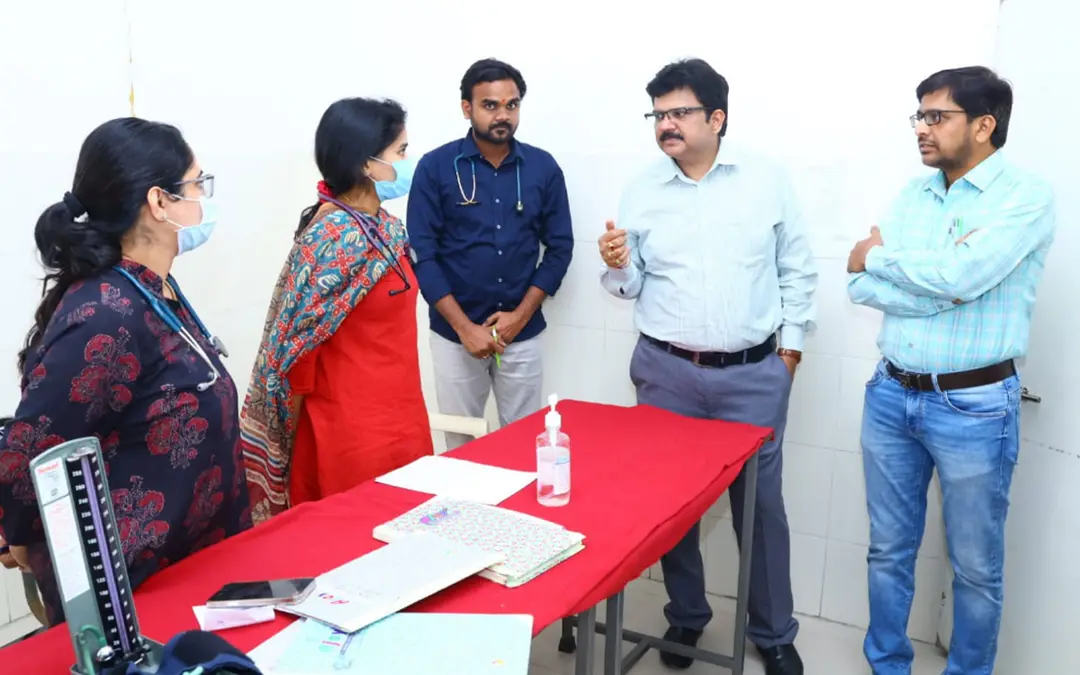
Collector issues show cause notices to 82 district hospital staff
District Collector Hanumantha Rao has issued show cause notices to 82 staff of the Yadadri Bhuvanagiri district government hospital. Action was taken against 19 employees absent from duty without permission and 63 who did not follow timings. He made a surprise inspection of the hospital on Thursday, examining it for three hours. He expressed displeasure at the contractor over incomplete works and at sanitation staff over poor sanitation, spoke to four emergency ward patients and said quality must not be compromised.
Source
Yadadri Bhuvanagiri — వార్తలు · read the original report ↗
Desk check · compared with the source
What the desk checked (4)
- Show cause notices issued to 82 government hospital staff — 19 absent without permission and 63 not following timings. — Figures appear in the source headline and body and add up; attributed to District Collector Hanumantha Rao.
- The collector conducted a surprise inspection of the Yadadri Bhuvanagiri district government hospital on Thursday for three hours. — Stated in the source; day given as Thursday with story dated December 18, 2025, no further detail.
- The collector expressed displeasure at the contractor over incomplete development works and at sanitation staff over poor sanitation. — Reported in the source without direct quotes or contractor's name.
- He spoke to patients, including four in the emergency ward and recently delivered mothers, about services and vaccination. — Source description of the inspection; no independent corroboration available.
Analysts’ view opinion
This is less a one-hospital discipline story and more a fresh illustration of an old governance model: enforcing accountability in public health through surprise inspection rather than standing systems. Show-cause notices to 82 staff suggest the attendance and punctuality problem is structural, not individual; the collector's displeasure over an unfinished contract and poor sanitation signals the gap runs well beyond the muster roll. But a show-cause notice only opens a process — the outcome depends entirely on what follows it.
- That 63 of the 82 were cited for punctuality rather than absence points to routine supervision failing day to day, not a handful of errant employees.
- The intended beneficiaries are the poorer, largely rural patients who depend on the district hospital — reflected in the collector speaking directly to emergency-ward patients and recently delivered mothers.
- The real implementation test is how many notices convert into actual action, and whether vacancies or staff shortages are part of the cause — punitive action without that answer can itself hit service delivery.
- Compared with systemic fixes such as biometric attendance and continuous monitoring, surprise inspections deliver quick visibility but rarely durable change; in administration, conditions sliding back after an inspection is a familiar pattern.
- Unfinished works and sanitation lapses are not staff-discipline problems at root — they point to weaknesses in contract management and ongoing oversight.
What to watch — Watch how many of the 82 face action once replies are received, whether a deadline is fixed for the hospital building, and whether a follow-up inspection happens — that will separate reform from a one-off warning.
The story does not establish why staff were absent, how many sanctioned posts lie vacant, what the staff or the contractor say in their defence, so it cannot settle where the fault actually lies.
Deep dive
Research brief · 8 facts · 4 dates · exam-readyThe brief
Context
District Collectors in Telangana periodically conduct surprise inspections of government health facilities to check staff attendance, sanitation and the pace of construction works. On Thursday, December 18, 2025, Yadadri Bhuvanagiri District Collector Hanumantha Rao made such an unannounced visit to the district government hospital and spent three hours going through every ward. Following the inspection, show cause notices were issued to 82 hospital staff for absence from duty and for not observing duty timings. He also pulled up the contractor for incomplete development works and sanitation staff for poor hygiene.
Key facts
- Show cause notices were issued to 82 staff of the Yadadri Bhuvanagiri district government hospital by District Collector Hanumantha Rao.
- Of the 82, notices went to 19 staff absent from duty without permission and 63 who did not observe duty timings.
- The surprise inspection took place on Thursday and lasted three hours, covering every ward of the hospital.
- The Collector reviewed the functioning of SNCU, paediatric, post-delivery and delivery sections.
- He spoke to four patients undergoing treatment in the emergency ward and asked whether medical staff were reporting on time.
- He interacted with patients in male and female inpatient wards and enquired about the daily food served to patients.
- He spoke to women who had recently delivered, asking about services received and immunisation of infants.
- He directed officials to speedily complete the hospital building under construction and said quality must not be compromised, warning that lapses would invite action.
Timeline
- Thursday (report dated December 18, 2025)Collector Hanumantha Rao makes a surprise three-hour inspection of the Yadadri Bhuvanagiri district government hospital.
- During the inspectionHe inspects all wards, SNCU, paediatric, delivery and post-delivery sections, and speaks to inpatients and four emergency ward patients.
- During the inspectionHe expresses displeasure at the contractor over incomplete development works and at sanitation staff over poor sanitation.
- After the inspectionShow cause notices issued to 82 staff — 19 for unauthorised absence and 63 for not following timings.
Who has a stake
- District Collector Hanumantha Rao — As district administrative head, accountable for health service delivery; initiated disciplinary action and ordered timely completion of works.
- 82 hospital staff issued notices — Face disciplinary proceedings for unauthorised absence (19) and for not observing duty timings (63).
- Patients and inpatients of the district hospital — Depend on doctor availability during OP hours, ward hygiene, food quality and emergency care.
- Recently delivered mothers and newborns — Services in delivery, post-delivery, SNCU and paediatric units and infant immunisation were under review.
- Contractor executing hospital works — Pulled up for incomplete development works; directed to finish the hospital building quickly without compromising quality.
- Sanitation staff — Drew the Collector's displeasure for inadequate sanitation in the hospital.
Why it matters
Government district hospitals are the main referral point for poor and rural patients, and staff absenteeism directly translates into denied care in emergency, delivery and newborn units. The action against 82 staff and the rebuke to the contractor and sanitation workers show how administrative monitoring, rather than new funds alone, drives accountability in public health delivery.
UPSC angle
Prelims pointers
- Yadadri Bhuvanagiri is a district in Telangana; its district government hospital was inspected on December 18, 2025.
- Show cause notice: a written demand that an employee explain alleged misconduct before disciplinary action.
- 82 staff issued notices — 19 for unauthorised absence, 63 for not observing duty timings.
- SNCU (Special Newborn Care Unit) was among the sections inspected, along with paediatric, delivery and post-delivery units.
- The Collector spoke to four emergency ward patients and reviewed doctor availability during OP hours.
- District Collector is the administrative head of a district and supervises health facility functioning.
Mains framing
The Yadadri Bhuvanagiri episode illustrates a familiar weakness in India's public health system: infrastructure and posts exist on paper, but service delivery falters on staff presence, punctuality, sanitation and delayed construction. Here a single three-hour surprise inspection surfaced 19 cases of unauthorised absence and 63 of poor time discipline, alongside incomplete hospital works and inadequate sanitation — problems that fall hardest on emergency patients, pregnant women and newborns using SNCU, delivery and paediatric units. The causes are structural as much as individual: weak supervisory oversight, absence of routine attendance monitoring, contractor delays in capital works and limited grievance redress for patients, who in this case could only voice complaints when the Collector personally asked them. Implications include erosion of trust in government hospitals and avoidable out-of-pocket shifts to private care. A way forward consistent with what the source shows would be institutionalising periodic inspections rather than one-off visits, linking contractor payments to time-bound completion with quality checks, strengthening sanitation supervision, and following through on show cause notices so that warnings of action translate into consequence.
Key terms
- Show cause notice
- A formal notice asking an employee to explain alleged misconduct before disciplinary action is finalised.
- SNCU
- Special Newborn Care Unit — hospital facility for sick and low-birth-weight newborns; its functioning was reviewed.
- OP hours
- Outpatient hours, when doctors are expected to be available to examine walk-in patients.
- District Collector
- Senior civil servant heading district administration, here exercising oversight of the district government hospital.
- Surprise inspection
- An unannounced visit to a facility to verify actual attendance, hygiene and service quality.
Practice questions
- Staff absenteeism, not lack of buildings, is the binding constraint on India's district hospitals. Critically examine with reference to recent administrative action in Telangana.
- What role do District Collectors play in ensuring public health service delivery? Discuss with examples of surprise inspections and disciplinary mechanisms such as show cause notices.
- Suggest institutional reforms to ensure accountability in government hospitals for staff punctuality, sanitation and timely completion of construction works.
Grounded only in the source report — figures and dates are the source's, not inferred.