
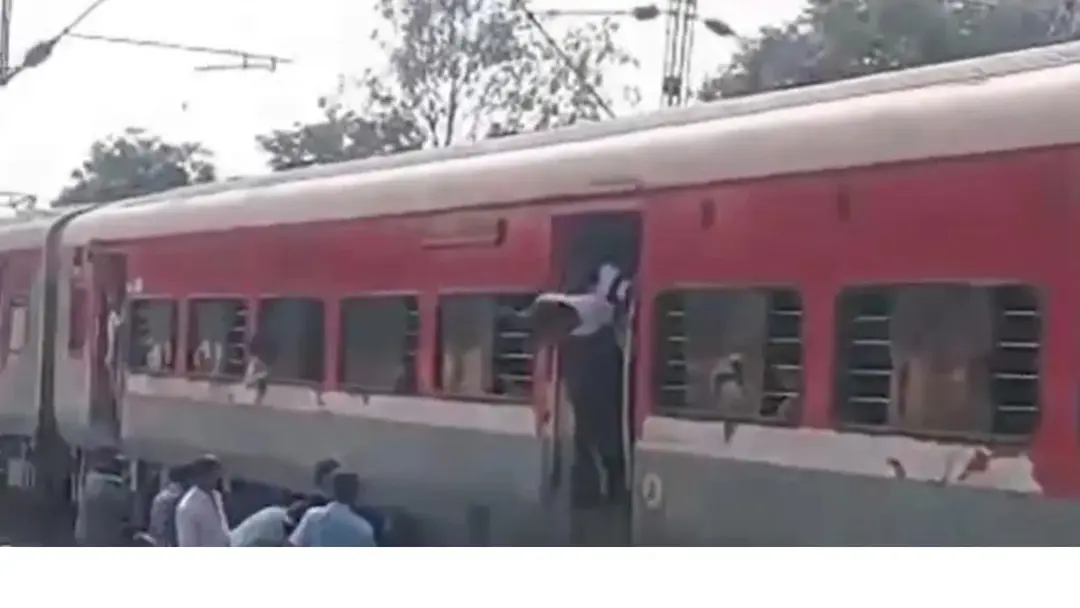
Smoke from train near Bibinagar alarms passengers
Passengers were alarmed after smoke was seen coming from a train near Bibinagar in Telangana's Yadadri Bhuvanagiri district. The train was running from Secunderabad to Sirpur-Kagaznagar, and the fire was found to have spread after brake liners jammed. The co-pilot noticed the smoke and raised an alert, following which the driver stopped the train immediately. The blaze was brought under control with the help of a fire engine. A major accident was averted. Railway officials are investigating the cause.
Source
Yadadri Bhuvanagiri — వార్తలు · read the original report ↗
Desk check · compared with the source
What the desk checked (5)
- Smoke was seen coming from a train near Bibinagar in Yadadri Bhuvanagiri district. — Appears in source; no named official attribution given.
- The train was running from Secunderabad to Sirpur-Kagaznagar. — Stated in source text; route not attributed to a named railway source.
- Fire was found to have spread after brake liners jammed. — Presented in source as a finding; no source named for the determination.
- The co-pilot spotted the smoke and alerted, the driver halted the train and the fire was controlled with a fire engine. — Sequence described in source without attribution to an identified official.
- Railway officials are investigating the cause. — Attributed in source generically to the railway department; no individual named.
Analysts’ view opinion
As reported, the Bibinagar incident reads as a technical failure rather than a political flashpoint — no injuries, and the train was halted because staff acted in time. But rail safety sits squarely in the Union government's domain, so repeated episodes of this kind give state-level opposition leaders an easy stick to use against the Centre. For now the political beneficiaries are the co-pilot and driver whose alertness lets the railway administration frame the story as "the system worked".
- With no loss of life reported, the episode has limited escalation potential and the damage-control narrative is likely to dominate.
- Because railways are a Union subject, accountability on safety rests primarily with the central government.
- Highlighting staff alertness allows officialdom to push a "safety protocols functioned" line.
- If the inquiry points to maintenance lapses, it could open the familiar opposition line of questioning on upkeep, funding and staffing.
- Local representatives often fold such incidents into longstanding demands on regional rail infrastructure.
What to watch — Whether the railway department's inquiry lands on a routine technical fault or a maintenance failure will decide if this stays a local news item or becomes a political talking point.
The story does not establish the cause, where responsibility lies, or any reaction from political leaders or parties — the inquiry is still under way.
Deep dive
Research brief · 8 facts · 5 dates · exam-readyThe brief
Context
Smoke was spotted coming from a train near Bibinagar in Telangana's Yadadri Bhuvanagiri district, causing panic among passengers. The train was running from Secunderabad to Sirpur-Kagaznagar when flames were found to have spread after brake liners jammed. Bibinagar lies on the Secunderabad rail corridor in the South Central Railway network. Railway officials are investigating the cause of the incident.
Key facts
- Smoke was seen coming from a train near Bibinagar in Yadadri Bhuvanagiri district, Telangana, alarming passengers.
- The affected train was running from Secunderabad to Sirpur-Kagaznagar.
- Officials found that flames had spread after the train's brake liners jammed (brake binding).
- The co-pilot of the train first noticed the smoke and raised an alert.
- The driver stopped the train immediately after the alert was raised.
- The blaze was brought under control with the help of a fire engine.
- A major accident was averted and passengers were relieved; no casualties are stated in the source.
- Railway department officials are investigating the causes of the incident.
Timeline
- Not dated in the sourceTrain departs Secunderabad bound for Sirpur-Kagaznagar.
- Near Bibinagar, Yadadri Bhuvanagiri districtSmoke seen emerging from the train; passengers panic.
- Immediately afterCo-pilot notices the smoke and alerts the driver, who halts the train.
- SubsequentlyFire engine deployed; flames brought under control, major accident averted.
- OngoingRailway officials investigate the cause of the fire.
Who has a stake
- Passengers on the Secunderabad-Sirpur-Kagaznagar train — Their safety; they were alarmed by the smoke and were relieved after a major accident was averted.
- Train driver and co-pilot (loco crew) — Front-line responsibility for detecting the smoke and stopping the train, which prevented escalation.
- Railway department officials — Conducting the investigation into the cause and accountability for rolling-stock maintenance.
- Fire services — Deployed a fire engine that helped bring the blaze under control.
- Yadadri Bhuvanagiri district administration and Bibinagar locality — Local emergency response and safety on a busy rail stretch passing through the district.
Why it matters
A jammed brake liner escalating into flames on a running passenger train shows how a routine mechanical fault can turn into a potential disaster if not caught in time. The incident highlights the value of alert loco crews, quick halting protocols and rapid fire response in averting casualties, and puts the focus on rolling-stock maintenance checks on busy routes.
UPSC angle
Prelims pointers
- Bibinagar is in Yadadri Bhuvanagiri district, Telangana, on the Secunderabad rail corridor.
- The train involved was running from Secunderabad to Sirpur-Kagaznagar.
- Cause identified on the spot: brake liners jammed, leading to flames and smoke.
- Co-pilot (assistant loco pilot) spotted the smoke; driver stopped the train.
- Fire was controlled with a fire engine; a major accident was averted.
- Railway department officials have taken up an investigation into the cause.
Mains framing
The Bibinagar incident, in which smoke and flames emerged from a Secunderabad-Sirpur-Kagaznagar train after its brake liners jammed, illustrates how mechanical wear in rolling stock can escalate into a fire risk on a moving passenger train. The immediate cause, as found on site, was brake binding; the mitigating factors were human vigilance by the co-pilot, the driver's prompt decision to stop the train, and the timely deployment of a fire engine, which together averted a major accident. The implications run beyond one train: routine components such as brake liners require periodic inspection and maintenance discipline, since the margin between a minor fault and a mass-casualty event is often just a few minutes of crew alertness. The way forward, consistent with what the source supports, lies in the railway department's ongoing investigation establishing the cause and fixing maintenance accountability, alongside strengthening on-board detection, crew reporting and coordination with local fire services on busy corridors. No official findings, casualty figures or policy decisions are stated in the source.
Key terms
- Brake liner
- The friction component of a train's braking system; when it jams or binds it generates intense heat that can cause smoke and fire.
- Co-pilot (assistant loco pilot)
- The second crew member in the locomotive who assists the driver and, in this case, first noticed the smoke and raised the alert.
- Bibinagar
- A location in Telangana's Yadadri Bhuvanagiri district on the rail route out of Secunderabad, where the incident occurred.
- Sirpur-Kagaznagar
- The destination of the affected train, which had started from Secunderabad.
- Yadadri Bhuvanagiri district
- Telangana district in which Bibinagar and the site of the incident fall.
Practice questions
- Discuss how mechanical faults such as brake binding in rolling stock can escalate into fire incidents, and what preventive maintenance and crew-level safeguards can reduce such risks on Indian Railways.
- The Bibinagar episode shows that human vigilance remains central to railway safety even in an era of technological monitoring. Examine with reference to the role of the loco crew in this incident.
- What should an effective post-incident investigation by railway authorities cover when a passenger train catches fire due to a braking system fault?
Grounded only in the source report — figures and dates are the source's, not inferred.