
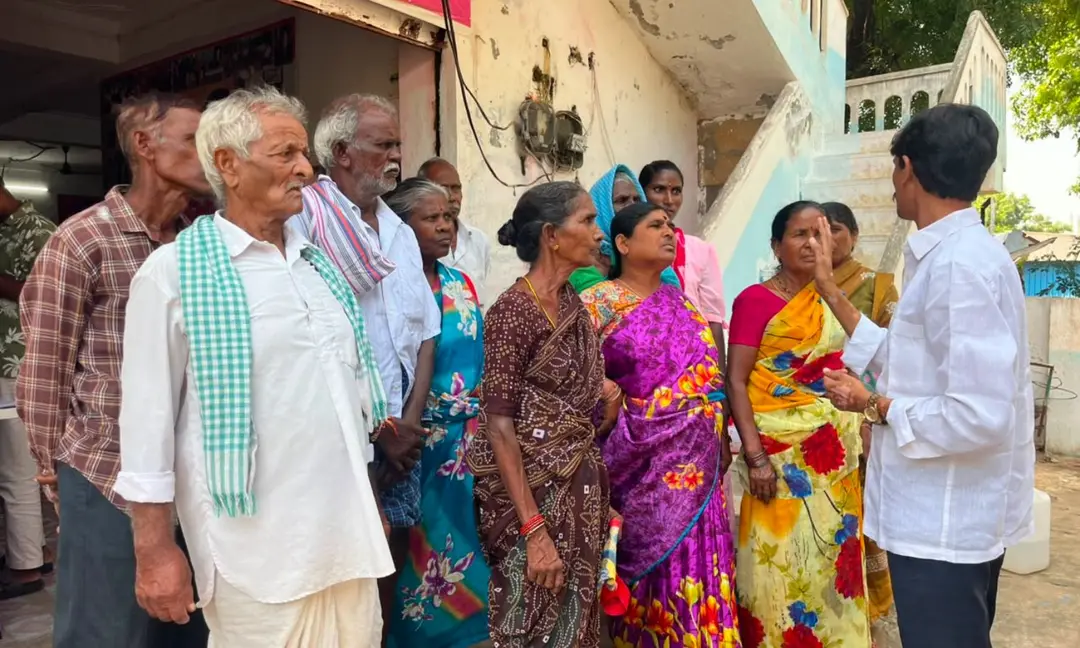
32nd free eye camp concludes in Mulugu district
The 32nd round of a free eye care camp concluded in Mulugu district, BRS Mulugu constituency leader Bhukya Jampanna said. Over the past two and a half years, 32 camps were held across various mandals, with about 4,000 people given free eye surgeries and 17,300 provided medical tests and free medicines on doctors' advice, he said. He added that around 20,000 families received support in health, education, employment and financial aid. The programme draws inspiration from KCR's Kanti Velugu scheme.
Source
Mulugu — వార్తలు · read the original report ↗
Desk check · some claims need care
What the desk checked (5)
- 32 free eye camps held across Mulugu constituency mandals over two and a half years — Attributed to BRS leader Bhukya Jampanna; no independent or official confirmation in source.
- About 4,000 people received free eye surgeries — Figure appears in source as Jampanna's claim; an earlier sentence loosely says 'over 4,000', a minor internal inconsistency.
- 17,300 people given medical tests and free medicines on doctors' advice — Figure stated by Jampanna; no supporting records cited.
- Around 20,000 families helped with health, education, employment and financial aid — Self-reported claim, unattributed to any audit or third party.
- Programme inspired by the Kanti Velugu scheme of former CM KCR — Stated by Jampanna as his motivation; political framing, not independently assessed.
Analysts’ view opinion
This is not a government scheme but a politician-run, party-networked service programme. The numbers cited — 32 camps and roughly 4,000 free surgeries over two and a half years — suggest genuine organisational stamina; they also raise the policy question of whether private patronage is filling a gap that a public eye-health system should be covering. The explicit framing as inspired by the earlier Kanti Velugu programme reads as an attempt to keep a party-identified welfare brand alive outside office.
- The story does not disclose beneficiary selection criteria, eligibility rules or funding sources — a weaker accountability model than a statutory scheme.
- Transporting patients to Hyderabad for surgery points to questions about district-level surgical capacity and post-operative follow-up care.
- State programmes of the Kanti Velugu type aim at universal screening; individually run camps are smaller in reach and their continuity depends on one leader's political standing.
- Sustained constituency presence after being out of office is a familiar pattern of welfare delivery as political continuity — the service may be real, but the incentives are also political.
- The claim of helping 20,000 families across health, education, employment and emergency aid is self-reported and not independently verified in the story.
What to watch — Watch how these camps interface with official eye-care programmes and district hospital surgical capacity — and whether their intensity rises as the next election cycle approaches.
All camp counts, beneficiary figures and cost claims come from the organiser himself; the story neither verifies them independently nor establishes the current status of government eye-care programmes in the district.
Deep dive
Research brief · 8 facts · 3 dates · exam-readyThe brief
Context
In Mulugu district of Telangana, BRS constituency leader Bhukya Jampanna has concluded the 32nd round of a free eye care camp. The camps, run across mandals of the Mulugu Assembly constituency over the past two and a half years, offer free eye screening, medicines and cataract-type eye surgeries, with patients taken to Hyderabad for operations. Jampanna says the initiative is inspired by the Kanti Velugu eye-screening programme launched by former Chief Minister K. Chandrashekar Rao's government for the elderly, women and the poor. The source is based on Jampanna's own statements and beneficiary testimonies.
Key facts
- The 32nd round of the free eye medical camp concluded in Mulugu district, as announced by BRS Mulugu constituency leader Bhukya Jampanna.
- 32 free eye camps have been held across various mandals of Mulugu constituency over the past two and a half years.
- About 4,000 people have been given free eye surgeries through the camps so far.
- Around 17,300 people were given medical tests and free medicines as advised by doctors.
- Roughly 20,000 families were directly supported in healthcare, education, employment and emergency financial aid over two and a half years.
- Beneficiaries said they were taken to Hyderabad for free eye operations and followed up on after surgery, at zero cost to them.
- Jampanna said the programme draws inspiration from the Kanti Velugu programme taken up by former CM KCR in the previous government.
- Jampanna said he would continue these service programmes and question the government on behalf of the people.
Timeline
- Previous government's tenure (year not stated in the source)Then Chief Minister K. Chandrashekar Rao launched the Kanti Velugu programme to prevent vision loss among the elderly, women and the poor.
- Past two and a half yearsBhukya Jampanna runs 32 free eye camps across mandals of Mulugu constituency; about 4,000 surgeries and 17,300 tests.
- Latest round (date not stated in the source)The 32nd free eye medical camp concludes in Mulugu district.
Who has a stake
- Poor and elderly patients in Mulugu constituency — Restored eyesight through free surgery, tests and medicines without any out-of-pocket spending.
- Bhukya Jampanna, BRS Mulugu constituency district leader — Builds political credibility through continuous service work; says politics for him means public service, not office.
- BRS (Bharat Rashtra Samithi) — Keeps its welfare image alive in Mulugu by invoking the legacy of the Kanti Velugu scheme.
- Doctors and hospitals (including in Hyderabad) — Conduct the screenings and surgeries that make the camps possible.
- State government — Jampanna says he will question the government and press for resolution of people's problems.
Why it matters
Avoidable blindness, largely from untreated cataract and refractive error, is concentrated among the elderly and the rural poor, who often cannot reach or afford surgery. A privately organised chain of 32 camps delivering about 4,000 surgeries and 17,300 screenings shows both the scale of unmet need in a tribal-majority district like Mulugu and the limits of relying on individual or political initiative instead of sustained public provision.
UPSC angle
Prelims pointers
- Kanti Velugu: Telangana's mass eye-screening programme launched under then CM K. Chandrashekar Rao for the elderly, women and the poor.
- Mulugu is a district and an Assembly constituency in Telangana; the camps were held across its mandals.
- 32 free eye camps in two and a half years; about 4,000 free eye surgeries.
- 17,300 persons given medical tests and free medicines on doctors' advice.
- About 20,000 families supported in health, education, employment and emergency financial aid.
- BRS stands for Bharat Rashtra Samithi; Bhukya Jampanna is its Mulugu constituency district leader.
Mains framing
The Mulugu eye camps illustrate how avoidable blindness persists in rural and tribal India despite public programmes: distance from tertiary facilities, cost of surgery, lack of post-operative follow-up and low awareness keep the elderly and poor from timely cataract care, so patients had to be transported to Hyderabad for operations. Filling this gap through a politician-led camp model delivers immediate relief, as beneficiary testimonies of restored sight show, and extends to education, employment and emergency financial aid for some 20,000 families, but it also raises questions of continuity, accountability and the blurring of welfare with political patronage, since such effort depends on one individual's resources and intent rather than on institutional guarantee. The source itself locates the inspiration in a state scheme, Kanti Velugu, suggesting the way forward lies in universalising screening-to-surgery pathways: strengthening primary-level vision screening, dedicated referral and transport links to district and tertiary hospitals, assured post-operative follow-up, and convergence with existing public health machinery so that free eye care is an entitlement rather than a camp-dependent favour.
Key terms
- Kanti Velugu
- Telangana eye-care programme cited in the story, taken up by then CM KCR to prevent vision loss among the elderly, women and the poor.
- BRS
- Bharat Rashtra Samithi, the party whose Mulugu constituency district leader, Bhukya Jampanna, organises the camps.
- Mandal
- Administrative sub-district unit in Telangana; the camps were rotated across mandals of Mulugu constituency.
- Free eye camp
- Outreach camp offering vision tests, free medicines on doctors' advice and referral for free eye surgery.
- Beneficiary (labdhidarulu)
- Those who received the free surgery or medicines; in this story they publicly credited Jampanna for restored eyesight.
Practice questions
- Avoidable blindness remains high among India's rural elderly despite state screening programmes. Examine the structural barriers to cataract surgery access and suggest measures to close the screening-to-surgery gap.
- Discuss the merits and risks of welfare delivery through individual or party-led service camps as against institutional public health provision, with reference to the Mulugu eye camps.
- What was the Kanti Velugu programme, and how can mass screening initiatives be made sustainable rather than episodic?
Grounded only in the source report — figures and dates are the source's, not inferred.