
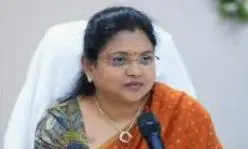
West Godavari circular economy blueprint draws official praise
West Godavari collector C Nagarani presented a Circular Economy Blueprint combining agriculture, industry, renewable energy and rural entrepreneurship at a two-day district collectors' conference in the capital. Chief Minister Chandrababu Naidu was among speakers who appreciated it. The model plans local industries using rice husk, shrimp waste, cattle and poultry waste and cocoa. Nagarani said rice millers at a Bhimavaram meeting agreed to set up nearly 500 units, with investment interest of about Rs 60 crore expressed.
Source
West Godavari — agriculture · read the original report ↗
Desk check · compared with the source
What the desk checked (5)
- West Godavari collector C Nagarani presented a Circular Economy Blueprint at a two-day district collectors' conference held in the capital two days ago. — Attributed to the source report; internally consistent, no independent document cited.
- Chief Minister Chandrababu Naidu was among the speakers who appreciated the model. — Stated in the source without direct quote or official statement reference.
- Rice millers agreed at a recent Bhimavaram meeting to establish nearly 500 'waste to wealth' units, with investment interest of nearly Rs 60 crore. — Figures attributed to the collector; appear in source but represent expressed interest, not confirmed investment.
- Industrial clusters are planned via land pooling in Tanuku, Tadepalligudem and Bhimavaram constituencies. — Attributed to the collector as a planning proposal; no timeline or approval detail given.
- Experts and officials suggest a high-level meeting and statewide guidelines for district-level circular economy plans. — Unnamed experts and officials; no individual sourcing provided.
Analysts’ view opinion
The economic logic of the West Godavari blueprint is straightforward: attach industrial value to low-value by-products the district already generates — rice husk, shrimp waste, cattle and poultry waste, cocoa — and keep the resulting income circulating locally. The numbers in the story are modest rather than transformative: roughly 500 units agreed to by rice millers and about Rs 60 crore of investment interest works out to small average ticket sizes, which marks this as a micro- and small-enterprise programme rather than a big-capital industrial push. Its real payoff is therefore distributional — extra farm income from waste, rural jobs, lower disposal costs for millers — more than headline growth. But the distance between an applauded presentation and functioning units is considerable.
- Who gains: farmers who can now sell residue, small industries sitting close to their raw material, women's self-help groups, farmer collectives and rural youth seeking local employment.
- Who pays: landowners in the land-pooling clusters, the state through infrastructure, clearances and likely incentives, and existing buyers who have been sourcing this waste cheaply or free.
- Creating a market for waste raises its price — good for farmers, but it could raise input costs for current users of husk, bran and animal waste in fuel and feed.
- Decentralised clusters in Tanuku, Tadepalligudem and Bhimavaram should cut haulage and aggregation costs, though they also forgo some of the scale economies and technical depth of a single concentrated industrial zone.
- The "profits stay in the state" argument is appealing, but survival of small units will depend on price stability, access to credit, steady feedstock supply and finding buyers for the output.
What to watch — Watch how quickly the Rs 60 crore of "interest" converts into committed investment and the 500 agreed units into operating ones, and whether the statewide guidelines being discussed actually materialise.
The story does not establish employment numbers, per-unit costs and returns, how many units are commercially viable without subsidy, or how many have actually started — this is an admired plan, not a verified outcome.
Deep dive
Research brief · 8 facts · 3 dates · exam-readyThe brief
Context
West Godavari district collector C Nagarani presented a "Circular Economy Blueprint" at a two-day district collectors' conference in the Andhra Pradesh capital, held two days before the report. The model knits together agriculture, industry, renewable energy and rural entrepreneurship in one framework, using locally available waste — rice husk, shrimp waste, cattle and poultry waste, cocoa and farm residue — as industrial raw material. Chief Minister Chandrababu Naidu was among the speakers who appreciated it, and the presentation has triggered official discussion on a statewide district-level circular economy action plan.
Key facts
- The Circular Economy Blueprint was presented by West Godavari collector C Nagarani at a two-day district collectors' conference held in the state capital two days before the report.
- Chief Minister Chandrababu Naidu was among the speakers who appreciated the model; it drew attention from government secretaries, ministers and collectors of other districts.
- The model is built around locally available resources: rice husk, shrimp waste, cattle and poultry waste, cocoa and agricultural residue.
- At a recent meeting in Bhimavaram, rice millers agreed to establish nearly 500 'waste to wealth' industrial units.
- Investment interest worth nearly Rs 60 crore has already been expressed for these projects, according to Nagarani.
- The district administration plans industrial clusters through land pooling in Tanuku, Tadepalligudem and Bhimavaram constituencies rather than one urban zone.
- Rice husk is being used for power generation, silica production, particle boards and plywood furniture; rice bran is processed into edible oil.
- The stated long-term goal is to transform West Godavari from a purely agriculture-based district into a 'zero-waste industrial hub'.
Timeline
- Recently (date not stated in the source)Meeting held in Bhimavaram where rice millers agreed to set up nearly 500 'waste to wealth' units, with about Rs 60 crore investment interest expressed.
- Two days before the reportTwo-day district collectors' conference in the capital where Nagarani presented the Circular Economy Blueprint; CM Chandrababu Naidu appreciated it.
- After the conferenceOfficials and experts began discussing a statewide action plan and a high-level meeting to frame comprehensive guidelines.
Who has a stake
- West Godavari district administration / collector C Nagarani — Author of the blueprint; aims to convert the district into a zero-waste industrial hub and a national sustainability benchmark.
- Andhra Pradesh government and CM Chandrababu Naidu — Considering whether to scale the district model into a statewide circular economy action plan with guidelines.
- Rice millers of the Bhimavaram region — Agreed to set up nearly 500 waste-to-wealth units; nearly Rs 60 crore investment interest expressed.
- Farmers and farmer collectives — Agricultural waste becomes a saleable industrial input, adding income beyond the food-crop value of paddy.
- Rural youth, small industries and women self-help groups — Expected direct beneficiaries through employment and local enterprise in the waste-based industrial chain.
- Agriculture universities and pollution control board representatives — Proposed participants in a high-level meeting to prepare comprehensive implementation guidelines.
- Landowners in Tanuku, Tadepalligudem and Bhimavaram — Land pooling is planned in these constituencies to create decentralised industrial clusters.
Why it matters
The blueprint argues that using local waste as local raw material keeps investment, production, employment and profits inside the state economy, unlike conventional industry where technology, branding and profits are often controlled by multinationals and wealth flows out. If implemented, officials believe Andhra Pradesh could become a national model in sustainable industrial development. It also reframes paddy as an industrial raw material, not just a food crop, opening new income streams for farmers and rural enterprises.
UPSC angle
Prelims pointers
- Circular Economy Blueprint was presented by West Godavari collector C Nagarani at a two-day district collectors' conference in the AP capital.
- Rice millers at a Bhimavaram meeting agreed to nearly 500 'waste to wealth' units with about Rs 60 crore investment interest.
- Industrial clusters via land pooling are planned in Tanuku, Tadepalligudem and Bhimavaram constituencies.
- Feedstocks named in the model: rice husk, shrimp waste, cattle and poultry waste, cocoa and agricultural residue.
- Rice husk uses cited: power generation, silica production, particle boards, plywood furniture; rice bran yields edible oil.
- Experts propose a high-level meeting of collectors, industrial experts, agriculture universities and pollution control board for guidelines.
Mains framing
The West Godavari Circular Economy Blueprint illustrates how district administration can convert an agrarian resource base into an industrial one by treating waste as raw material. Its causal logic is simple: paddy husk, rice bran, shrimp waste, cattle and poultry waste and cocoa residue are abundant locally, so processing them locally retains investment, production, employment and profit within the regional economy, in contrast to conventional industrialisation where technology, branding and profits are controlled by multinationals and wealth flows out. Implications are distributive as well as environmental: officials expect direct gains for small industries, women self-help groups, farmer collectives and rural youth, while decentralised clusters via land pooling in Tanuku, Tadepalligudem and Bhimavaram avoid concentrating industry in a single urban zone. The commitments so far are intentions rather than outcomes — nearly 500 units agreed by rice millers and about Rs 60 crore of investment interest — so delivery will depend on financing, technology and environmental compliance. The way forward suggested in official circles is a statewide action plan built through a high-level meeting of collectors, industrial experts, agriculture universities and pollution control board representatives to frame comprehensive guidelines, so that the district experiment becomes a replicable model rather than an isolated success.
Key terms
- Circular economy
- An economic approach where waste from one activity becomes input for another, keeping resources, employment and profits circulating within the same regional economy.
- Waste to Wealth
- Converting agricultural, livestock and aquaculture waste into marketable industrial products; experts call the West Godavari version 'local resources to local prosperity'.
- Zero-waste industrial hub
- Nagarani's stated long-term goal for West Godavari — a district where every form of waste is turned into an economic resource.
- Land pooling
- Aggregating land parcels to create industrial clusters; planned in Tanuku, Tadepalligudem and Bhimavaram for decentralised industrial development.
- Rice husk and rice bran
- Paddy by-products; husk used for power generation, silica, particle boards and plywood furniture, bran processed into edible oil.
- District collectors' conference
- Two-day state-level meeting of collectors, secretaries and ministers in the AP capital where the blueprint was presented.
Practice questions
- Examine how a district-level circular economy model based on agricultural and aquaculture waste can retain value within a regional economy. Illustrate with the West Godavari blueprint.
- Decentralised industrial clusters created through land pooling are presented as an alternative to concentrating industry in urban zones. Discuss the advantages and challenges of this approach.
- 'Paddy is an industrial raw material, not only a food crop.' Critically analyse this shift in perspective for farm incomes and rural employment.
Grounded only in the source report — figures and dates are the source's, not inferred.