
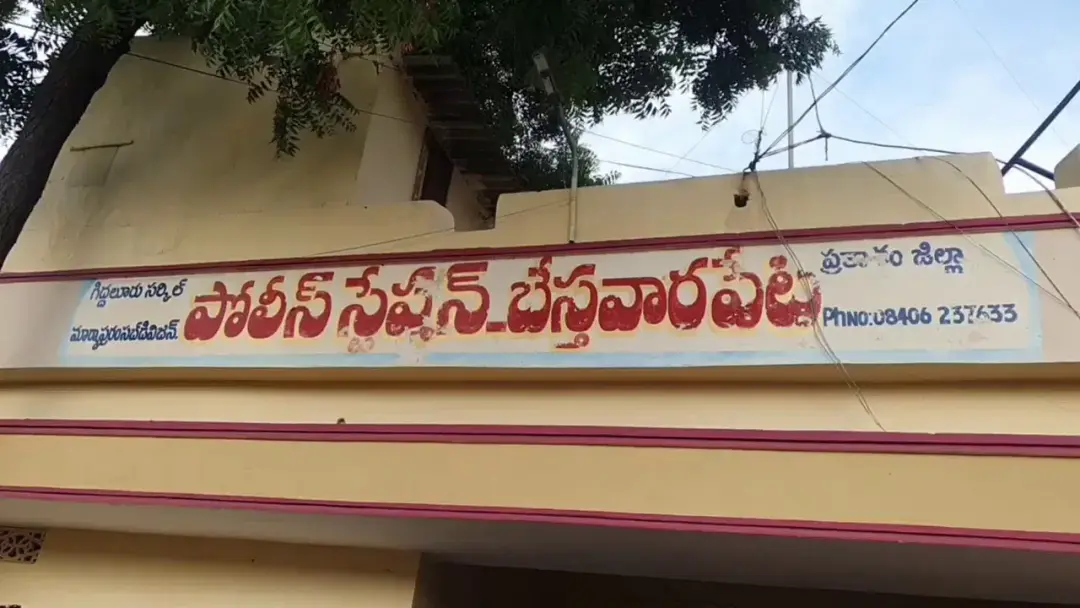
Man arrested for cheating Rs 50,000 posing as Bestavaripeta SI
Police in Bestavaripeta, Prakasam district, arrested a man who cheated a State Bank of India service point owner of Rs 50,000 by posing as the local sub-inspector. The caller said he urgently needed money for his daughter's college fee and sent a QR code on WhatsApp. When the phone went switched off, the victim complained. SI Madhava Rao formed two teams and caught Rajendra Naik of Palnadu district. CI Rajesh Kumar said four other cases are pending against him.
Source
Prakasam — నేరాలు · read the original report ↗
Desk check · compared with the source
What the desk checked (4)
- A caller posing as Bestavaripeta SI got the SBI service point owner to transfer Rs 50,000 via a QR code sent on WhatsApp. — Described in source as the complainant's account; figure appears in source, no document cited.
- The accused is Rajendra Naik of Palnadu district, taken into custody by two police teams. — Attributed to police action reported in source; identification credited to investigating officers.
- The accused has a prior criminal record and four other cases against him. — Attributed to CI Rajesh Kumar in the source.
- The accused obtained service point phone numbers from the internet to target owners. — Attributed to CI Rajesh Kumar; method not independently documented in source.
Analysts’ view opinion
This is more than an ordinary cheating case: posing as a named police sub-inspector to induce a payment combines deception with impersonation of a public servant, and the use of WhatsApp and a QR code adds an electronic-transaction layer. The CI's statement that four other cases already exist against the accused makes antecedents a live factor at the investigation, remand and bail stages. But what has happened so far is an arrest, not a finding of guilt — the allegations still have to survive court scrutiny.
- Impersonating a government officer to extract money is legally distinct from plain cheating and can attract additional charges, though the story does not specify the sections invoked.
- Because the transfer ran through WhatsApp and a QR code, the digital trail — call records, the phone number, the payment path — becomes central evidence, and the prosecution must gather and authenticate it lawfully.
- Procedurally, the next steps are production before a magistrate within 24 hours, remand, and eventually the filing of a charge sheet.
- If the other cases arise in different districts, questions of multiple jurisdictions, transfer or clubbing of trials could follow.
- From the complainant's side, recovering money lost in a digital payment fraud is a process separate from the criminal prosecution, and the story does not say whether the amount was recovered.
What to watch — Watch how the four other cases are linked to this one, how the accused's antecedents are argued at the bail stage, and whether the Rs 50,000 is traced or recovered.
The story rests on an arrest and police statements — the exact charges, the court process, the accused's defence and any recovery are not established, and an arrest is not a conviction.
Deep dive
Research brief · 8 facts · 6 dates · exam-readyThe brief
Context
In Bestavaripeta town of Andhra Pradesh's Prakasam district, a caller phoned the owner of a State Bank of India service point claiming to be the local sub-inspector (SI) and asked for Rs 50,000 urgently, saying he had to pay his daughter's college fee and had no money in his account. He sent a QR code over WhatsApp and promised his men would return the cash shortly. When nobody came and the number went switched off, the victim realised he had been cheated and complained at Bestavaripeta police station. Police traced and arrested Rajendra Naik of Palnadu district, who had a prior record of similar impersonation frauds.
Key facts
- The victim, owner of a State Bank of India service point in Bestavaripeta town, Prakasam district, was cheated of Rs 50,000.
- The caller claimed to be the Bestavaripeta SI and said he urgently needed money for his daughter's college fee as his account had no funds.
- The fraudster sent a QR code via WhatsApp and the victim transferred Rs 50,000 to his phone-pay account.
- The promise was that the SI's men would come shortly and return the cash; nobody came and the caller's number was later found switched off.
- Bestavaripeta SI Madhava Rao formed two teams to search for the accused after his own name was misused.
- The accused was identified as Rajendra Naik, a resident of Palnadu district, and was sent to jail.
- CI Rajesh Kumar said the accused had a prior criminal history of posing as an SI and speaking persuasively to cheat people.
- CI Rajesh Kumar said four other cases are pending against Rajendra Naik.
Timeline
- Step 1The SBI service point owner in Bestavaripeta receives a call from a man claiming to be the local sub-inspector, asking for Rs 50,000 for his daughter's college fee.
- Step 2The caller sends a QR code on WhatsApp; the owner, believing him, transfers Rs 50,000.
- Step 3No one arrives to return the cash; the victim calls back and finds the number switched off.
- Step 4The victim files a complaint at Bestavaripeta police station.
- Step 5SI Madhava Rao forms two teams, searches, and takes the accused into custody.
- Step 6Accused identified as Rajendra Naik of Palnadu district and sent to jail; CI Rajesh Kumar reveals four other pending cases.
Who has a stake
- SBI service point owner, Bestavaripeta — Lost Rs 50,000 to the impersonation fraud; complainant in the case.
- Bestavaripeta SI Madhava Rao — His official identity was misused; led the two search teams that caught the accused.
- CI Rajesh Kumar — Disclosed the accused's modus operandi and criminal record; issued a public caution against trusting unknown callers.
- Rajendra Naik (accused), Palnadu district — Arrested and jailed; faces four other pending cases.
- Mee Seva and other service point operators — Targeted group whose phone numbers are available online, making them vulnerable to such calls.
- Bestavaripeta police station / Prakasam district police — Investigating agency; credibility at stake when police designations are impersonated.
Why it matters
Impersonating a police officer converts public trust in the uniform into a tool of fraud, and a single WhatsApp QR code is enough to move Rs 50,000 in minutes. Small digital-payment intermediaries such as bank service points and Mee Seva centres are especially exposed because their phone numbers are publicly listed online. The case shows both the ease of such scams and the need for basic verification before any urgent money transfer.
UPSC angle
Prelims pointers
- Bestavaripeta is a town in Prakasam district, Andhra Pradesh; the accused, Rajendra Naik, is from Palnadu district.
- Amount cheated: Rs 50,000, transferred after a QR code was sent on WhatsApp.
- Bestavaripeta SI Madhava Rao formed two teams to trace the accused; CI Rajesh Kumar briefed on the case.
- Four other cases are pending against the accused, who has a prior record of posing as an SI.
- Modus operandi: collecting Mee Seva and service point numbers from the internet and posing as a known person.
- Victim was a State Bank of India service point owner — a banking correspondent-type outlet.
Mains framing
Police-impersonation frauds riding on instant digital payments illustrate how social engineering, not technical hacking, drives much of India's everyday cyber-enabled crime. The Bestavaripeta case shows the full chain: publicly available phone numbers of Mee Seva and bank service points scraped from the internet, a claim of police authority to suppress questioning, an emotive urgency (a daughter's college fee), and a WhatsApp QR code that completes an irreversible transfer of Rs 50,000. The implications are twofold — erosion of trust in public office when a designation like sub-inspector can be borrowed by a fraudster with four pending cases, and financial vulnerability of small last-mile payment intermediaries who operate with thin margins and little fraud-training. The response in this case was traditional and effective: a complaint at the local station, two search teams and an arrest. A durable way forward, as the CI himself advised, rests on verification discipline — confirming the identity of any caller before transferring money — combined with awareness outreach to service point operators, tracking repeat offenders with multiple pending cases, and caution in publishing operator contact details online.
Key terms
- SI (Sub-Inspector)
- Officer in charge of or posted at a police station; the designation the fraudster impersonated in this case.
- CI (Circle Inspector)
- Police officer supervising a circle of stations; here CI Rajesh Kumar briefed on the accused's record and methods.
- SBI service point
- A local outlet offering basic State Bank of India banking services; its owner was the victim here.
- Mee Seva
- Telugu-states citizen service centres for government services, whose phone numbers the accused collected online to target operators.
- QR code payment
- A scannable code that routes money to a payee's account; used here on WhatsApp to receive the Rs 50,000.
- Impersonation fraud
- Cheating by falsely posing as another person or official to win trust and extract money.
Practice questions
- Social engineering, not technical sophistication, drives most digital payment frauds in India. Discuss with reference to police-impersonation cases and suggest safeguards for last-mile service providers.
- How does impersonation of police officials affect public trust in state institutions? Suggest measures for verification of official identity in phone-based interactions.
- Examine the vulnerabilities created when contact details of citizen service centres and banking service points are freely available online, and how repeat offenders exploit them.
Grounded only in the source report — figures and dates are the source's, not inferred.