
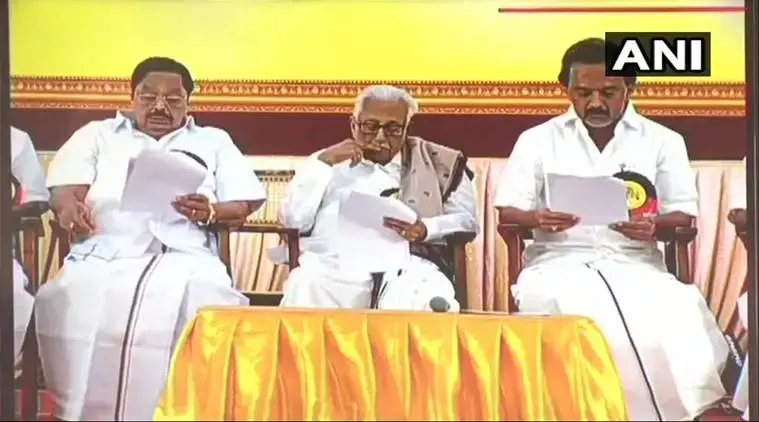
DMK executive council meets in Chennai, pays tribute to Karunanidhi
Amid a power tussle between DMK working president MK Stalin and his brother MK Alagiri, the party's executive council met in Chennai on Tuesday. Leaders said it was convened to condole Karunanidhi's death, though there is speculation that a general council was decided on to endorse Stalin as party chief. Stalin criticised the AIADMK government over the denied Marina burial. Alagiri said loyalists back him and that he is not in the party.
Source
Party live streams (coverage) · read the original report ↗
Desk check · some claims need care
What the desk checked (5)
- DMK's executive council met in Chennai on Tuesday to condole M Karunanidhi's death — Attributed to party leaders in the source; meeting reported as underway.
- A decision may have been taken to convene the general council to elevate Stalin as party chief — Presented in the source as speculation, not confirmed by any named official.
- Stalin said he pleaded with the Chief Minister for a Marina Beach burial for Karunanidhi but the government refused — Direct quote attributed to Stalin in the source.
- Alagiri said loyal party workers support him and that he is not part of the DMK — Direct quotes attributed to Alagiri, made to reporters on Monday.
- Stalin will never readmit Alagiri or his son Dayanidhi Alagiri — Attributed only to an unnamed source close to Stalin.
Analysts’ view opinion
Billed as a condolence meeting for M Karunanidhi, this DMK executive council gathering looks in practice like a step towards closing the succession question. Stalin, already working president, appears to have the party machinery and the executive with him, while Alagiri — expelled back in 2014 — is left leaning on the politics of personal "loyalists" without an organisational platform. Stalin's attack on the AIADMK establishment over the Marina burial also works as a unifier, shifting attention from a family feud to an external adversary.
- The condolence framing gives the leadership political cover while speculation swirls that a general council will be convened to formally elevate Stalin as party chief.
- Alagiri's absence and his flat "I am not part of the party" underline that whatever strength he has is personal and regional, not institutional.
- The claim that a Marina burial was denied positions Stalin as the defender of Karunanidhi's dignity and casts the AIADMK government as the antagonist — emotionally potent political ground.
- The unattributed line from a source close to Stalin that Alagiri will never be readmitted signals a strategy of containment rather than compromise.
- A prolonged public family fight risks reading as weakness to voters, which is precisely why Stalin's camp benefits from settling succession quickly and without visible dissent.
What to watch — Watch when the general council is actually convened, whether Stalin's elevation is unanimous, and how many senior leaders or district cadres openly line up behind Alagiri.
The story does not establish that any decision on the general council was in fact taken at the meeting, nor does it offer any measure of Alagiri's real support base.
Deep dive
Research brief · 8 facts · 5 dates · exam-readyThe brief
Context
DMK patriarch M Karunanidhi died and was buried at Marina Beach in Chennai only after the Madras High Court cleared it, the AIADMK state government having refused permission. Days later, the party's executive council met in Chennai on a Tuesday, officially to condole his death, but amid speculation that it would pave the way for a general council to formally elevate working president MK Stalin as party chief. The meeting came against the backdrop of a long-running succession tussle between Stalin and his elder brother MK Alagiri, expelled from the DMK by Karunanidhi in 2014.
Key facts
- The DMK executive council met in Chennai on Tuesday, with leaders saying it was convened to condole party patriarch M Karunanidhi's death.
- Speculation was that the meeting decided to convene the party's general council to approve elevating MK Stalin, currently working president, to party chief.
- Leaders observed a two-minute silence for Karunanidhi and recalled his contribution to social justice, industrialisation and regional autonomy.
- Stalin said he had held the Chief Minister's hands and pleaded for Karunanidhi's last wish of a Marina Beach burial, but the government did not agree.
- Stalin credited lawyers for securing the Madras High Court's nod for the Marina burial, saying otherwise he would have been buried along with his leader.
- MK Alagiri said on Monday, after visiting his father's burial site, that 'my leader's true loyalists are with me' and that time would prove it.
- Alagiri was accompanied to the burial site by his son Dayanidhi Alagiri and daughter Kayalvizhi.
- Alagiri was expelled from the DMK by Karunanidhi in 2014 for 'anti-party activities' and said 'I am not part of the party'.
Timeline
- 2014Karunanidhi expels his elder son MK Alagiri from the DMK for 'anti-party activities'.
- Before the expulsionAlagiri publicly questions whether the DMK is a 'mutt' where the pontiff can anoint his successor.
- Not stated in the source (recent)Karunanidhi dies; the AIADMK government denies a Marina Beach burial, which the Madras High Court then permits.
- MondayAlagiri visits his father's burial site with his son and daughter and claims loyal party workers are with him.
- TuesdayDMK executive council meets in Chennai; Stalin addresses workers and criticises the AIADMK government over the denied Marina burial.
Who has a stake
- MK Stalin, DMK working president — Formal elevation to party chief and consolidation of control over the party after his father's death.
- MK Alagiri — Claims Karunanidhi's loyalists back him; expelled since 2014, he seeks relevance and possibly re-entry into the DMK.
- DMK executive council and general council — The bodies that must endorse leadership succession within the party.
- AIADMK state government — Faces DMK criticism for refusing permission for Karunanidhi's burial at Marina Beach.
- Madras High Court — Its order enabled the Marina Beach burial, settling a politically charged dispute.
- Dayanidhi Alagiri — Named by a source close to Stalin as a reason Alagiri's family will not be accommodated in the party.
Why it matters
The DMK is one of India's most influential regional parties, and its first leadership transition after Karunanidhi's decades-long dominance will shape Tamil Nadu's opposition politics. A contested succession between Stalin and Alagiri risks splitting the cadre, while the Marina burial row has already sharpened the DMK's confrontation with the ruling AIADMK.
UPSC angle
Prelims pointers
- MK Stalin was DMK working president at the time of Karunanidhi's death; a general council is needed to elevate him as party chief.
- MK Alagiri was expelled from the DMK in 2014 for 'anti-party activities'.
- Karunanidhi's burial at Marina Beach was permitted by the Madras High Court after the state government refused.
- The DMK's executive council met in Chennai; the general council is the body that would ratify a new party chief.
- The DMK recalled Karunanidhi's role in social justice, industrialisation and regional autonomy.
Mains framing
Karunanidhi's death has triggered the DMK's first real succession test, illustrating a wider feature of Indian regional parties: leadership often rests on personal charisma and family lineage rather than institutionalised processes. The formal route — an executive council meeting followed by a general council resolution — exists, but the real contest is over cadre loyalty, with Stalin as working president holding organisational advantage and Alagiri, expelled in 2014, claiming Karunanidhi's 'true loyalists'. Alagiri's earlier jibe that the DMK is not a 'mutt' where a pontiff anoints a successor captures the legitimacy problem of dynastic transfer, while a source close to Stalin ruling out his brother's return signals that reconciliation is unlikely. Simultaneously, the refusal of a Marina Beach burial by the AIADMK government and its reversal by the Madras High Court shows how memorial politics and symbolic space become instruments of partisan contestation, drawing courts into essentially political disputes. The way forward lies in transparent intra-party democracy — timely councils, recorded decisions and clear disciplinary norms — so that succession is settled by party institutions rather than by public claims of loyalty and litigation over symbols.
Key terms
- DMK (Dravida Munnetra Kazhagam)
- Tamil Nadu's major Dravidian party, led for decades by M Karunanidhi until his death.
- Working president
- The post held by MK Stalin, functioning as de facto leader under the party chief Karunanidhi.
- Executive council
- The DMK's senior decision-making body, which met in Chennai on Tuesday to condole Karunanidhi's death.
- General council
- The wider party body whose approval would formally elevate Stalin to the post of DMK chief.
- AIADMK
- The rival Dravidian party in government in Tamil Nadu, criticised by Stalin for denying the Marina burial.
- Kalaignar
- The popular honorific for M Karunanidhi, used by Stalin in his speech.
Practice questions
- Succession in India's regional parties is often decided by family rather than party institutions. Discuss with reference to the DMK's leadership transition after Karunanidhi.
- Examine the role of courts when political disputes over public space and memorials, such as the Marina Beach burial row, reach the judiciary.
- How do intra-party rivalries within dominant regional parties affect the stability of state politics? Illustrate with recent examples from Tamil Nadu.
Grounded only in the source report — figures and dates are the source's, not inferred.