
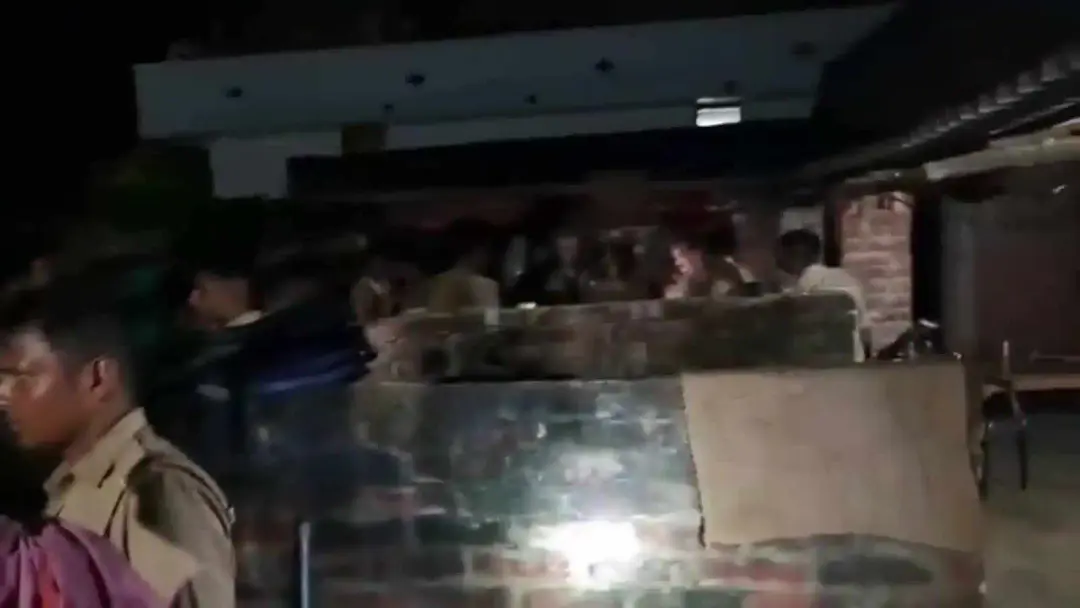
Farmer kills wife, two priests in Azamgarh; dies in police firing
Police said a 45-year-old farmer, Arvind Singh, shot dead his wife Babita Singh, 35, and priests Mahendra Pathak, 42, and Akhilesh Mishra, 55, with his licensed revolver in Shambhupur village, Azamgarh, Uttar Pradesh, on Tuesday. He then locked himself in a room with his three children and refused to surrender for nearly seven hours. When police broke in, he opened fire and was injured in retaliation. Arvind and his 9-year-old son died. The family had arranged a five-day ritual believing he was possessed.
Source
Indian Express — Cities · read the original report ↗
Desk check · some claims need care
What the desk checked (5)
- Farmer Arvind Singh, 45, shot dead his wife Babita Singh, 35, and priests Mahendra Pathak, 42, and Akhilesh Mishra, 55, in Shambhupur village, Azamgarh. — Attributed to police and family members in the source; names and ages appear in source; remains an allegation.
- Arvind locked himself in a room with his three children for nearly seven hours before police broke in. — Attributed to police, including SSP Anil Kumar and ADG Naveen Arora; timeline as stated in source.
- His 9-year-old son was shot and both father and son were declared dead at hospital; Arvind died around 3.30 am. — Attributed to police and doctors in the source; figure appears in source.
- Arvind fired four to five rounds from a six-round revolver and police returned three to four rounds. — Direct quote from ADG Naveen Arora; police account, not independently verified.
- The family believed Arvind was possessed by a spirit and had arranged a five-day ritual; he had a history of mental health issues and was under treatment. — Attributed to relatives via police; no medical records cited in source.
Analysts’ view opinion
This is not one case but a knot of interlocking legal questions. With the principal accused dead, the homicide prosecution effectively ends in law; what remains are two tracks — the mandatory independent scrutiny of a death during police firing, and the regulatory failure of a licensed revolver sitting in the home of a man his family says was under treatment for mental illness. On the police account, force was used in a situation where a child was allegedly being held as a shield, and the decisive legal test there is whether only the minimum necessary force was used.
- The death of the accused extinguishes any trial on the murder charges, though the police investigation and a final report to record the facts would still be completed.
- A death in police firing triggers mandatory process in Indian practice — magisterial inquiry, investigation by an agency independent of the team involved, and scrutiny by human rights bodies.
- The police narrative of a gunshot heard from inside after seven hours of negotiation is the factual pivot on which the proportionality of the entry and return fire will be judged.
- Arms licensing requires the mental fitness of the holder to be weighed, so the continuance of this licence amid reported ongoing treatment invites review and possible use of revocation powers.
- The two surviving children now fall squarely within child-protection law — custody, rehabilitation and shielding their identity become legal priorities.
What to watch — Watch whether a magisterial or independent inquiry is formally ordered, what post-mortem and ballistic findings say about which weapon caused which wound, and whether any review of the arms licence process follows.
The sequence of events rests largely on police and relatives' accounts; it is not independently established whose weapon caused the boy's wound or the accused's death, what cases have been registered, or what inquiry has been ordered.
Deep dive
Research brief · 8 facts · 6 dates · exam-readyThe brief
Context
In Shambhupur village of Uttar Pradesh's Azamgarh district, a family had arranged a five-day religious ritual to "cure" 45-year-old farmer Arvind Singh of what they believed was spirit possession; police say relatives told them he had a history of mental health issues and was under treatment. On Tuesday, the fourth day of the ceremony, Arvind allegedly argued with his wife and the two officiating priests, called them frauds, and then shot dead all three with his licensed revolver. He locked himself in a room with his three children for nearly seven hours, shot his 9-year-old son and fired at police when they stormed the room; he was injured in retaliatory firing and both he and the boy died.
Key facts
- Arvind Singh, 45, a farmer, allegedly shot dead his wife Babita Singh, 35, and priests Mahendra Pathak, 42, and Akhilesh Mishra, 55, in Shambhupur village, Azamgarh, on Tuesday.
- The weapon used was Arvind's licensed revolver, a six-round revolver kept inside the house.
- The family was holding a five-day religious ritual for what they believed was spirit possession; Tuesday was the fourth day.
- Police said relatives reported Arvind had a history of mental health issues and was undergoing treatment.
- Arvind locked himself in a room with his three children; police tried for nearly seven hours to persuade him to surrender.
- ADG Naveen Arora said police used stun grenades and tear gas, broke the door, and Arvind fired four to five rounds, emptying all six chambers; police returned three to four rounds.
- Arora said Arvind held his older daughter as a human shield while the younger girl slipped from his grip; the other two children were rescued.
- Arvind's 9-year-old son and Arvind were declared dead; Arvind died around 3.30 am, according to police.
Timeline
- Five days before/around the incidentFamily arranges a five-day religious ritual to rid Arvind Singh of what they believed was spirit possession.
- Tuesday (fourth day of the ritual)Arvind becomes agitated, argues with and abuses the two priests as frauds, and allegedly assaults his wife Babita.
- Tuesday, during the confrontationPriests begin recording on mobile phones; Arvind takes out his licensed revolver and shoots Babita, then Pathak and Mishra. All three declared dead at hospital.
- Tuesday, after the shootingArvind locks himself in a room with his three children; police surround the house, enlist relatives, and negotiate for nearly seven hours as he threatens to shoot the children.
- After seven hoursPolice hear a gunshot, use stun grenades and tear gas, break the door; Arvind fires at the team and is injured in retaliatory firing. His 9-year-old son found with a gunshot wound.
- Around 3.30 amArvind dies, police said; his son was also declared dead on arrival at hospital.
Who has a stake
- Arvind Singh's surviving children — Two children rescued after a seven-hour standoff; one daughter was allegedly used as a human shield; they lost their mother, father and brother.
- Families of priests Mahendra Pathak and Akhilesh Mishra — Both priests were shot dead while officiating the ritual after objecting to being called frauds.
- Azamgarh police / SSP Anil Kumar — Led the cordon and negotiation; accountability for the operation in which the accused and his child died.
- ADG Naveen Arora — Publicly explained the police decision to storm the room using stun grenades and tear gas and the return of fire.
- Arvind's relatives — Attributed his condition to spirit possession, arranged the ritual, and were enlisted by police to persuade him to surrender.
- Licensing and health authorities — Questions arise over a licensed firearm held by a person described as undergoing treatment for mental health issues.
Why it matters
The case links three concerns at once: untreated or poorly supported mental illness being interpreted as spirit possession, a licensed firearm in the hands of a person said to be under psychiatric treatment, and the difficulty of resolving hostage situations involving children without loss of life. Four people, including a 9-year-old, died despite a seven-hour negotiation. It raises hard questions about whether faith-based "cures" delay medical care and whether arms licensing and police hostage protocols account for such risks.
UPSC angle
Prelims pointers
- Incident location: Shambhupur village, Azamgarh district, Uttar Pradesh.
- Victims: Babita Singh (35), priests Mahendra Pathak (42) and Akhilesh Mishra (55); accused Arvind Singh (45) and his 9-year-old son also died.
- Weapon: accused's own licensed revolver, a six-round revolver.
- Officials named: SSP Azamgarh Anil Kumar; ADG Naveen Arora.
- Police used stun grenades and tear gas to break into the room after nearly seven hours of negotiation.
- Family attributed the accused's condition to spirit possession and held a five-day ritual; police said he had a history of mental health issues and was under treatment.
Mains framing
The Azamgarh killings illustrate how mental illness, when reframed as supernatural affliction, can end in catastrophic violence. Police say relatives knew Arvind Singh had a history of mental health problems and was undergoing treatment, yet the family's chosen intervention was a five-day ritual to expel a "spirit"; the confrontation escalated when he called the priests frauds and they began filming him. The immediate enabling factor was access to a licensed firearm inside the home, which converted a domestic quarrel into a triple homicide and then a seven-hour hostage standoff in which the accused threatened his children, shot his 9-year-old son and used his daughter as a shield. The police response - cordon, negotiation with help of relatives, then stun grenades, tear gas and return fire - shows the narrow choices available once a barricaded armed subject holds children. A grounded way forward, on the evidence in this case, points to three areas: strengthening accessible community mental health care and family counselling so that faith-based remedies do not substitute for treatment; reviewing whether arms licences and possession are compatible with documented psychiatric treatment; and building specialised negotiation and rescue capacity for hostage situations involving minors. The source does not state any policy action taken or announced.
Key terms
- Spirit possession ritual
- A faith-based ceremony the family arranged over five days believing it would rid Arvind Singh of possession and improve his condition.
- Licensed revolver
- A legally held firearm; in this case a six-round revolver kept inside the house, which the accused emptied at police.
- Triple homicide
- Term used in the report for the killing of three people - Arvind's wife and the two priests - in the same incident.
- Stun grenade / tear gas
- Non-lethal police tools used to disorient the accused before officers broke open the locked room.
- Human shield
- ADG Arora's description of the accused holding his older daughter in front of him during the exchange of fire.
- SSP / ADG
- Senior Superintendent of Police (district-level head, here Anil Kumar) and Additional Director General of Police (senior state rank, here Naveen Arora).
Practice questions
- Superstitious explanations of mental illness continue to delay medical treatment in parts of India. Examine the social and administrative measures needed to address this, using recent incidents as illustration.
- Should the grant and retention of private arms licences be linked to mental health assessment? Discuss with reference to the Azamgarh case.
- Evaluate the challenges before police in resolving barricaded hostage situations involving children, and the safeguards that should govern the use of force in such operations.
Grounded only in the source report — figures and dates are the source's, not inferred.