
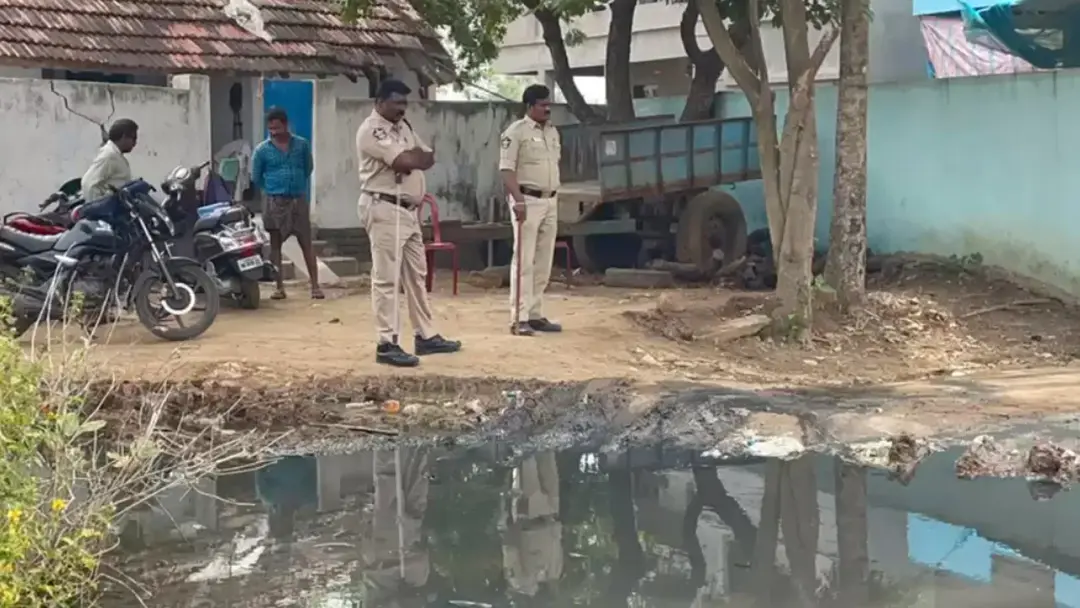
Police deployed at sewage stream in Kakinada district village
Police security has been posted at a stretch of stagnant sewage on a road in a village in Pithapuram mandal of Andhra Pradesh's Kakinada district. Differences between the sarpanch and another group led one side to block the wastewater outlet, and SC colony residents now wade through the water. Residents said repeated petitions to the district collector and MLA Pendem Dorababu brought no solution. The sarpanch said drainage works are being deliberately halted. Women said both groups belong to the same party and hardship has continued for six months.
Source
Kakinada — నేరాలు · read the original report ↗
Desk check · some claims need care
What the desk checked (5)
- Police security was deployed at a sewage stream on a road in Pithapuram mandal, Kakinada district, to prevent clashes between two groups. — Stated as reporter observation in the source; no police officer named or quoted.
- One group blocked the drainage outlet for household wastewater amid differences with the village sarpanch, leaving sewage stagnant on the road used by SC colony residents. — Appears in source without named attribution; based on the reporter's account.
- Residents petitioned the district collector and Pithapuram MLA Pendem Dorababu several times without a solution. — Attributed to residents in general; the MLA's name appears in the source but no response from him is included.
- The sarpanch says drainage works are being deliberately stopped. — Attributed to the village sarpanch, who is not named in the source.
- Local women say both groups belong to the same party and that people have faced illness and hardship for six months. — Attributed to unnamed local women; party name and health data not specified.
Analysts’ view opinion
This looks like a sanitation story, but the real story is a dominance fight between two factions of the same party — with the village's SC colony residents paying the price. The report says the rift between the sarpanch and the rival group has hardened to the point that administration stalled and police had to be posted to 'guard' stagnant sewage on a road. The politically damaging part is the claim that repeated appeals to the district collector and Pithapuram MLA Pendem Dorababu have gone unresolved for six months.
- Because locals say the cause is an internal factional fight within one party rather than a clash between rivals, it is harder for the ruling side to shift blame elsewhere.
- The episode illustrates how local works can freeze when panchayat-level leadership and constituency-level leadership are not aligned.
- The detail that SC colony residents must wade through sewage gives the issue a social-justice dimension that can widen the political debate.
- Officials themselves saying they are caught in leaders' factional battles signals that local political pressure is now blocking administrative decisions.
- A six-month delay plus the striking image of police posted at a sewage pool is easy campaign material for opponents.
What to watch — Watch whether the MLA or the district administration steps in with a clear order to restart the drainage work and broker a truce between the factions, or whether the police posting remains the only response.
The story does not establish which faction blocked the drain or why, what the MLA or collector have to say, or which party the two groups belong to.
Deep dive
Research brief · 8 facts · 4 dates · exam-readyThe brief
Context
In a village in Pithapuram mandal of Andhra Pradesh's Kakinada district, police have been posted to guard a stretch of stagnant sewage water on a village road — an unusual deployment meant to prevent clashes between two rival groups. A dispute between the village sarpanch and another faction led one side to block the outlet through which household wastewater and sewage drained away, leaving the water standing on the road. Residents of the SC colony have to wade through the stagnant sewage to move in and out of their homes. Officials say they are caught in the factional fight of local leaders and are unable to resolve the issue.
Key facts
- Police bandobast (security posting) has been arranged at a stagnant sewage water point on a village road in Pithapuram mandal, Kakinada district, Andhra Pradesh.
- The deployment is to prevent clashes between the two rival groups in the village.
- One faction closed the channel carrying household used water and sewage, causing the wastewater to stagnate on the road.
- Residents of the village's SC colony move in and out through the stagnant sewage water.
- Residents say they petitioned the district collector, Pithapuram MLA Pendem Dorababu and others several times, but no solution has been provided so far.
- The village sarpanch says drainage works taken up to address the village's drainage problem are being deliberately stopped.
- Local women say both factions belong to the same party and that their dominance battle has turned the village into a cesspool.
- Women residents say people have been suffering from the filth and falling ill for the past six months.
Timeline
- Past six months (as stated by local women)Residents suffer due to stagnant sewage and report falling ill.
- Not dated in the sourceOne faction blocks the wastewater outlet amid differences between the sarpanch and another group; sewage stagnates on the road.
- Repeatedly, dates not statedResidents petition the district collector, MLA Pendem Dorababu and others; no solution results.
- Current (as reported)Police bandobast set up at the sewage water spot to prevent clashes between the two groups.
Who has a stake
- SC colony residents of the village — Forced to wade through stagnant sewage; face foul smell, unhygienic surroundings and illness.
- Village sarpanch — Says drainage works being executed for the village are being deliberately halted by the rival side.
- The rival faction in the village — Accused of closing the wastewater outlet, causing sewage to stagnate on the road.
- Police — Deployed at the sewage point to prevent clashes between the two groups.
- District collector and Pithapuram MLA Pendem Dorababu — Received repeated petitions from residents; no solution provided so far, as per residents.
- Officials (local administration) — Say they are caught in the factional fight of leaders and are unable to resolve the problem.
- Local women — Voice anguish that both factions of the same party turned the village into a cesspool, causing six months of hardship and illness.
Why it matters
A basic civic service — draining household wastewater — has been held hostage to a local dominance battle, with the state's response limited to posting police at the sewage rather than clearing it. The worst affected are SC colony residents, who must wade through the filth daily, showing how village-level factionalism translates directly into health risks and social burden for the most vulnerable.
UPSC angle
Prelims pointers
- The incident is reported from Pithapuram mandal, Kakinada district, Andhra Pradesh.
- Pendem Dorababu is named in the source as the Pithapuram MLA.
- Sarpanch is the elected head of a gram panchayat; the village sarpanch is one party to the dispute.
- Residents approached the district collector, the district administration's head, for redress.
- Both rival groups belong to the same political party, as per local women quoted in the report.
- Residents report six months of hardship from the stagnant sewage; police bandobast has been posted at the spot.
Mains framing
The Kakinada episode illustrates how intra-party factionalism at the panchayat level can paralyse the delivery of the most elementary civic services. The proximate cause is a dispute between the sarpanch and a rival group, in which one side blocked the outlet for household wastewater, leaving sewage stagnant on a village road; the sarpanch alleges drainage works are being deliberately stopped. The implications are unequal and severe: the source notes that SC colony residents must move through the sewage, and local women report illness over six months, underlining how weak local governance imposes its heaviest costs on marginalised habitations. Equally telling is the administrative response — officials say they are squeezed by the leaders' factional fight and cannot resolve the matter, while the state's visible presence takes the form of police bandobast at the sewage point to prevent clashes. The way forward, on the facts available, lies in the district administration and elected representatives acting on the repeated petitions from residents to restore the drainage channel and complete the works, rather than treating a sanitation failure purely as a law-and-order problem; the source does not state any remedial plan.
Key terms
- Bandobast
- Police security arrangement or duty posting, here placed at the stagnant sewage spot to prevent clashes.
- Sarpanch
- Elected head of the village panchayat; in this story, one party to the local dispute.
- Mandal
- An administrative sub-district unit in Andhra Pradesh; the village lies in Pithapuram mandal.
- District Collector
- Head of district administration, approached repeatedly by residents for a solution.
- SC colony
- Residential locality of Scheduled Caste families; its residents wade through the stagnant sewage.
Practice questions
- How does factionalism within a single political party at the panchayat level undermine basic service delivery? Discuss with reference to the Kakinada sewage dispute.
- Examine why localised sanitation failures disproportionately affect Scheduled Caste habitations, and suggest institutional safeguards.
- Is deploying police at a civic grievance site an adequate administrative response? Critically evaluate the role of the district administration in resolving panchayat-level disputes.
Grounded only in the source report — figures and dates are the source's, not inferred.