
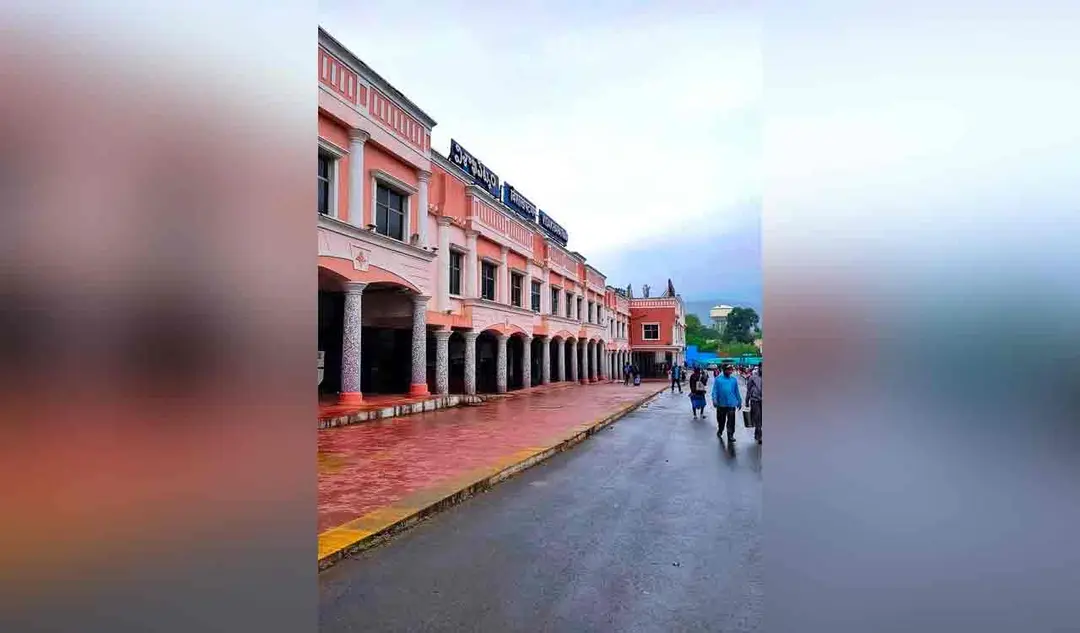
Visakhapatnam railway station turns 130, to expand to 14 platforms
Visakhapatnam Railway Station in Andhra Pradesh has completed 130 years. Opened in 1896 with two platforms and a daily footfall of about 200 passengers, it now serves more than 65,000 passengers daily across eight platforms, South Coast Railway zone general manager Sandeep Mathur said. The anniversary was marked on Monday with a 'Station Mahotsav', a flag march and historical photo and heritage exhibitions. A coffee-table book, 'Waltair Visakhapatnam', was released. Redevelopment to expand the station to 14 platforms is under way, Mathur said.
Source
Telangana Today · read the original report ↗
Desk check · compared with the source
What the desk checked (5)
- Visakhapatnam Railway Station began operations in 1896 with two platforms and about 200 daily passengers. — Figure appears in source and is repeated in a quote attributed to SCoR general manager Sandeep Mathur.
- The station now serves more than 65,000 passengers daily across eight platforms. — Attributed to Sandeep Mathur in an official press release cited by the source.
- The station completed 130 years, marked on Monday with a 'Station Mahotsav', flag march, photo and heritage exhibitions. — Stated in source as part of a Ministry of Railways nationwide initiative; no independent confirmation possible.
- Redevelopment plans will expand the station to 14 platforms. — Attributed to the general manager as an ongoing plan; no timeline or cost given in source.
- A coffee-table book titled 'Waltair Visakhapatnam' was released. — Detail appears in source without further sourcing.
Analysts’ view opinion
On the surface this is a heritage celebration, but it carries two political signals. First, the fact that the South Coast Railway (SCoR) zone's general manager fronted the announcement lets the zone — a long-standing demand in Andhra Pradesh — be shown as an operating reality. Second, the promise of expansion from eight to 14 platforms is the kind of long-cycle project that allows leaders at both the central and state level to cut the same ribbon more than once before it is finished.
- The arc from 200 passengers in 1896 to over 65,000 a day is a ready-made 'investment delivers' narrative for whoever is in office.
- Because 'Station Mahotsav' is a nationwide Railway Ministry initiative, this is less a local event than part of a central messaging push framing railways as national pride.
- The 'Waltair to Visakhapatnam' heritage framing taps local identity sentiment, which plays well amid the state's continuing debate over Visakhapatnam's importance.
- The statement carries no cost, timeline or land details for the expansion — precisely the gap opposition voices typically use to argue announcements outpace delivery.
- Competition over whether the Centre or the state claims credit for infrastructure milestones is routine in projects of this kind.
What to watch — Watch whether a firm timeline and funding figure for the redevelopment is released, and on whose platform that announcement is made — that will show who banks the credit.
The story does not establish that any political leader attended, nor does it state the expansion's cost, timeline or completion date; the political implications here are analysis, not reporting.
Deep dive
Research brief · 8 facts · 4 dates · exam-readyThe brief
Context
Visakhapatnam Railway Station in Andhra Pradesh, which opened in 1896 with two platforms and roughly 200 passengers a day, has completed 130 years. Once part of the erstwhile Waltair Railway Division, it is today described as one of the busiest transit hubs on India's eastern coast, handling more than 65,000 passengers daily across eight platforms. The anniversary was marked on a Monday with a 'Station Mahotsav', part of a Ministry of Railways nationwide initiative to honour the legacy of key stations. The station now falls under the South Coast Railway (SCoR) Zone, whose general manager announced redevelopment to expand it to 14 platforms.
Key facts
- Visakhapatnam Railway Station began operations in 1896 with two platforms and a daily footfall of about 200 passengers.
- The station completed 130 years, with celebrations held on Monday (report published 30 September 2026).
- It now serves more than 65,000 passengers daily through eight platforms.
- Redevelopment plans aim to expand the station to 14 platforms as a 'next-generation mobility centre'.
- The statement was made by Sandeep Mathur, general manager, South Coast Railway (SCoR) Zone, in an official press release.
- The anniversary was marked with a 'Station Mahotsav' under the Ministry of Railways' nationwide initiative honouring historic stations.
- Celebrations included a flag march, a curated historical photo exhibition and an exhibition of heritage artefacts.
- A commemorative coffee-table book titled 'Waltair Visakhapatnam' was released.
Timeline
- 1896Visakhapatnam Railway Station begins operations with two platforms and about 200 daily passengers.
- Erstwhile Waltair era (period not stated in the source)Station and the Waltair Railway Division form the base of the present-day hub's operational history.
- Monday (date not stated in the source)130th anniversary marked with 'Station Mahotsav', flag march, exhibitions and release of the coffee-table book 'Waltair Visakhapatnam'.
- 30 September 2026Report published carrying the general manager's announcement of expansion to 14 platforms.
Who has a stake
- Daily passengers at Visakhapatnam station — More than 65,000 users a day stand to gain from modern amenities and added platforms, but face disruption during redevelopment.
- South Coast Railway (SCoR) Zone — Executing the world-class redevelopment and managing operations at one of the eastern coast's busiest hubs.
- Ministry of Railways — Runs the nationwide 'Station Mahotsav' initiative to honour station heritage and drives station redevelopment.
- Sandeep Mathur, SCoR general manager — Announced the 14-platform expansion and framed railway heritage as part of collective identity.
- Railway personnel and heritage community — Legacy of the erstwhile Waltair Railway Division documented through archival photos, memorabilia and the coffee-table book.
- Visakhapatnam city and Andhra Pradesh — Improved intermodal connectivity and sustainable infrastructure at a key eastern-coast transport node.
Why it matters
A station that grew from 200 to over 65,000 passengers a day illustrates how India's urban rail nodes have outgrown their colonial-era footprints, forcing capacity-led redevelopment. The planned jump from eight to 14 platforms at Visakhapatnam signals investment in intermodal connectivity and sustainable infrastructure on the eastern coast. At the same time, the heritage exhibitions and the 'Waltair Visakhapatnam' book show the attempt to preserve railway history even as stations are rebuilt.
UPSC angle
Prelims pointers
- Visakhapatnam Railway Station opened in 1896 with two platforms; completed 130 years.
- Present capacity: eight platforms, over 65,000 passengers daily; planned expansion to 14 platforms.
- Visakhapatnam station falls under the South Coast Railway (SCoR) Zone; general manager is Sandeep Mathur.
- 'Station Mahotsav' is a Ministry of Railways nationwide initiative honouring the legacy of key railway stations.
- The station's predecessor administrative unit was the erstwhile Waltair Railway Division; Waltair is the older name for Visakhapatnam.
- Commemorative coffee-table book released: 'Waltair Visakhapatnam'.
Mains framing
Visakhapatnam station's 130-year arc — from two platforms and 200 daily passengers in 1896 to eight platforms handling over 65,000 passengers a day — captures the core challenge of Indian Railways: legacy infrastructure built for colonial-era traffic now serving mass urban mobility. Rapid urbanisation, port-industrial growth on the eastern coast and rising passenger volumes have made capacity the binding constraint, which the proposed expansion to 14 platforms seeks to ease alongside modern amenities, seamless intermodal connectivity and sustainable infrastructure, as articulated by the South Coast Railway general manager. Such redevelopment raises questions of phasing construction without disrupting existing services, integrating rail with road and urban transit, and financing large station projects. Equally, the 'Station Mahotsav' initiative, the historical photo and heritage artefact exhibitions and the coffee-table book 'Waltair Visakhapatnam' point to a parallel objective — conserving railway heritage as part of collective identity even while stations are rebuilt as next-generation mobility centres. The way forward lies in balancing capacity augmentation with heritage conservation, passenger convenience during works, and genuine multimodal integration rather than cosmetic upgrades.
Key terms
- South Coast Railway (SCoR) Zone
- The railway zone under which Visakhapatnam station operates; its general manager is Sandeep Mathur.
- Station Mahotsav
- Ministry of Railways' nationwide initiative to honour the historical significance and legacy of key railway stations.
- Waltair Railway Division
- The erstwhile division whose evolution and operational milestones were showcased in the anniversary exhibitions.
- Next-generation mobility centre
- Term used for the redeveloped station concept with modern amenities, intermodal connectivity and sustainable infrastructure.
- Intermodal connectivity
- Seamless linkage between different transport modes, cited as a goal of the station's redevelopment.
Practice questions
- Trace the growth of Visakhapatnam Railway Station from 1896 to its 130th year and discuss what its expansion from eight to 14 platforms reveals about capacity constraints in Indian Railways.
- How can station redevelopment projects balance modernisation and capacity augmentation with the conservation of railway heritage? Illustrate with the Visakhapatnam example.
- Discuss the role of initiatives such as 'Station Mahotsav' in building public engagement with railway heritage while stations are transformed into next-generation mobility centres.
Grounded only in the source report — figures and dates are the source's, not inferred.