
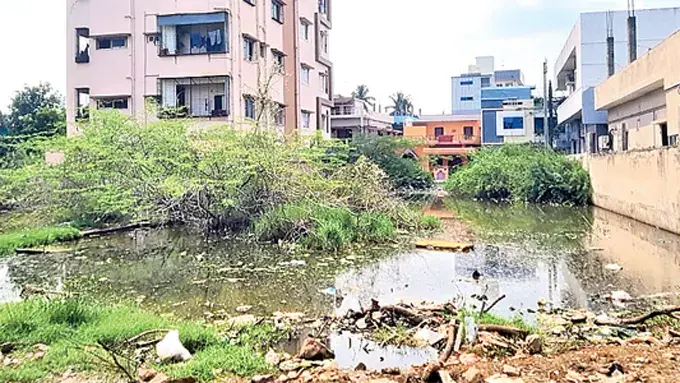
Unused vacant plots causing hardship in Kakinada district
Residents in towns across Kakinada district say vacant plots left unused for years collect rainwater and grow weeds, becoming breeding grounds for mosquitoes and shelter for snakes. About 3,000 vacant plots have been identified in Kakinada, but taxes are paid on only 1,735, yielding Rs 5 crore in revenue. Gollaprolu has 326 plots, Pithapuram 1,727 and Gandepalli 150. Tuni has 1,750 private and 40 government plots. Officials said notices cannot be served as some owners are untraceable.
Source
East Godavari — వార్తలు · read the original report ↗
Desk check · compared with the source
What the desk checked (5)
- About 3,000 vacant plots have been identified in Kakinada — Figure appears in source as an identified count; issuing authority not named.
- Taxes are being paid on only 1,735 vacant plots, yielding about Rs 5 crore revenue — Figures appear in source; no official or department cited as the source.
- Gollaprolu has 326 vacant plots, of which 150 are untaxed — Numbers appear in source; officials quoted saying owners of some plots are untraceable, so notices cannot be served.
- Tuni has about 1,750 private vacant plots and about 40 belonging to government departments — Figures appear in source; attributed broadly to town planning and sanitation officials' observations.
- Pithapuram has 1,727 vacant plots and Gandepalli 150 — Figures appear in source without named attribution; internally consistent with the report's district-wide pattern.
Analysts’ view opinion
This reads like a sanitation story, but its roots lie in the political economy of local bodies. The report notes that of roughly 3,000 vacant plots identified in Kakinada, only 1,735 are paying tax — meaning public inconvenience and a municipal revenue gap flow from the same source. The politically sensitive part is that officials reportedly have the power to clean such plots and recover the cost if owners ignore a 15-day notice, yet that power is not being used — and plot owners tend to be locally influential, while those suffering are colony residents who vote.
- Tax leakage on one side and mosquitoes and snakes on the other combine into direct pressure on ward-level representatives.
- Having legal powers but not using them is easily read as political convenience rather than incapacity, and the party in office locally will have to answer for it.
- The officials' explanation that notices cannot be served because owners are untraceable can be read both as an administrative excuse and as a genuine records problem.
- Pithapuram's 1,727 plots, bought by outsiders and left idle as the town grows, point to a tension between real-estate investment and resident welfare.
- The strongest defence for the machinery is that plots locked in inheritance or court disputes genuinely limit municipal action, so framing this purely as political neglect would be unfair.
What to watch — Watch whether municipalities now move on surveys, notices and cost-recovery against untaxed plots, or whether the issue quietly fades once the rainy season ends.
The story does not establish that any particular party or representative is responsible for the inaction, or that pressure blocked enforcement — it offers residents' complaints, officials' explanations and numbers, nothing more.
Deep dive
Research brief · 8 facts · 3 dates · exam-readyThe brief
Context
Across towns in Andhra Pradesh's Kakinada district, privately owned plots bought for investment or caught in inheritance and court disputes have been left unbuilt and uncleared for years. Monsoon water stagnates in them, weeds and bushes grow, and residents of adjoining colonies complain of mosquitoes, stench, snakes and pigs. Many owners neither pay property tax on these plots nor fence or level them, and civic officials say they often cannot even trace owners to serve notices.
Key facts
- About 3,000 vacant plots have been identified in Kakinada city, but tax is being paid on only 1,735 of them.
- The 1,735 taxed plots yield around Rs 5 crore in revenue.
- Gollaprolu town figure cited: 326 plots; 150 vacant plots there have not been brought under tax.
- Pithapuram municipality figure cited: 1,727 vacant plots.
- Gandepalli figure cited: 150 plots; a roughly two-acre plot at Mallepalli outskirts has lain vacant for years.
- Tuni town has up to 1,750 private vacant plots plus about 40 belonging to various government departments.
- In Kakinada's Lakshminarayana Nagar, one plot has been left vacant for a decade.
- Rules require officials to clean plots and recover the cost from owners if no action is taken within 15 days of notice; this is not being enforced.
Timeline
- Over the past decadeA plot in Lakshminarayana Nagar, Kakinada, lies vacant; similar plots across the district stay unused for years.
- Recent yearsPithapuram's rapid growth and 15-km proximity to the district headquarters push up land demand; outside employees and traders buy plots, get them taxed and leave them idle.
- October 7, 2026Report published on hardship caused by unused vacant plots in Kakinada district towns.
Who has a stake
- Residents of affected colonies (Bank Colony, Sai Nagar, Ramakrishna Colony, Upparigudem Kothakalony in Tuni) — Face mosquitoes, stench, disease spread, snakes and pigs from overgrown adjoining plots.
- Plot owners — Liable for property tax, levelling, fencing and clearing; some ignore warnings, others are untraceable or locked in heirship/court disputes.
- Municipalities (Kakinada, Pithapuram, Gollaprolu, Tuni) — Lose tax revenue on untaxed plots and must enforce notices and sanitation.
- Town planning and sanitation department officials — Issued warnings in Tuni that owners ignored; say notices cannot be served where owners are unknown.
- Gram panchayats / panchayat officials (Gandepalli) — Expected to act on bush-filled government and private plots but are not taking the prescribed steps.
- Government departments — Own about 40 vacant plots in Tuni that are also left unmaintained.
Why it matters
Idle urban land is simultaneously a public health hazard and a revenue leak: stagnant water and bushes breed mosquitoes and shelter snakes, while over 1,200 identified plots in Kakinada alone pay no tax. The story shows how weak enforcement of existing powers, including the rule allowing officials to clean plots and recover costs, leaves rapidly urbanising towns with unmanaged gaps between houses.
UPSC angle
Prelims pointers
- Kakinada city: about 3,000 vacant plots identified; tax paid on only 1,735, yielding about Rs 5 crore.
- Plot counts cited: Pithapuram 1,727; Gollaprolu 326 (150 untaxed); Gandepalli 150; Tuni 1,750 private + 40 government.
- Pithapuram municipality lies 15 km from the district headquarters, with roads to Kakinada, Samalkot, Kathipudi and Uppada.
- Rule cited: if an owner does not act within 15 days of notice, officials may clean the plot and recover the expense.
- Reason given by officials for inaction: owners of some plots are untraceable; others are in heirship or court disputes.
- Vacant plots are concentrated in outskirts and non-layout (unapproved layout) areas.
Mains framing
The Kakinada case illustrates a classic urban land-management failure: speculative holding of plots in fast-growing peri-urban towns, incomplete property-tax coverage (only 1,735 of about 3,000 identified plots in Kakinada), and administrative paralysis where ownership records are untraceable or titles are under litigation. The consequences are public-health externalities borne by neighbours - stagnant rain and sewage water, mosquito breeding and disease, venomous snakes and stray pigs - plus foregone municipal revenue needed for the very sanitation services demanded. Causes include unapproved non-layout development on the outskirts, absentee owners from other places, weak property records and non-enforcement of the existing provision empowering officials to clear plots after 15 days' notice and recover costs. A grounded way forward, as the source implies, lies in completing the survey and tax assessment of all vacant plots, mandating minimum owner obligations such as levelling and compound walls, actually invoking the clean-and-recover power, updating ownership data so notices can be served, and holding government departments owning idle plots (about 40 in Tuni) to the same standard.
Key terms
- Vacant land tax / property tax on plots
- Levy on undeveloped plots; in Kakinada only 1,735 of about 3,000 identified plots pay it, giving about Rs 5 crore.
- Non-layout areas
- Areas developed without approved layout plans, where the source says vacant unmaintained plots are most common.
- Municipal notice and cost recovery
- Power allowing officials to clean a neglected plot after 15 days of notice and recover the expense from the owner.
- Panchayat
- Village-level local body, as in Gandepalli mandal, responsible for acting on overgrown government and private plots.
- Town planning and sanitation wings
- Municipal departments that issued warnings to plot owners in Tuni, which the source says were ignored.
Practice questions
- Unused vacant plots in towns are both a public-health hazard and a fiscal loss. Examine with reference to Kakinada district and suggest enforcement measures.
- Why do urban local bodies fail to tax and regulate privately held vacant land? Discuss the roles of land records, litigation and non-layout development.
- Evaluate the adequacy of 'notice and cost recovery' provisions for maintaining private vacant plots, and suggest how municipalities can make them effective.
Grounded only in the source report — figures and dates are the source's, not inferred.