
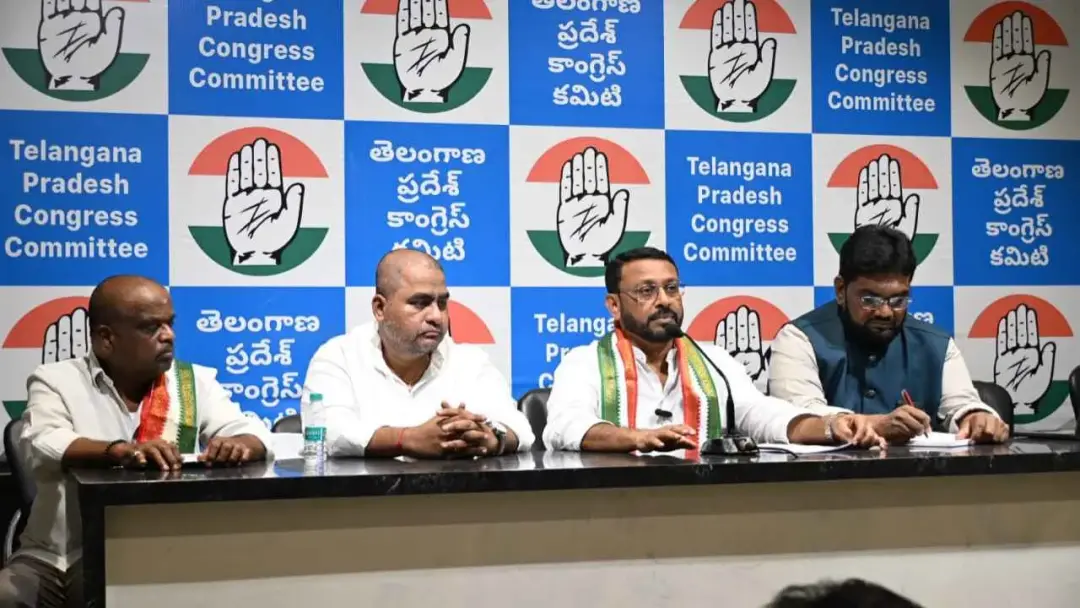
Section 22 A row: Congress challenges KTR, Harish Rao
The Congress has challenged BRS leaders KT Rama Rao and T Harish Rao to give survey-wise details of private properties they say were wrongly placed under Section 22 A. TPCC spokesperson Syed Nizamuddin, speaking at Gandhi Bhavan on Saturday, said the provision has been in force since 2007. He said 1.02 crore acres were under prohibited records in December 2023, of which private land was about four lakh acres, and 47,440 acres were removed after errors were found.
Source
Harish Rao (BRS) · read the original report ↗
Desk check · some claims need care
What the desk checked (5)
- About 1.02 crore acres were already under prohibited property records when Congress took office in December 2023. — Attributed to Nizamuddin; no independent documentation cited in source.
- Private land accounted for about four lakh acres of the prohibited list. — Attributed to Nizamuddin; figure appears in source without official record reference.
- 47,440 acres were removed from the prohibited category by August 2026 after erroneous entries were identified. — Figure appears in source attributed to Nizamuddin, but the stated month is in the future relative to the Sept. 19 datelinetext — internal inconsistency an editor should check.
- Section 22 A has been in force since 2007 and was not introduced by the Revanth Reddy government. — Attributed to Nizamuddin; presented as statement of fact, not independently sourced in the text.
- Irregularities occurred in Dharani records, with some changes made without proper sale or gift documents. — Unverified allegation attributed to Nizamuddin; no evidence or official response included.
Analysts’ view opinion
This is less a land-records dispute than a contest over who controls the political initiative. By demanding survey numbers and framing the BRS campaign as hashtag politics, the Congress is trying to shift the debate from grievance and emotion to administrative detail. At the same time, its insistence that Section 22 A has been in force since 2007 is a clear attempt to push responsibility back onto the previous administration.
- Asking for district, village and survey-number detail is a classic move to transfer the burden of proof onto the opposition.
- Pointing out that the provision dates to 2007 and was not changed during a decade of BRS rule is designed to neutralise blame on the Revanth Reddy government.
- Citing about four lakh acres of private land within a 1.02 crore acre prohibited list works to shrink the perceived scale of the grievance.
- Conceding that errors exist and claiming 47,440 acres were removed lets the government stand as the corrector rather than the culprit — politically the lower-cost position.
- Dragging Dharani and assigned-land irregularities into the argument turns the land-records conversation back toward the BRS years, and because land touches voters directly, the issue is sensitive for both sides.
What to watch — Watch whether KTR and Harish Rao respond with documented, survey-number-level cases or keep the fight at the level of broad allegation — that choice will largely decide who wins this exchange.
The story carries only the Congress spokesperson's claims and figures; they are not independently verified here and no BRS response is recorded.
Deep dive
Research brief · 8 facts · 4 dates · exam-readyThe brief
Context
Section 22 A of the Registration Act lists properties barred from registration — typically government, forest, assigned (Lavani), shikam, Waqf and endowment land. In Telangana, the prohibited property list has become a political flashpoint, with BRS leaders KT Rama Rao and T Harish Rao alleging that private and farmers' land has been wrongly placed under the restriction by the Congress government. At a press conference at Gandhi Bhavan on Saturday (dateline Hyderabad, Sept. 19), TPCC spokesperson Syed Nizamuddin challenged them to produce survey-wise details instead of political claims, arguing the provision has been in force since 2007 and that the government is correcting erroneous entries.
Key facts
- TPCC spokesperson Syed Nizamuddin challenged BRS leaders KT Rama Rao and T Harish Rao to give district, village, survey number, land extent and ownership details for each disputed property.
- Nizamuddin said Section 22 A was not introduced by the Revanth Reddy government and has been in force since 2007.
- About 1.02 crore acres were already covered by prohibited property records when the Congress came to power in December 2023, per Nizamuddin.
- Most of that extent was government and protected land — forest, assigned or Lavani land, shikam land, Waqf properties and endowment land.
- Private land accounted for about four lakh acres, some facing court cases, government claims or ownership disputes.
- Nizamuddin said 47,440 acres had been removed from the prohibited category by August 2026 after officials identified erroneous entries.
- He admitted errors such as entire survey numbers being placed under restrictions when only part of the land faced an issue.
- A high level committee is examining complaints linked to the prohibited list; owners can apply with supporting documents for removal.
Timeline
- 2007Section 22 A provision comes into force, according to the Congress spokesperson.
- December 2023Congress comes to power in Telangana; about 1.02 crore acres already under prohibited property records.
- By August 202647,440 acres removed from the prohibited category after officials identified erroneous entries.
- Saturday (dateline Hyderabad, Sept. 19)Syed Nizamuddin holds press conference at Gandhi Bhavan and challenges KTR and Harish Rao to bring survey numbers.
Who has a stake
- Congress / TPCC (spokesperson Syed Nizamuddin) — Defending the Revanth Reddy government's handling of the prohibited list and shifting blame to the BRS decade in office.
- BRS leaders KT Rama Rao and T Harish Rao — Alleging private properties were wrongly placed under Section 22 A; now asked to substantiate with survey-wise details.
- Private landowners on the prohibited list — Cannot register or transact until erroneous entries are removed; urged not to sell under pressure or pay intermediaries.
- Revenue officials and the high level committee — Must verify complaints, examine records and remove erroneous Section 22 A entries.
- Assigned/Lavani land beneficiaries (landless poor) — Restrictions defended to prevent such land becoming a source of real estate transactions.
- Waqf, endowment and forest departments — Protection of institutional and government land categories listed under Section 22 A.
Why it matters
Section 22 A entries freeze a property's registration, so an erroneous listing can block a genuine owner's right to sell or mortgage land. The dispute over how much of the 1.02 crore acres is actually private — the Congress says about four lakh acres — determines whether this is a governance failure in land records or a political exaggeration. It also revives scrutiny of the Dharani portal and the quality of village-wise revenue records in Telangana.
UPSC angle
Prelims pointers
- Section 22 A relates to properties prohibited from registration; in force since 2007 as per the source.
- Categories under the prohibited list: government, forest, assigned/Lavani, shikam, Waqf and endowment land.
- 1.02 crore acres under prohibited property records in Telangana in December 2023; private land about four lakh acres.
- 47,440 acres removed from the prohibited category by August 2026 after error identification.
- Dharani is Telangana's land records portal, cited in the row over village-wise revenue records.
- TPCC = Telangana Pradesh Congress Committee; Gandhi Bhavan is its Hyderabad headquarters.
Mains framing
The Section 22 A row in Telangana is fundamentally a land records governance problem dressed as a political quarrel. The Congress says 1.02 crore acres were already under prohibited records when it took office in December 2023, most of it government, forest, assigned/Lavani, shikam, Waqf and endowment land, with only about four lakh acres private and much of that under litigation or competing claims; the BRS, it alleges, presents the entire extent as farmers' land, which can mislead owners. Yet the Congress itself concedes systemic error — whole survey numbers restricted when only part of the land is disputed — which is why 47,440 acres have been de-listed and a high level committee now examines complaints. The causes lie in incomplete village-wise records, contested entries on the Dharani portal and mutations allegedly made without proper sale or gift documents. Implications include frozen transactions for genuine owners and a market for intermediaries promising removal. The way forward suggested in the source is record-based, survey-number-level verification: complainants submit documents, officials verify, erroneous entries are removed, disputed titles stay restricted until courts or authorities decide, and illegal sale or occupation of assigned and Lavani land is investigated irrespective of political identity — "let records decide, not rumours".
Key terms
- Section 22 A
- Provision under which specified properties are barred from registration; in force since 2007 as per the source.
- Prohibited property list
- Official list of land that cannot be registered or transacted, covering government and protected categories.
- Assigned / Lavani land
- Government land assigned to landless poor families; restricted from sale as real estate.
- Shikam land
- A protected land category included in the prohibited property records in Telangana.
- Dharani portal
- Telangana's land records platform; Congress alleges some changes were made without proper sale or gift documents.
- TPCC
- Telangana Pradesh Congress Committee, the state Congress unit headquartered at Gandhi Bhavan, Hyderabad.
Practice questions
- Erroneous entries in prohibited property lists can nullify a citizen's ability to transact legally owned land. Examine, with reference to the Telangana Section 22 A dispute, how land records governance affects property rights.
- Digitisation of land records was expected to end disputes but has generated new ones. Critically assess in the light of allegations against the Dharani portal.
- Discuss the rationale for restricting sale of assigned land granted to landless poor families, and the challenges in enforcing such restrictions.
Grounded only in the source report — figures and dates are the source's, not inferred.