
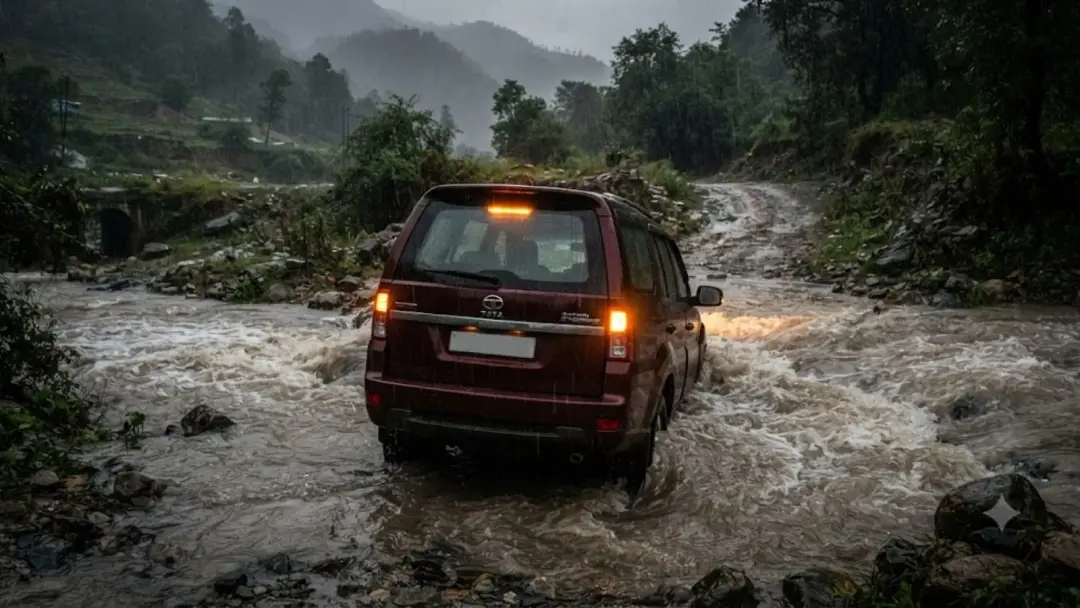
Eight killed as car swept away by swollen stream in Madhya Pradesh
Eight people died when their vehicle was swept away while crossing a rain-swollen stream near the Maa Bagalamukhi Temple at Nalkheda in Madhya Pradesh on Saturday. The dead include seven members of a Bhubaneswar family — among them three children and two women — and taxi driver Krushna Rajveer. They were travelling from Ujjain to the temple, a trip planned ahead of the engagement of one of the deceased. Nalkheda recorded 3.7 inches of rain in 24 hours. Odisha CM Mohan Charan Majhi offered condolences.
Source
Indian Express — India · read the original report ↗
Desk check · compared with the source
What the desk checked (5)
- Eight people, including seven members of an Odisha family and a taxi driver, were killed when their vehicle was swept away by a rain-swollen stream near Maa Bagalamukhi Temple at Nalkheda on Saturday. — Attributed in source to officials and police sources; figures appear in source.
- The vehicle tried to cross the stream in haste and was swept away by the force of the water. — Attributed to officials as preliminary findings; provisional, not a final determination.
- The family, residents of Bhubaneswar including three children and two women, was travelling from Ujjain to Nalkheda and had planned the trip ahead of an engagement of one of the deceased. — Attributed to police and family sources in the source text.
- Nalkheda received 3.7 inches of rainfall in the previous 24 hours. — Figure appears in source; no measuring agency named.
- Odisha CM Mohan Charan Majhi offered condolences and said steps were being taken to bring the mortal remains back to Odisha. — Quoted from his post on X, as cited in the source.
Analysts’ view opinion
This is first and last a human tragedy, but it carries a political dimension because it links two state administrations — the accident happened in Madhya Pradesh while the victims were from Odisha. Odisha Chief Minister Mohan Charan Majhi's quick condolence and his instruction to officials to maintain constant coordination with the Madhya Pradesh government is the standard playbook of a state government showing it stands with its people even when the incident occurs far outside its borders. With the same party in office in both states, that coordination is more likely to look cooperative than confrontational.
- Bringing the bodies home and visibly standing by the bereaved families are the immediate yardsticks by which governments are judged politically after such incidents.
- Because the crash occurred in Madhya Pradesh, any questions about warning signage, barricades or monsoon road safety at the stream crossing fall on the local administration there.
- Safety arrangements at pilgrimage-heavy sites during the monsoon are a natural line of opposition criticism, though this story records no such criticism.
- The official figure of 3.7 inches of rain in 24 hours and the preliminary finding that the car tried to cross "in haste" are the two facts most likely to shape any debate over where responsibility lies.
- There is no indication so far of friction at the chief-ministerial level; this looks set to remain a crisis-management and humanitarian response rather than a political row.
What to watch — Watch whether the Madhya Pradesh government announces compensation, an inquiry or new safety measures at the site, and how smoothly the Odisha–Madhya Pradesh coordination plays out.
The story establishes nothing about compensation, an FIR, a formal inquiry or any political criticism — only a preliminary official assessment, with no finding of negligence.
Deep dive
Research brief · 8 facts · 5 dates · exam-readyThe brief
Context
Eight people, including seven members of a single family from Bhubaneswar, Odisha, and their taxi driver, died when their vehicle was swept away while attempting to cross a rain-swollen stream near the Maa Bagalamukhi Temple at Nalkheda in Madhya Pradesh on Saturday. The family had left Bhubaneswar on September 16 and was travelling from Ujjain to Nalkheda on a pilgrimage planned ahead of the engagement of one of the deceased. Nalkheda had recorded 3.7 inches of rain in the preceding 24 hours, raising water levels in the stream. Officials' preliminary findings indicate the vehicle tried to cross the stream in haste and was overpowered by the current.
Key facts
- Eight people died when their vehicle was swept away by a rain-swollen stream near the Maa Bagalamukhi Temple at Nalkheda, Madhya Pradesh, on Saturday.
- The dead include seven members of one family from Bhubaneswar, Odisha, among them three children and two women.
- The eighth victim was the taxi driver, identified as Krushna Rajveer.
- Nalkheda received 3.7 inches of rainfall in the 24 hours preceding the accident, raising the stream's water level.
- The family had left Bhubaneswar on September 16 and was travelling from Ujjain to Nalkheda to visit the temple.
- The pilgrimage had been planned ahead of the engagement of one of those who died.
- A rescue team pulled out the submerged vehicle, but all the deceased were found trapped inside.
- Officials said preliminary findings showed the vehicle must have tried to cross the stream in haste and was swept away by the force of the water.
Timeline
- September 16The family left Bhubaneswar for the pilgrimage, planning to return home after offering prayers at the Bagalamukhi Temple.
- 24 hours before the mishapNalkheda received 3.7 inches of heavy rainfall, causing a rise in water levels in the stream.
- SaturdayThe car attempted to cross the swollen stream near the temple amid a strong current and was swept away; all eight occupants died.
- After the mishapRescue team reached the site and pulled out the submerged vehicle; all deceased found trapped inside.
- Same day (as reported)Odisha CM Mohan Charan Majhi offered condolences on X and directed officials to coordinate with the Madhya Pradesh government.
Who has a stake
- Bereaved family from Bhubaneswar — Lost seven members, including three children and two women; awaiting return of mortal remains to Odisha.
- Family of taxi driver Krushna Rajveer — Lost the driver, the eighth victim of the mishap.
- Odisha government / CM Mohan Charan Majhi — Directed constant coordination with Madhya Pradesh, expediting rescue and relief and bringing back mortal remains.
- Madhya Pradesh administration and rescue teams — Conducted the recovery of the submerged vehicle and the preliminary inquiry into the cause.
- Pilgrims to Maa Bagalamukhi Temple, Nalkheda — Face risk from stream crossings on the route during heavy rainfall.
Why it matters
The deaths show how quickly a routine pilgrimage route can turn fatal when vehicles attempt to cross streams swollen by heavy rain. With 3.7 inches of rain in 24 hours preceding the incident, the tragedy points to gaps in warning, barricading and crossing discipline at vulnerable water crossings during the monsoon. It also involves inter-state coordination, as Odisha's government works with Madhya Pradesh to bring the victims' remains home.
UPSC angle
Prelims pointers
- Maa Bagalamukhi Temple is located at Nalkheda in Madhya Pradesh; the victims were travelling there from Ujjain.
- Eight died in the mishap: seven members of a Bhubaneswar family (three children, two women) and taxi driver Krushna Rajveer.
- Nalkheda recorded 3.7 inches of rain in the 24 hours before the accident.
- Odisha Chief Minister is Mohan Charan Majhi, who offered condolences and ordered coordination with Madhya Pradesh.
- The family had left Bhubaneswar on September 16 for the pilgrimage.
- Officials' preliminary view: the vehicle tried to cross the stream in haste and was swept away by the water's force.
Mains framing
The Nalkheda tragedy, in which eight pilgrims including three children died as their car was swept away by a stream swollen by 3.7 inches of rain in 24 hours, illustrates a recurring monsoon hazard: vehicles attempting causeway or stream crossings during high flow. The immediate cause, per officials' preliminary findings, was an attempt to cross in haste against a strong current, but the underlying factors are systemic — unregulated crossings on pilgrimage routes, absence of effective on-site deterrence or closure during high water, and low public risk perception about the force of shallow-looking flowing water. Implications extend to disaster management at religious tourism sites, where footfall is high and local authorities must anticipate surges during rainfall. A way forward consistent with the facts available would combine real-time rainfall-linked closure of vulnerable crossings, physical barricading and signage, local警 patrolling at known crossing points during heavy rain, and awareness messaging for pilgrims and taxi operators. The episode also underscores the value of inter-state coordination, as seen in Odisha directing constant contact with Madhya Pradesh for rescue, relief and repatriation of mortal remains.
Key terms
- Maa Bagalamukhi Temple, Nalkheda
- Temple in Madhya Pradesh that the Odisha family was travelling to from Ujjain when the mishap occurred.
- Nalkheda
- Place in Madhya Pradesh near the temple; recorded 3.7 inches of rainfall in the 24 hours before the accident.
- Mohan Charan Majhi
- Odisha Chief Minister, who offered condolences and sought coordination with the Madhya Pradesh government.
- Preliminary findings
- Officials' initial assessment that the vehicle tried to cross the stream in haste and was swept away by the water's force.
- Rescue and relief operations
- Steps the Odisha government said were being expedited, including bringing the mortal remains back to Odisha.
Practice questions
- Discuss the risks posed by flooded stream and causeway crossings during the monsoon, using the Nalkheda incident to suggest preventive administrative measures.
- How can states improve disaster response and inter-state coordination when residents of one state are victims of a mishap in another?
- Examine the specific safety challenges of managing religious tourism and pilgrimage routes during periods of heavy rainfall.
Grounded only in the source report — figures and dates are the source's, not inferred.