
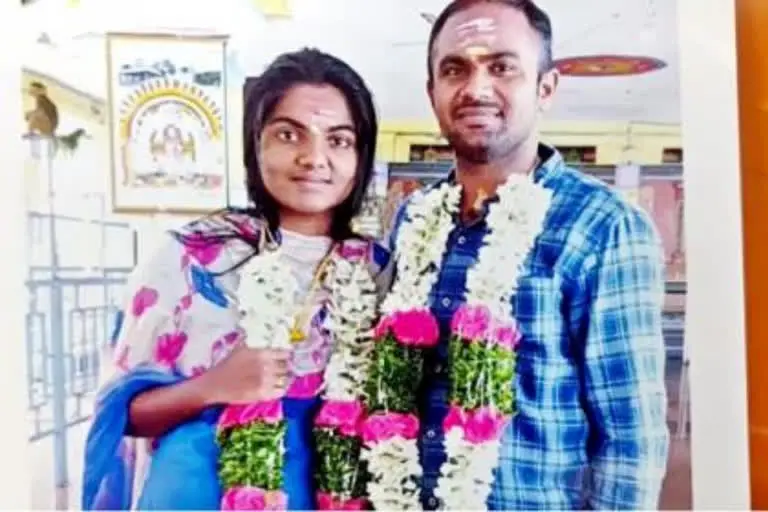
Telangana police say father-in-law paid contract to kill son-in-law
Police on Sunday confirmed an honour killing in Telangana's Yadadri Bhuvanagiri district. Erukula Ramakrishna (32), missing from Bhuvanagiri town since Friday, was found dead in Kondapaka mandal of Siddipet district. ACP Venkat Reddy said father-in-law Pallepati Venkatesh struck a Rs 10 lakh deal, paying Rs 6 lakh to one Latif, because his daughter Bhargavi had married outside their caste. Of 11 people involved, four are in custody and seven are absconding.
Source
Yadadri Bhuvanagiri — crime · read the original report ↗
Desk check · some claims need care
What the desk checked (5)
- Erukula Ramakrishna (32) went missing on Friday and his body was found on Sunday near Peddammatalli temple in Kondapaka mandal, Siddipet district. — Attributed to police; dates and place appear consistently in source.
- Father-in-law Pallepati Venkatesh paid a contract of Rs 10 lakh, of which Rs 6 lakh was given to Latif, to kill Ramakrishna over an inter-caste marriage. — Attributed to police based on interrogation of accused Amritaiah and Latif; not independently established in source.
- Bhargavi, the victim's wife, filed a missing complaint on April 16 saying her husband left with Amritaiah of Jammapur on April 15. — Attributed to the complaint cited by police.
- 11 people were involved; Latif, Divya, Afsar and Mahesh are in custody and seven others are absconding. — Figures stated by Bhuvanagiri ACP Venkat Reddy; internally consistent (4 in custody + 7 at large = 11).
- Venkatesh's role as the alleged conspirator is described as confirmed, while a linked report says the accused father-in-law died by suicide. — Source mentions the related report only as a link headline; status of Venkatesh is not clarified in this text — editor should verify before publishing.
Analysts’ view opinion
This is more than an ordinary murder case: because police themselves attribute the motive to an inter-caste marriage, it goes to the heart of the right to life under Article 21 and the settled principle that consenting adults may choose their own partner. The allegation that a contract killing was paid for widens the case well beyond the act of killing itself, into criminal conspiracy and disposal of a body; with seven of eleven named suspects still absconding, the investigation is at an early stage. Everything on record so far is a police allegation and statements described as confessions — matters still to be proved in court.
- On the police account this is not a lone-hand crime; paying for a killing brings in conspiracy and joint-liability principles under which people who never wielded a weapon can be equally culpable.
- Statements described as confessions made to police carry little independent evidentiary weight at trial; what will matter is the recoveries, the body, call records and any money trail that flow from them.
- The body was found in one district while the attack is said to have happened in another mandal, so jurisdiction, transfer of the case and coordinated investigation could become live procedural issues.
- The immediate procedural track is arrest of the seven absconders, remand of those in custody, filing of a charge sheet within the statutory period, and the bail applications that will follow.
- Since the conspiracy surfaced from the wife's missing-person complaint, she is a central witness — and in honour-killing prosecutions witness pressure and retraction are recognised risks, making protection for her and the child a genuine rights question.
What to watch — Watch the remand orders, whether the seven absconders are arrested, and which sections the charge sheet ultimately carries — especially how firmly the conspiracy allegation is framed.
The account rests on police statements alone: no guilt has been established in court, the accused's version is not on record, and the story does not specify the sections invoked in the FIR.
Deep dive
Research brief · 8 facts · 7 dates · exam-readyThe brief
Context
Police in Telangana's Yadadri Bhuvanagiri district confirmed on Sunday (April 18, 2022) that the killing of 32-year-old Erukula Ramakrishna, a home guard turned real estate businessman, was an honour killing. His father-in-law, Pallepati Venkatesh, a Village Revenue Officer, allegedly paid a contract ("supari") to have him killed because his daughter Bhargavi had married Ramakrishna, who belonged to another caste. The couple had married in August 2020 at a temple and had a 10-month-old daughter. The conspiracy surfaced after Bhargavi filed a missing complaint and police interrogated an acquaintance, Amritaiah.
Key facts
- Erukula Ramakrishna (32) went missing from Bhuvanagiri town on Friday; his body was found on Sunday on the foundation of an under-construction railway line near Peddammatalli temple, Kondapaka mandal, Siddipet district.
- Police say father-in-law Pallepati Venkatesh struck a Rs 10 lakh contract to kill Ramakrishna and paid Rs 6 lakh to Latif of Siddipet.
- The stated motive: Venkatesh's daughter Bhargavi had married Ramakrishna, who belonged to another caste.
- A total of 11 people were involved; Latif, his wife Divya, Afsar and Mahesh are in custody, seven others are absconding.
- Bhargavi lodged a complaint at the Town Police Station on April 16, saying her husband had left with one Amritaiah of Jammapur on April 15 and not returned.
- Amritaiah, taken into custody, revealed the Latif gang of Siddipet's involvement; Latif later confessed during interrogation.
- Ramakrishna was lured to a lemon orchard in Gundala mandal by Amritaiah, where the killers attacked him with a knife and a hammer before dumping the body in Siddipet district.
- Ramakrishna, a native of Lingarajupalli in Valigonda mandal, had joined as a home guard 10 years ago and served at Valigonda and later Yadagirigutta Police Station.
Timeline
- About 10 years before 2022Ramakrishna joined as a home guard; initially posted at Valigonda, later transferred to Yadagirigutta Police Station.
- August 2020Ramakrishna married Bhargavi at Jadala Ramalingeswara Swamy temple, Chervugattu, Nalgonda district.
- After the marriageCouple lived at Lingarajupalli and then Nalgonda; Venkatesh forcibly took Bhargavi home and pressed her to leave Ramakrishna, but she returned to her husband.
- LaterRamakrishna shifted to Thathanagar in Bhuvanagiri town, entered the real estate business, and lived with his wife and 10-month-old daughter.
- April 15, 2022Ramakrishna left home with Amritaiah of Jammapur and did not return; he was taken to a lemon orchard in Gundala mandal and killed.
- April 16, 2022Bhargavi lodged a missing complaint at the Town Police Station.
- April 17-18, 2022 (Sunday)Body found in Kondapaka mandal, Siddipet district; ACP Venkat Reddy and inspector Satyanarayana briefed the media on Sunday night.
Who has a stake
- Bhargavi, wife of the deceased — Lost her husband; her missing-person complaint triggered the investigation that named her own father as the conspirator.
- Erukula Ramakrishna (deceased) and his 10-month-old daughter — Victim of the alleged honour killing; the infant is left without a father.
- Pallepati Venkatesh, father-in-law and a VRO — Named by police as the man who paid the supari; faces criminal liability and loss of government position.
- Bhuvanagiri police (ACP Venkat Reddy, inspector Satyanarayana) — Responsible for cracking the conspiracy, arresting the seven absconders and proving the case in court.
- Latif, Divya, Afsar, Mahesh and seven absconding accused — Alleged contract killers; four in custody, seven being hunted.
- Inter-caste married couples in Telangana — Their physical safety and the credibility of state protection against family and caste-based violence.
Why it matters
The case shows how caste endogamy is still enforced through lethal violence, with a serving government employee allegedly hiring a gang to kill his own son-in-law. It also highlights the risk faced by inter-caste couples even after years of marriage and parenthood, and the investigative burden on police when killings are outsourced to contract gangs across district lines.
UPSC angle
Prelims pointers
- Districts involved: Yadadri Bhuvanagiri (victim's home) and Siddipet (body recovered, Kondapaka mandal) in Telangana.
- ACP Venkat Reddy of Bhuvanagiri and town inspector Satyanarayana briefed the media on April 18, 2022.
- Alleged contract amount: Rs 10 lakh total, Rs 6 lakh paid upfront to Latif of Siddipet.
- 11 accused in all: four (Latif, Divya, Afsar, Mahesh) in custody, seven absconding.
- The accused father-in-law Pallepati Venkatesh worked as a Village Revenue Officer (VRO); the victim was a home guard.
- Marriage solemnised in August 2020 at Jadala Ramalingeswara Swamy temple, Chervugattu, Nalgonda district.
Mains framing
So-called honour killings arise where marriage is treated as a transaction between castes rather than a choice between consenting adults; this Telangana case shows the pattern in full, from coercive attempts to separate the couple (Bhargavi was forcibly taken home and pressed to leave her husband) to a Rs 10 lakh contract killing executed by a hired gang and the body dumped in another district. Two features deserve attention: the alleged conspirator was himself a public servant (a VRO), indicating that state employment does not dilute caste enforcement within families; and the outsourcing of the killing to an 11-member network complicates detection, since the immediate assailants have no obvious motive and the trail depends on one insider (here, Amritaiah) breaking down. Implications include the deterrent value of prompt police action after a missing complaint, the need for witness and spouse protection once a family member is named, and the importance of tracing the seven absconders so the conspiracy, not just the execution, is proved in court. A grounded way forward lies in faster registration and investigation of disappearances of inter-caste spouses, protection and safe-housing support for such couples, and criminal accountability for financiers of contract killings alongside the actual killers.
Key terms
- Honour killing
- Murder of a family member, typically for marrying outside caste or religion, framed by perpetrators as restoring family honour.
- Supari
- Colloquial term for a paid contract to commit murder; here Rs 10 lakh was allegedly promised, Rs 6 lakh paid.
- VRO (Village Revenue Officer)
- Village-level revenue functionary; the post held by the accused father-in-law Pallepati Venkatesh.
- Home guard
- Auxiliary force volunteer assisting the police; the victim Ramakrishna had served as one for about 10 years.
- ACP (Assistant Commissioner of Police)
- Police officer rank; ACP Venkat Reddy of Bhuvanagiri led the questioning that exposed the conspiracy.
- Mandal
- Sub-district administrative unit in Telangana, such as Kondapaka, Gundala, Valigonda and Yadagirigutta mandals in this case.
Practice questions
- Honour killings persist despite constitutional guarantees of individual liberty. Examine the social causes and suggest legal and administrative measures, using recent instances from Telangana.
- How does the outsourcing of murder to contract gangs complicate criminal investigation? Discuss with reference to the Yadadri Bhuvanagiri case of April 2022.
- What institutional protections should be available to inter-caste couples who face coercion from their own families? Critically evaluate.
Grounded only in the source report — figures and dates are the source's, not inferred.