
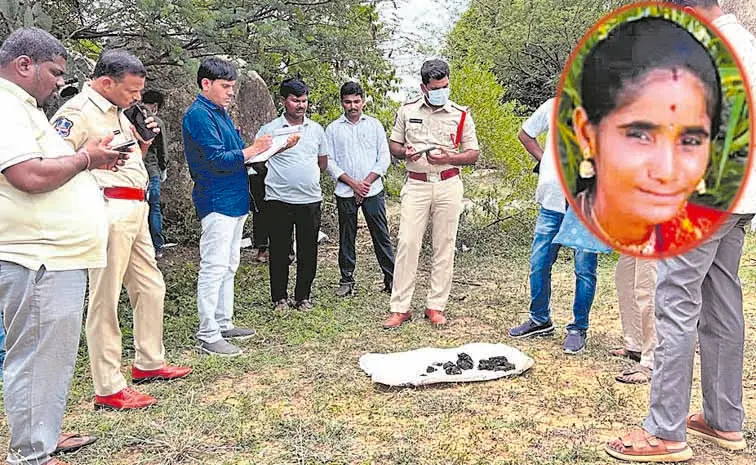
Woman killed in Nagarkurnool district, husband's friend surrenders
Police said Kavati Anusha (25) of Kotra village in Veldanda mandal, Nagarkurnool district, was killed by her husband's friend Shyampuri Ramulu. According to police, Ramulu, resentful that she was distancing herself, took her on his bike from Kalwakurthy on Wednesday night, strangled her near a mango orchard and burnt the body on a pyre he had prepared earlier. He surrendered at Veldanda police station at midnight. A post-mortem was held at the spot before Achampet DSP Srinivasulu.
Source
Nagarkurnool — వార్తలు · read the original report ↗
Desk check · some claims need care
What the desk checked (5)
- Kavati Anusha (25), married six years to Naramalla Chennaiah of Kotra village, was strangled on Wednesday night — Attributed to police account in source; age and timeline appear in source
- Accused Shyampuri Ramulu, a friend of the husband, had an extramarital relationship with Anusha and killed her out of resentment at being distanced — Motive attributed to police narrative based on accused's statement; not independently verifiable
- Ramulu gathered firewood on Sunday and prepared a pyre at Vaddoniralla on the town outskirts four days in advance — Appears in source as police version; no other sourcing given
- Ramulu surrendered at Veldanda police station at midnight Wednesday and confessed — Stated in source; attributed to police
- Post-mortem was conducted at the spot in the presence of Achampet DSP Srinivasulu, and bones and other items were handed to the husband — Officials named in source: CI Raghuveer Reddy, SI Yugandhar Reddy, DSP Srinivasulu
Analysts’ view opinion
On the police account, this reads as an alleged premeditated killing with a second, separate layer of criminality: the claimed advance preparation of a funeral pyre, the strangulation, and the subsequent burning of the body point to both premeditation and destruction of evidence. Although the accused is said to have walked into a police station and confessed, a confession made to police carries very limited evidentiary value under Indian evidence law and cannot by itself sustain a conviction. The strength of the case will therefore rest on forensics — DNA identification of the recovered bones, the on-site post-mortem record, call data and witness statements.
- Where a body has been burnt, establishing identity and cause of death is the hardest evidentiary hurdle, making the bone DNA analysis, forensic report and the post-mortem conducted at the scene central to the prosecution.
- A confession to police is generally inadmissible at trial, though the fact of a discovery made on the strength of information given by an accused can be treated as evidence.
- If the police claim that firewood was gathered days earlier and a pyre readied is proved, it is the kind of fact a prosecution would use to argue intent rather than a sudden act.
- The role of the second person said to have helped burn the body will have to be tested in investigation — whether it attracts charges relating to causing disappearance of evidence or shielding an offender.
- Surrender does not dilute rights: the presumption of innocence, access to counsel and production before a magistrate on remand all apply, and a press account is no substitute for trial.
What to watch — Watch which sections are invoked in the FIR, whether the accused is produced before a magistrate and remanded, whether forensic and DNA reports confirm identification, and whether the second man is formally charged.
Every detail here rests on a preliminary police narrative; nothing has been proved in court, the accused's own version is not on record, and the story does not specify the exact sections of law invoked.
Deep dive
Research brief · 8 facts · 7 dates · exam-readyThe brief
Context
In Kotra village of Veldanda mandal, Nagarkurnool district (Telangana), a 25-year-old woman, Kavati Anusha, was strangled and her body burnt on a pre-prepared pyre. According to police, she had married Naramalla Chennayya six years earlier in an inter-caste love marriage; her husband's close friend Shyampuri Ramulu grew close to the family and later developed a relationship with Anusha. Police say Ramulu, angered that she was distancing herself and refusing to meet him, planned the killing days in advance. He surrendered at Veldanda police station at midnight on Wednesday.
Key facts
- The victim, Kavati Anusha, was 25 years old and belonged to Kotra village, Veldanda mandal, Nagarkurnool district.
- Anusha and Naramalla Chennayya had an inter-caste love marriage six years ago and have a four-year-old son.
- Anusha worked at a shop in Kalwakurthy; on Wednesday evening she waited at Hyderabad Chowrasta for an auto to her village.
- Around 7 p.m. on Wednesday, the accused Shyampuri Ramulu took her on his bike saying he was going to the village.
- Police say Ramulu gathered firewood and prepared a pyre at Vaddoneeralla on the town outskirts on Sunday itself, four days in advance.
- She was strangled near a mango orchard on the Kotra Gate–Hyderabad road; the body was then taken to the pyre, doused with diesel and burnt.
- Ramulu called Nayini Srinu of the same village, related to him as a son-in-law, to the spot after the killing.
- Ramulu surrendered at Veldanda police station at midnight on Wednesday and confessed to the murder.
Timeline
- Six years agoAnusha and Chennayya marry in an inter-caste love marriage; they later have a son, now four.
- Sunday (before the crime)Ramulu collects firewood and prepares a pyre at Vaddoneeralla on the outskirts of the town.
- Wednesday eveningAnusha finishes work in Kalwakurthy, reaches Hyderabad Chowrasta and phones her husband saying she is waiting for an auto.
- Wednesday, around 7 p.m.Ramulu takes her on his bike; she is later attacked and strangled near a mango orchard on the Kotra Gate–Hyderabad road.
- Wednesday nightThe body is taken to the prepared pyre, doused with diesel and burnt; Chennayya, unable to reach her switched-off phone, checks the shop and approaches police.
- Wednesday midnightRamulu, alarmed that Chennayya was searching for his wife, surrenders at Veldanda police station.
- After the surrenderVeldanda CI Raghuveer Reddy and SI Yugandhar Reddy reach the spot; post-mortem is conducted there before Achampet DSP Srinivasulu, and bones and other items are handed to Chennayya.
Who has a stake
- Kavati Anusha (25), victim — Lost her life; a working woman travelling home alone at night who, police say, was killed by a family acquaintance.
- Naramalla Chennayya, husband — Lost his wife; first raised the alarm with police and was handed the recovered bones and belongings.
- Their four-year-old son — Left without his mother; long-term care and custody implications.
- Shyampuri Ramulu, accused — Surrendered and confessed; faces murder and evidence-destruction charges and trial.
- Nayini Srinu — Allegedly called to the spot and involved in burning the body; potential liability for aiding and destroying evidence.
- Veldanda police, CI Raghuveer Reddy, SI Yugandhar Reddy, Achampet DSP Srinivasulu — Responsible for recovering forensic evidence from a burnt body and building a case largely on the confession.
Why it matters
The case shows how intimate-partner and acquaintance violence against women often comes from within trusted circles, and how premeditation, here a pyre built four days earlier, aims at destroying the body itself. When a corpse is burnt, investigators must rely on bone fragments, spot post-mortem and confessional evidence, making forensic rigour decisive for conviction. It also underlines the safety risks faced by women commuting home alone at night from work.
UPSC angle
Prelims pointers
- Veldanda mandal and Kalwakurthy lie in Nagarkurnool district, Telangana; Achampet is a police sub-division there.
- Police hierarchy in the story: SI (Sub-Inspector) and CI (Circle Inspector) at station level, DSP at sub-division level.
- A post-mortem was conducted at the scene of the crime itself, in the presence of the Achampet DSP.
- Recovered bones and articles were handed over to the deceased's husband after the spot examination.
- The accused surrendered voluntarily at the police station and confessed; investigation proceeded on information he gave.
Mains framing
The Nagarkurnool case is a textbook instance of premeditated violence against a woman by a person embedded in her domestic circle: police say a husband's friend who had entered the household developed a relationship with the victim and, resenting her withdrawal and refusal to meet him, planned her killing and prepared a pyre four days in advance to destroy the body. Causally, it reflects the intersection of possessive control over women's autonomy, the vulnerability of women commuting alone at night after shop work, and social pressures around inter-caste marriages and extramarital ties. Institutionally, it tests investigative capacity: with the body burnt, the case rests on the accused's confession, the spot post-mortem, recovered bone fragments and corroborating circumstantial links such as the bike ride, the switched-off phone and the associate summoned to the scene, with the risk that a retracted confession weakens the prosecution. The way forward, on the source's facts, lies in forensic-led investigation and careful chain-of-custody of remains, prompt action on missing-person complaints like the husband's, examination of the associate's role in destroying evidence, and attention to safe transport and reporting mechanisms for women workers returning home late.
Key terms
- Mandal
- An administrative sub-unit of a district in Telangana; Veldanda is the mandal where the crime occurred.
- DSP (Deputy Superintendent of Police)
- Sub-divisional police officer; here Achampet DSP Srinivasulu oversaw the spot post-mortem.
- Post-mortem
- Medico-legal autopsy to establish cause of death; conducted at the crime spot in this case on the burnt body.
- Premeditation
- Advance planning of a crime; here the accused allegedly built a pyre on Sunday for a Wednesday killing.
- Surrender
- Voluntary appearance of an accused before police; Ramulu surrendered at Veldanda police station at midnight.
Practice questions
- Discuss how violence against women by known persons within the household circle challenges existing policing and prevention frameworks, using recent cases.
- When a body is burnt to destroy evidence, what investigative and forensic steps become critical for a successful prosecution? Explain with reference to this case.
- Examine the safety of women workers commuting at night in small towns and suggest administrative measures to reduce risk.
Grounded only in the source report — figures and dates are the source's, not inferred.