
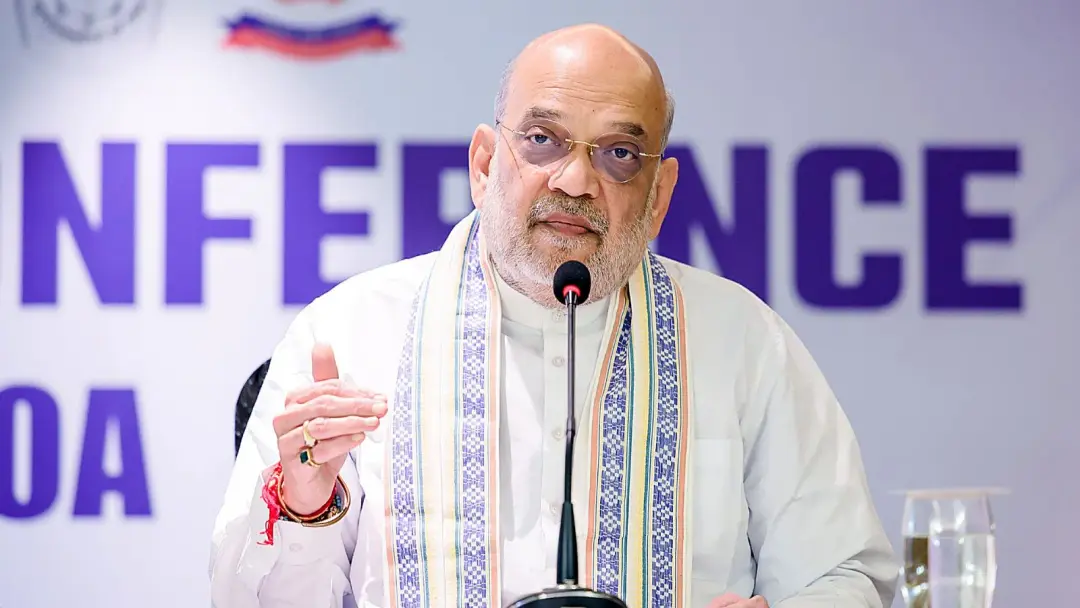
Six states sign Kishau project pact, ending eight-year deadlock
Six Yamuna basin states — Himachal Pradesh, Haryana, Uttarakhand, Uttar Pradesh, Delhi and Rajasthan — signed an agreement on the Kishau Multipurpose Project in New Delhi on Tuesday. Union Home Minister Amit Shah called it historic and the 10th water dispute resolved since Narendra Modi became Prime Minister. Stalled for over eight years, the 422-MW project is estimated to cost Rs 15,624 crore. A 232.6-metre dam on the Tons river will irrigate about 97,000 hectares. The Centre will bear 90 per cent of the water component cost.
Source
Indian Express — Cities · read the original report ↗
Desk check · compared with the source
What the desk checked (5)
- Six Yamuna basin states signed an agreement on the Kishau Multipurpose Project in New Delhi on Tuesday. — Attributed to the source report, which names all six states and the signing chief ministers; internally consistent.
- It is the 10th water dispute resolved since Narendra Modi became PM. — Explicitly a claim by Union Home Minister Amit Shah, not independently verified in the source.
- The 422-MW project involves a 232.6-metre dam on the Tons river, storage of 1,562 MCM, irrigation of about 97,000 hectares and 1,476 million units of hydropower, at a cost of Rs 15,624 crore. — Figures appear in the source and are attributed to Shah; project cost figure given without further attribution.
- The Centre will bear about 90% of the water component cost, with states sharing 10% as per the 1994 Yamuna water agreement. — Figure appears in source as terms of the agreement; no document cited.
- Himachal secured that its Rs 2,000-crore power component would be borne by Delhi, Rajasthan and Haryana, and will get about 1,000 MU annually worth around Rs 1,200 crore. — Attributed to Himachal CM Sukhvinder Singh Sukhu; described as an in-principle understanding, no Centre confirmation in source.
Analysts’ view opinion
On paper the Kishau pact is a water agreement; politically it is a showcase of the Centre's ability to broker consensus. With five of the six signatory states run by the BJP/NDA and only one by the Congress, alignment was comparatively easier to achieve — and that hands the Centre a ready-made 'cooperative federalism' talking point. Amit Shah's framing of this as the 10th water dispute resolved under PM Modi shows an effort to convert river disputes into a countable governance record.
- Five NDA chief ministers and one Congress chief minister signing on the same stage is a politically favourable optic for the Centre.
- Delhi being described as the biggest beneficiary, alongside the Yamuna clean-up goal, gives the capital's government a visible win on water and river issues.
- In Himachal, CM Sukhu's pitch that he refused a burden accepted by the previous government is plainly aimed at the state's ruling-versus-opposition contest.
- Sukhu signing with the Centre while simultaneously restating Himachal's hydropower royalty demands is a calibrated 'cooperate and keep bargaining' strategy.
- The argument that displacement and environmental-social costs fall disproportionately on hill states could become a source of local political pressure later.
What to watch — Watch whether the in-principle understanding that Delhi, Rajasthan and Haryana absorb Himachal's roughly Rs 2,000-crore power-component share is put in writing, or becomes a fresh inter-state friction point.
The story records an agreement being signed but does not establish final clarity on rehabilitation, forest and environmental clearances, the Himachal power-share liability, or any construction timeline.
Deep dive
Research brief · 8 facts · 6 dates · exam-readyThe brief
Context
The Kishau Multipurpose Project is a long-planned dam on the Tons river, a tributary of the Yamuna, on the Uttarakhand–Himachal Pradesh border. It had been stalled for more than eight years over cost-sharing and consent among the Yamuna basin states. On Tuesday, six states — Himachal Pradesh, Haryana, Uttarakhand, Uttar Pradesh, Delhi and Rajasthan — signed an agreement in New Delhi in the presence of Union Home Minister Amit Shah and Union Jal Shakti Minister C R Patil. Shah called it the 10th water dispute resolved since Narendra Modi became Prime Minister.
Key facts
- The project involves a 232.6-metre-high concrete gravity dam on the Tons river along the Uttarakhand-Himachal Pradesh border.
- Capacity: 422 MW; storage 1,562 million cubic metres; irrigation of about 97,000 hectares; generation of 1,476 million units of hydropower, as per Amit Shah.
- Estimated cost: Rs 15,624 crore; the Centre will bear around 90 per cent of the water component, states 10 per cent as per the 1994 Yamuna water agreement.
- The pact was signed by CMs Sukhvinder Singh Sukhu, Nayab Singh Saini, Pushkar Singh Dhami, Yogi Adityanath, Rekha Gupta and Bhajanlal Sharma.
- Shah said a formal agreement was reached on June 16 after the Ministry of Jal Shakti secured all states' consent and examined technical and economic aspects.
- Himachal CM Sukhu said the Centre agreed in principle that the Rs 2,000-crore power component falling on Himachal would be borne by beneficiary states Delhi, Rajasthan and Haryana.
- Delhi CM Rekha Gupta said the capital will receive around 110 million cubic metres (MCM) of water from the project.
- Shah said 25 per cent of the water would become available through the pact for environmental flow, and that a clean Yamuna would be achieved by 2029.
Timeline
- 1994Yamuna water agreement fixes water sharing among basin states; it now governs the 10 per cent state share of the water component cost.
- Over eight years before the signingThe 422-MW Kishau Multipurpose Project remains stalled.
- 2018 to 2026Period Shah said would be remembered for resolving almost all major water disputes, from Kashmir to Uttar Pradesh.
- June 16Formal agreement reached after Ministry of Jal Shakti secured consent of all states and examined technical and economic aspects.
- Tuesday (day of the story)Six Yamuna basin states sign the Kishau agreement in New Delhi with Amit Shah and C R Patil present.
- 2029Target year Shah cited for achieving a clean Yamuna.
Who has a stake
- Himachal Pradesh — Faces displacement and environmental and social costs; secured relief on the Rs 2,000-crore power component and expects about 1,000 MU power a year, worth around Rs 1,200 crore.
- Delhi — Described by Shah as the biggest beneficiary; CM Rekha Gupta says the city will get around 110 MCM of water and better Yamuna environmental flow.
- Uttarakhand — Hosts the dam site along with Himachal; Sukhu said comparatively more villages would be affected in Uttarakhand than in Himachal.
- Uttar Pradesh — CM Yogi Adityanath expects expanded irrigation, stronger drinking water availability and improved Yamuna flow and cleanliness.
- Rajasthan and Haryana — Beneficiary states for water and, per Sukhu, expected to bear Himachal's power component share; Rajasthan cites irrigation and drinking water gains.
- Union Ministry of Jal Shakti / Centre — Secured state consent, examined technical and economic aspects, and will fund about 90 per cent of the water component.
- Affected families in project villages — Face displacement; Sukhu assured adequate compensation under applicable land acquisition provisions.
Why it matters
Inter-state river water disputes have stalled major storage and hydropower projects for decades, and the Kishau pact shows how negotiated cost-sharing can unlock them. For Delhi and the wider Yamuna basin it promises drinking water, irrigation for about 97,000 hectares and, for the first time, a share of flow reserved for the river itself. It also reopens the larger question of how much upstream hill states like Himachal should be compensated for bearing displacement and ecological costs of hydropower.
UPSC angle
Prelims pointers
- Kishau Multipurpose Project: 232.6-m concrete gravity dam on the Tons river, on the Uttarakhand-Himachal Pradesh border; 422 MW.
- Six signatories: Himachal Pradesh, Haryana, Uttarakhand, Uttar Pradesh, Delhi, Rajasthan; cost Rs 15,624 crore.
- Storage 1,562 MCM; irrigation about 97,000 hectares; 1,476 million units of hydropower.
- Cost-sharing: Centre about 90 per cent of water component; states 10 per cent as per the 1994 Yamuna water agreement.
- Other projects cited by Shah: Lakhwar Multipurpose, Shahpur Kandi Dam, Renukaji Multipurpose Dam, Ken-Betwa Link.
- Himachal currently gets 12 per cent free power royalty plus 1 per cent under the Local Area Development Fund.
Mains framing
The Kishau agreement illustrates both the promise and the fault lines of cooperative federalism in river basin management. The project, stalled for over eight years, moved only after the Ministry of Jal Shakti secured the consent of all six Yamuna basin states and the Centre agreed to absorb about 90 per cent of the water component of the Rs 15,624-crore cost, with the balance shared under the 1994 Yamuna water agreement. The deadlock was rooted in an asymmetry of costs and benefits: downstream states such as Delhi, Haryana, Rajasthan and Uttar Pradesh gain drinking water and irrigation for about 97,000 hectares, while upstream Himachal Pradesh and Uttarakhand bear submergence, displacement and ecological costs — which is why Himachal refused the earlier Rs 800-crore commitment and obtained an in-principle understanding that its roughly Rs 2,000-crore power component would be met by beneficiary states. A second gap the pact addresses is ecological: Shah noted that the Yamuna's environmental flow was never accounted for in the original allocation, and 25 per cent of the water is now to be available for the river. The way forward lies in transparent, time-bound rehabilitation under land acquisition provisions, a durable formula for sharing hydropower benefits with hill states — as Sukhu's demand for higher free power royalty suggests — and linking storage creation to the clean Yamuna and clean Ganga goals.
Key terms
- Kishau Multipurpose Project
- A 422-MW, Rs 15,624-crore dam project on the Tons river for storage, irrigation, drinking water and hydropower in the Yamuna basin.
- Tons river
- River along the Uttarakhand-Himachal Pradesh border on which the 232.6-metre Kishau dam is proposed; part of the Yamuna basin.
- 1994 Yamuna water agreement
- Pact among Yamuna basin states that governs water sharing and, here, the 10 per cent state share of the water component cost.
- Environmental flow
- Water left in the river for its own ecological health; Shah said it was not accounted for in the original Yamuna allocation.
- Free power royalty
- Share of electricity a host state receives free from a hydropower project; Himachal now gets 12 per cent, plus 1 per cent for local area development.
- Local Area Development Fund
- Fund financed by a 1 per cent levy from hydro projects, meant for development in areas affected by such projects.
Practice questions
- Inter-state water disputes persist because costs and benefits of storage projects fall on different states. Examine this with reference to the Kishau Multipurpose Project agreement.
- How does the Kishau agreement reflect the practice of cooperative federalism in India? Discuss the role of the Union government as a facilitator.
- Should upstream hill states receive a larger share of hydropower benefits in return for bearing displacement and ecological costs? Critically discuss.
Grounded only in the source report — figures and dates are the source's, not inferred.