
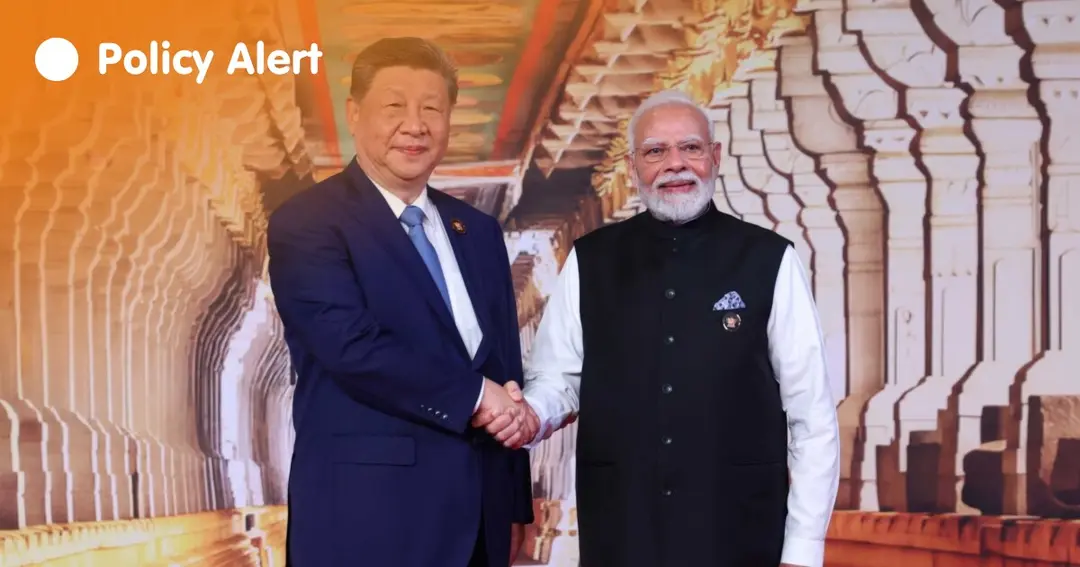
Xi attends BRICS summit in New Delhi hosted by Modi
The two-day BRICS summit chaired by Prime Minister Narendra Modi concluded in New Delhi on Sunday. Chinese President Xi Jinping's attendance was his first visit to India in more than six years, according to a European Council on Foreign Relations analysis. It described India-China normalisation as tactical de-escalation rather than realignment and urged Europe to accelerate ties with India. The EU and India signed a free-trade agreement and a security and defence partnership in January. BRICS membership has grown from five to eleven countries.
Source
BRICS / G20 / SCO / Quad · read the original report ↗
Desk check · compared with the source
What the desk checked (5)
- The two-day BRICS summit chaired by Narendra Modi concluded in New Delhi on Sunday, with Xi Jinping attending. — Stated in source, dated 15 September 2026; photo caption places Xi's arrival on 12 September 2026. No independent verification possible.
- This was Xi Jinping's first visit to India in more than six years. — Asserted in source without supporting detail.
- The EU and India signed a free-trade agreement in New Delhi in January, alongside a new security and defence partnership. — Presented as background fact in the source; no document or official cited.
- BRICS has grown from five to eleven members, including Egypt, Ethiopia, Iran, Saudi Arabia and the UAE. — Figure and names appear in the source; membership expansion attributed to moves at the 2023 summit.
- India's normalisation with China is tactical de-escalation rather than realignment, and the EU should accelerate ties with India. — Author's assessment and policy recommendation, not a verifiable fact.
Analysts’ view opinion
Xi Jinping's first visit to India in more than six years is a visible marker of Sino-Indian normalisation — but the ECFR analysis reads it as tactical de-escalation rather than any strategic realignment. Delhi still treats Beijing as a security threat while cautiously opening doors to Chinese investment in manufacturing and climate technology, a dual-track approach driven by developmental need alongside enduring mistrust. Modi's effort to keep BRICS from becoming a purely anti-Western vehicle signals that India does not want to be boxed into any single camp.
- Anti-Western rhetoric featured at the summit, yet the declaration was limited — a reminder that BRICS is defined more by internal divisions than by shared strategic weight.
- Expansion from five to eleven members adds political breadth but complicates consensus, with regional rivals such as Iran and the UAE now inside the same tent.
- The clearest warning for Europe is that if India cannot source technology and capital from European partners, it will turn to China — which hands Delhi real bargaining leverage.
- Europe's credibility now rests on execution of the January EU-India free-trade agreement and the new security and defence partnership, with semiconductors, AI and clean-tech supply chains as the test cases.
- Strained transatlantic ties and uncertainty around the Trump administration are pushing both Brussels and Delhi towards diversifying their partnerships.
What to watch — Watch Modi's anticipated Brussels visit later this year for concrete movement on an upgraded Trade and Technology Council, defence cooperation, and India's entry into the Horizon Europe programme.
The story does not establish what specific India-China agreements were reached around the summit, nor whether there has been any movement on the border dispute, and it offers no basis for judging how durable this normalisation will prove.
Deep dive
Research brief · 8 facts · 7 dates · exam-readyThe brief
Context
The BRICS summit, chaired by Indian Prime Minister Narendra Modi, concluded in New Delhi on Sunday after a two-day gathering at Bharat Mandapam. Chinese President Xi Jinping's presence marked his first visit to India in more than six years, following a sustained period of Sino-Indian tensions. A European Council on Foreign Relations (ECFR) policy alert dated 15 September 2026 reads the India-China thaw as tactical de-escalation rather than a realignment, and argues Europe should accelerate its own deepening of ties with India. The EU and India had signed a free-trade agreement and a security and defence partnership in New Delhi in January.
Key facts
- The two-day BRICS summit, chaired by PM Narendra Modi, concluded in New Delhi on Sunday; Modi welcomed Xi Jinping at Bharat Mandapam on 12 September 2026.
- It was Xi Jinping's first visit to India in more than six years.
- The summit brought together the leaders of China, India and Russia and featured, per ECFR, plenty of anti-Western rhetoric.
- This year's summit produced only a limited declaration with vague promises to enhance cooperation.
- The EU and India signed a landmark free-trade agreement in New Delhi in January, alongside a new security and defence partnership.
- BRICS began with Brazil, Russia, India, China and South Africa and has since grown to eleven members, including Egypt, Ethiopia, Iran, Saudi Arabia and the UAE.
- India supported the major membership expansion agreed at the 2023 BRICS summit.
- ECFR notes Modi is expected to visit Brussels later this year; the analysis is dated 15 September 2026.
Timeline
- 2023 BRICS summitIndia supports moves to agree a major expansion of BRICS membership.
- January (this year)EU and India sign a landmark free-trade agreement in New Delhi, alongside a new security and defence partnership.
- Past yearIndia-China normalisation advances, with more measures agreed to give Chinese investment access in manufacturing and climate technology.
- 12 September 2026Modi welcomes Xi Jinping on arrival for the BRICS summit at Bharat Mandapam, New Delhi.
- Sunday (September 2026)The two-day BRICS summit concludes in New Delhi with a limited declaration; India signs bilateral agreements with China on the sidelines.
- 15 September 2026ECFR publishes its policy alert urging the EU to accelerate Europe-India ties.
- Later this yearModi's anticipated visit to Brussels.
Who has a stake
- India / PM Narendra Modi — As BRICS chair, seeks technology and capital for development while preventing BRICS from becoming a purely anti-Western vehicle against India's interests.
- China / President Xi Jinping — Uses normalisation and the summit to expand investment access in Indian manufacturing and climate technology despite Indian security suspicions.
- European Union / Brussels — Risks losing ground to China in India if it does not deliver on trade, technology, defence and research cooperation.
- Russia — A core BRICS leader present at the summit, invested in the bloc's non-Western positioning.
- United States / President Donald Trump — India still seeks deeper ties with Washington despite difficulties Trump presents; tense transatlantic relations push Europe to diversify.
- New BRICS members (Egypt, Ethiopia, Iran, Saudi Arabia, UAE) — Expanded membership brings weight but also internal division, as with Iran-UAE regional tensions.
Why it matters
Xi's first India visit in over six years signals that the Sino-Indian thaw is real enough to change economic flows, even if the underlying security distrust persists. For India, the balance between Chinese capital, European partnership and a difficult Washington shapes its access to technology in semiconductors, AI and clean-tech. For BRICS, an eleven-member, internally divided bloc that produced only a limited declaration raises the question of how much the grouping can actually deliver.
UPSC angle
Prelims pointers
- BRICS originally stood for Brazil, Russia, India, China and South Africa; membership has since grown to eleven.
- New BRICS members named in the source include Egypt, Ethiopia, Iran, Saudi Arabia and the UAE.
- The 2023 BRICS summit agreed the major membership expansion, supported by India.
- The EU-India free-trade agreement and a security and defence partnership were signed in New Delhi in January.
- The BRICS summit venue in New Delhi was Bharat Mandapam; Xi Jinping arrived on 12 September 2026.
- ECFR proposals for EU-India ties: enhance the Trade and Technology Council, defence-security cooperation, and India's entry into Horizon Europe.
Mains framing
India's hosting of the BRICS summit, with Xi Jinping attending for the first time in more than six years, illustrates the balancing act at the centre of Indian foreign policy. The normalisation with Beijing over the past year is, as ECFR reads it, a tactical de-escalation rather than a realignment: New Delhi still treats China as a security threat yet has agreed measures giving Chinese investment greater access in manufacturing and climate technology, both critical to India's development. That creates leverage as well as risk, and it explains why Modi has worked to keep BRICS from tipping into a purely anti-Western platform even as the bloc's summits carry anti-Western rhetoric. Simultaneously, India is deepening ties with Brussels through the January free-trade agreement and security and defence partnership, and with Washington despite the difficulties the Trump presidency presents. The implication is structural: if India cannot source capital and technology from Europe, it will source them from China. The way forward suggested is faster European delivery, an enhanced Trade and Technology Council covering AI, movement on defence and security cooperation, and progress on India's participation in Horizon Europe, ahead of Modi's expected Brussels visit. Meanwhile BRICS itself, now eleven members with internal rifts such as Iran-UAE, managed only a limited declaration.
Key terms
- BRICS
- Grouping of emerging economies that began with Brazil, Russia, India, China and South Africa and has expanded to eleven members plus observers and partners.
- ECFR (European Council on Foreign Relations)
- Think tank that published the policy alert; it does not take collective positions, its publications reflect only the authors' views.
- Tactical de-escalation
- Reducing friction for immediate practical gains without changing underlying strategic alignment or distrust.
- EU-India Trade and Technology Council
- Existing EU-India mechanism that ECFR says should be enhanced to drive cooperation in areas such as AI.
- Horizon Europe
- EU funding programme for research and innovation which India plans to join.
- Bharat Mandapam
- New Delhi venue where Modi welcomed Xi Jinping for the BRICS summit on 12 September 2026.
Practice questions
- Is India-China normalisation a tactical de-escalation or the beginning of a realignment? Examine with reference to the New Delhi BRICS summit.
- Discuss how BRICS expansion from five to eleven members has affected the bloc's internal cohesion and its ability to issue substantive declarations.
- Evaluate the significance of the EU-India free-trade agreement and security and defence partnership for India's access to technology and capital.
Grounded only in the source report — figures and dates are the source's, not inferred.