
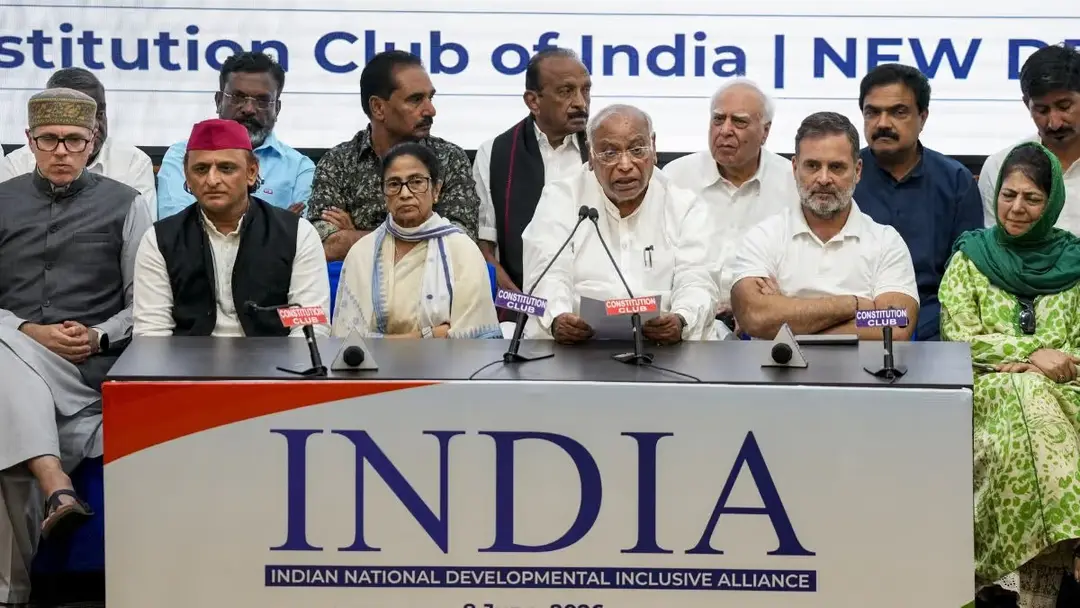
Akhilesh Yadav to skip September 30 INDIA bloc meeting in Delhi
INDIA bloc parties and leaders are gathering in Delhi on September 30, where a strategy against Gyanesh Kumar and the central government is expected to be decided after more than 13 crore names were deleted in the SIR exercise. Akhilesh Yadav has announced he will not attend; another Samajwadi Party leader will represent the party. The party cites Rajya Sabha election work, while insiders link it to delaying seat-sharing talks with Congress. Akhilesh said he has spoken to Mallikarjun Kharge.
Source
Politics · read the original report ↗
Desk check · some claims need care
What the desk checked (5)
- INDIA bloc parties and leaders are meeting in Delhi on September 30, where decisions against Gyanesh Kumar are expected. — Stated in source without named attribution; expectation of decisions is the writer's assessment.
- More than 13 crore names were deleted in the SIR exercise. — Figure appears in source with no source or agency cited; significant number requiring editorial verification.
- Akhilesh Yadav announced he will not attend, and another SP leader will represent the party. — Attributed to Akhilesh Yadav's own announcement as reported in the source.
- Party says Akhilesh is busy with Rajya Sabha election meetings, while insiders say he wants to avoid facing Congress leadership over seat sharing. — Attributed to 'the party' and unnamed party insiders; the seat-sharing motive is unverified inference.
- Akhilesh said he has spoken to Mallikarjun Kharge and a meeting may take place in the first week of October. — Conversation attributed to Akhilesh; the possible meeting is reported as 'charcha' (speculation) with no source.
Analysts’ view opinion
Akhilesh Yadav's absence from the Delhi meeting looks less like a diary clash and more like a bargaining tactic. By sending another Samajwadi Party leader, he keeps the party inside the INDIA bloc's joint campaign over SIR and the Election Commission, while avoiding a face-to-face moment with the Congress leadership that would inevitably turn into seat-sharing talk. Delay serves Akhilesh, who wants to negotiate as Uttar Pradesh's senior partner; delay is exactly what Congress fears.
- Deputising a party representative lets Akhilesh signal loyalty to the bloc without giving Congress a shared-stage photo that shifts the conversation to seats.
- The SIR deletions and criticism of the Election Commission are low-cost, unifying planks for the bloc; seat-sharing is the issue that pits allies directly against each other.
- Congress wants an early deal because, as the story notes, further delay hands the leverage entirely to the SP; Akhilesh appears to be reading the same clock and using it.
- The SP condition that Congress first name its winnable seats and organisationally strong constituencies is designed to make Congress concede its own weakness in UP.
- His "differences outside, together inside" framing lets him rebut talk of a rupture while conceding nothing on numbers yet.
What to watch — Whether the reported Kharge–Akhilesh meeting in the first week of October actually happens, and whether any framework on seat numbers emerges from it, will be the real test of the alliance's health.
The story does not establish that seat-sharing is the actual reason for his absence — the party's stated reason is Rajya Sabha election work, the rest is attributed to party insiders, and what the meeting will decide remains unclear.
Deep dive
Research brief · 8 facts · 5 dates · exam-readyThe brief
Context
Opposition parties in the INDIA bloc are meeting in Delhi on September 30 to decide a joint strategy against Chief Election Commissioner Gyanesh Kumar and the central government, after more than 13 crore names were reportedly deleted in the SIR (Special Intensive Revision) exercise and turmoil inside the Election Commission. Leaders from Mamata Banerjee to Uddhav Thackeray are expected to attend. Samajwadi Party chief Akhilesh Yadav has announced he will stay away, sending another party leader instead. The move has unsettled the Congress, which is pressing the SP to finalise Uttar Pradesh seat-sharing quickly.
Key facts
- INDIA bloc parties and senior leaders are gathering in Delhi on September 30 for a key meeting.
- The meeting is expected to take major decisions against Gyanesh Kumar; strategy against him and the central government will be decided.
- The trigger: more than 13 crore names were deleted in the SIR exercise, amid turmoil within the Election Commission.
- Leaders from Mamata Banerjee to Uddhav Thackeray are expected to set the strategy at the meeting.
- Akhilesh Yadav has announced he will not attend; another SP leader will represent the party.
- The SP's official reason is that Akhilesh is busy with Rajya Sabha election work, including meetings to select candidates.
- Akhilesh has disclosed that he has spoken to Congress president Mallikarjun Kharge; a meeting between them is being discussed for the first week of October.
- Congress wants the number and names of alliance seats settled in October; Congress leader Imran Masood has been pressing the SP hard on seat-sharing.
Timeline
- Before September 30More than 13 crore names deleted in the SIR exercise; turmoil inside the Election Commission prompts Opposition to plan joint action.
- Before September 30Akhilesh Yadav announces he will skip the INDIA bloc meeting; says in a press conference that SP and Congress are together internally even if it looks otherwise outside.
- September 30INDIA bloc meeting in Delhi to decide strategy against Gyanesh Kumar and the central government.
- First week of October (expected)Possible meeting between Akhilesh Yadav and Mallikarjun Kharge.
- October (Congress target)Congress wants seat numbers and specific seats in the alliance finalised.
Who has a stake
- Akhilesh Yadav / Samajwadi Party — Wants to delay seat-sharing talks and negotiate on its own terms; skipping the meeting avoids direct engagement with Congress's top leadership.
- Congress (Mallikarjun Kharge, Rahul Gandhi) — Fears heavy loss if seat-sharing drags on; wants seats fixed in October before Akhilesh can dictate terms.
- INDIA bloc parties (Mamata Banerjee, Uddhav Thackeray and others) — Need a united front against Gyanesh Kumar and the central government over the SIR deletions.
- Gyanesh Kumar and the Election Commission — Target of the Opposition's planned action; facing allegations over 13 crore-plus deletions and internal turmoil.
- Imran Masood (Congress leader) — Has been publicly pressuring the Samajwadi Party over seat-sharing.
- Voters whose names were deleted — Over 13 crore names removed in SIR; their inclusion in electoral rolls is the core issue.
Why it matters
The absence of a major regional ally from a meeting called to confront the Election Commission shows how alliance arithmetic can blunt a joint opposition campaign on an institutional issue. With over 13 crore names reportedly deleted in the SIR exercise, the strength of the Opposition's response depends on whether Congress and the Samajwadi Party can settle Uttar Pradesh seat-sharing, which both want on their own terms.
UPSC angle
Prelims pointers
- INDIA bloc meeting scheduled in Delhi on September 30 to frame strategy against CEC Gyanesh Kumar and the central government.
- SIR (Special Intensive Revision) exercise: more than 13 crore names deleted, as per the source.
- Mallikarjun Kharge is Congress president; Akhilesh Yadav leads the Samajwadi Party.
- Akhilesh Yadav to be represented at the meeting by another SP leader, citing Rajya Sabha election work.
- Congress leader Imran Masood has been pressing the SP on seat-sharing in Uttar Pradesh.
- Congress target: finalise seat numbers and names of seats in October.
Mains framing
The episode illustrates the structural tension in India's coalition opposition politics: a shared institutional grievance (over 13 crore deletions in the SIR exercise and the conduct of the Election Commission under Gyanesh Kumar) is competing with bilateral bargaining over seats. The Samajwadi Party's calculation, per party insiders, is that early negotiations would let Congress build pressure, so it prefers delay and wants Congress to first name the seats where its organisation is strong and its candidates winnable; Congress fears that delay leaves it with no alternative partners and forces it to accept Akhilesh Yadav's terms, hence its push to close the deal in October. The cost of this standoff is a diluted collective front on an electoral-integrity question that affects crores of voters. A way forward, on the source's own logic, lies in separating the two tracks: a common platform on the electoral roll issue, with a parallel leader-level channel — the reported Akhilesh-Kharge conversation and a possible meeting in the first week of October — to settle seat-sharing on transparent criteria of winnability and organisational strength rather than through public pressure.
Key terms
- INDIA bloc
- The opposition alliance of parties, including Congress, Samajwadi Party, TMC and Shiv Sena (UBT), meeting in Delhi on September 30.
- SIR
- The electoral roll revision exercise in which, as per the source, more than 13 crore names were deleted.
- Gyanesh Kumar
- The Chief Election Commissioner against whom the INDIA bloc meeting is expected to take major decisions.
- Seat-sharing
- Allocation of the number and names of constituencies between allies; the sticking point between Congress and the Samajwadi Party.
- Rajya Sabha election
- The upper house polls for which Akhilesh Yadav is holding candidate-selection meetings, cited as his reason for skipping the Delhi meeting.
Practice questions
- Why did Akhilesh Yadav skip the September 30 INDIA bloc meeting, and what does his absence reveal about the trade-off between joint opposition campaigns and bilateral seat-sharing bargaining?
- Discuss how disputes over electoral roll revision (SIR) affect public trust in the Election Commission, and what mechanisms exist to address such allegations.
- Coalition politics in India is shaped less by ideology than by seat arithmetic. Examine with reference to the Congress-Samajwadi Party negotiations described in the story.
Grounded only in the source report — figures and dates are the source's, not inferred.