
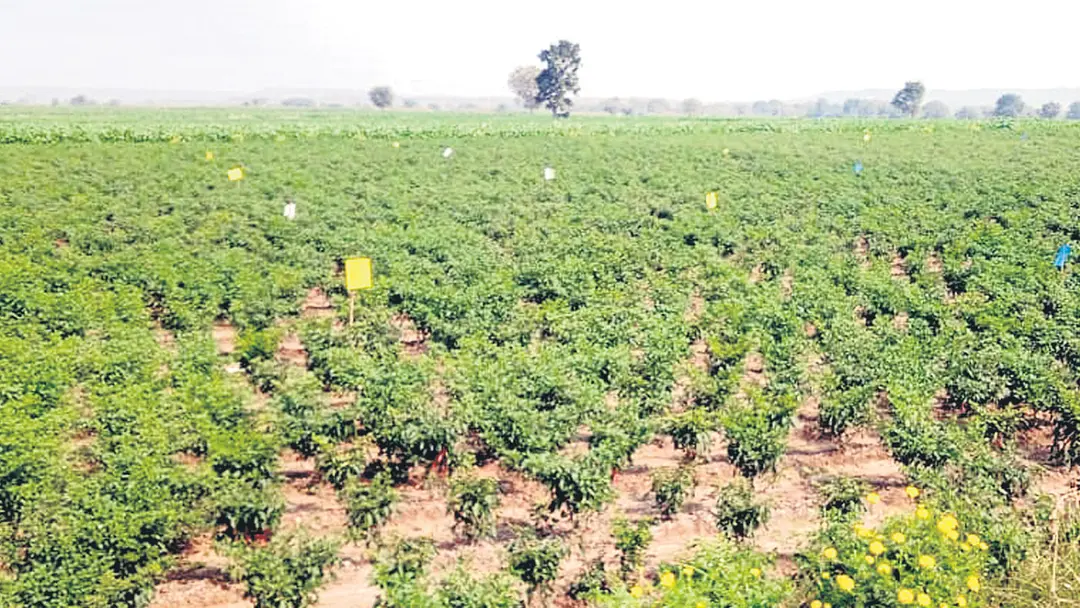
Chilli area rises tenfold in Telangana's Nirmal district
Farmers in Nirmal district are returning to older crops, with agriculture department officials reporting a sharp rise in chilli cultivation. Area under chilli grew from under 200 acres last year to 2,000 acres this kharif season. Officials said weak prices and yields in cotton, maize, groundnut and turmeric prompted the shift. In the 210-day crop, picking begins from day 140 and five pickings yield 20-25 quintals an acre. Dry chilli fetches over Rs 14,000 a quintal and green chilli Rs 4,000-6,000.
Source
Nirmal — వ్యవసాయం · read the original report ↗
Desk check · compared with the source
What the desk checked (4)
- Chilli cultivation in Nirmal district rose from under 200 acres last year to 2,000 acres this kharif season. — Attributed to agriculture department officials in the source; figures appear in the source text.
- Yield is 20-25 quintals per acre, with picking starting from day 140 of a 210-day crop cycle and five pickings. — Attributed to officials in the source; no independent data cited.
- Dry chilli fetches over Rs 14,000 per quintal and green chilli Rs 4,000-6,000 in the market. — Figures appear in the source but no market or date-specific source is named for the rates.
- Farmers shifted to cotton, maize, groundnut and turmeric earlier due to 24-hour power supply and good groundwater, and are now returning to chilli after poor prices and yields. — Presented as background in the source without a named source; internally consistent.
Analysts’ view opinion
Chilli acreage in Nirmal district jumping from under 200 acres to 2,000 acres is essentially farmers responding fast to price signals — weak prices and yields in cotton, maize, groundnut and turmeric squeezed incomes and pushed a switch. With over Rs 14,000 a quintal and 20-25 quintals an acre, per-acre earnings look materially better this season, though the story itself notes chilli demands higher investment. The risk in any mass shift into one crop is that a good season invites more supply next year, which can pull prices down.
- The ten-fold expansion is a voluntary, market-led crop switch rather than a scheme-driven one, showing how strongly price signals now drive cropping decisions.
- Higher reward comes with higher risk: bigger input outlay, pest exposure, and a 210-day cycle that locks up a farmer's working capital for longer.
- Five pickings starting from day 140 stagger the cash flow, which can ease debt servicing pressure compared with single-harvest crops.
- Chilli is more labour-intensive than cotton or maize, so local employment and harvest-season wage demand could rise.
- The story gives farm-gate prices (Rs 14,000+ dry, Rs 4,000-6,000 green) but not consumer prices; more local supply could soften market rates over the medium term.
What to watch — Watch whether the quintal price holds near Rs 14,000 once output from these 2,000 acres reaches the market, and whether storage and marketing infrastructure can absorb the larger crop.
The story does not establish per-acre cost of cultivation, net margins, or how durable these prices are; the acreage, price and yield figures come from agriculture department officials' statements.
Deep dive
Research brief · 8 facts · 5 dates · exam-readyThe brief
Context
Nirmal district in Telangana has seen a sudden revival of chilli cultivation, a crop that was widely grown there about a decade ago. Agriculture department officials say farmers had shifted away from chilli to cotton, maize, groundnut and turmeric after 24-hour power supply and abundant groundwater made those crops easier to grow. With market prices and yields of those crops disappointing, farmers have turned back to chilli in the current kharif season, attracted by strong demand and prices. The district's black cotton soils and high groundwater availability are cited as favourable for the crop.
Key facts
- Area under chilli in Nirmal district rose from under 200 acres last year to 2,000 acres this kharif season, a tenfold increase, per agriculture department officials.
- Chilli cultivation was substantial in Nirmal about ten years ago before farmers switched to cotton, maize, groundnut and turmeric.
- Officials attribute the earlier shift to the government's 24-hour power supply and abundant groundwater availability.
- Poor market prices and reduced yields in cotton, maize, groundnut and turmeric pushed farmers towards crop diversification.
- The chilli crop duration is 210 days, with fruiting/picking starting from day 140 and five pickings in all.
- Yield reported at 20-25 quintals per acre.
- Dry chilli fetches over Rs 14,000 per quintal in the market; green chilli fetches Rs 4,000 to Rs 6,000.
- Farmers say chilli needs higher investment than other crops, but a good harvest clears their difficulties; officials are running pest-control awareness drives.
Timeline
- About ten years agoChilli cultivation was well established in Nirmal district.
- Years after thatWith 24-hour power supply and ample groundwater, farmers prioritised cotton, maize, groundnut and turmeric.
- Up to last yearChilli area in the district remained under 200 acres.
- Current kharif seasonChilli area rises to 2,000 acres as farmers return to the crop.
- December 16-17, 2023Agriculture department officials report the sharp rise in chilli area and good market prices.
Who has a stake
- Chilli farmers of Nirmal district — Higher investment per acre, but prospects of profit from dry chilli above Rs 14,000 a quintal and green chilli at Rs 4,000-6,000.
- Telangana agriculture department (Nirmal district officials) — Tracking the area shift and providing pest-control awareness and advisories to raise yields.
- Cotton, maize, groundnut and turmeric growers — Weak prices and lower yields in these crops are driving them to switch crops.
- Local markets and traders — Strong demand for chilli underpins the current price levels the story reports.
Why it matters
A tenfold jump in one crop's area in a single season shows how quickly price signals reshape cropping choices at the district level, with implications for market arrivals, input demand and farmer incomes. It also highlights the risk side: chilli demands higher investment and is pest-prone, so a price crash or disease outbreak can hurt farmers who abandoned other crops.
UPSC angle
Prelims pointers
- Nirmal district is in Telangana; chilli is grown there on black cotton (nalla regadi) soils with high groundwater.
- Chilli area in Nirmal rose from under 200 acres to 2,000 acres in one kharif season.
- Chilli crop duration cited: 210 days; picking begins from day 140; five pickings; yield 20-25 quintals per acre.
- Reported prices: dry chilli over Rs 14,000 per quintal; green chilli Rs 4,000-6,000.
- Crops farmers moved away from: cotton, maize, groundnut and turmeric.
Mains framing
The tenfold rise in chilli area in Nirmal district is a textbook case of price-led crop substitution. The earlier move away from chilli was driven by enabling conditions - 24-hour power supply and abundant groundwater - that favoured cotton, maize, groundnut and turmeric; the return is driven by the failure of those crops on both price and yield, against strong chilli demand and rates of over Rs 14,000 a quintal for dry chilli. The implications are two-sided: chilli's 210-day duration, five pickings and 20-25 quintal per acre yields offer good returns, but it is capital-intensive and vulnerable to pests, which is why the agriculture department is running awareness programmes on disease control. A sustainable way forward, as the source indicates, lies in extension support for pest management and yield improvement; any wider policy prescriptions on price support, crop insurance or market infrastructure are not stated in the source.
Key terms
- Kharif season
- The monsoon cropping season in India, during which the reported chilli expansion in Nirmal took place.
- Crop substitution / crop change
- Farmers shifting from one crop to another, here from cotton, maize, groundnut and turmeric to chilli, in response to prices and yields.
- Quintal
- Unit of 100 kg used in Indian farm markets; chilli yields here are 20-25 quintals per acre.
- Black cotton soil (nalla regadi)
- Moisture-retentive dark soil abundant in the area, cited as suited to chilli cultivation.
- Agriculture department
- State department whose district officials reported the area figures and provide pest-control advisories to farmers.
Practice questions
- Examine how market prices and yields drive district-level cropping pattern shifts, using the tenfold rise in chilli area in Telangana's Nirmal district as an example.
- What are the risks for farmers who switch to high-investment commercial crops like chilli, and what role can agricultural extension play in mitigating them?
- Discuss how assured power supply and groundwater availability influence farmers' crop choices, with reference to the Nirmal district experience.
Grounded only in the source report — figures and dates are the source's, not inferred.