
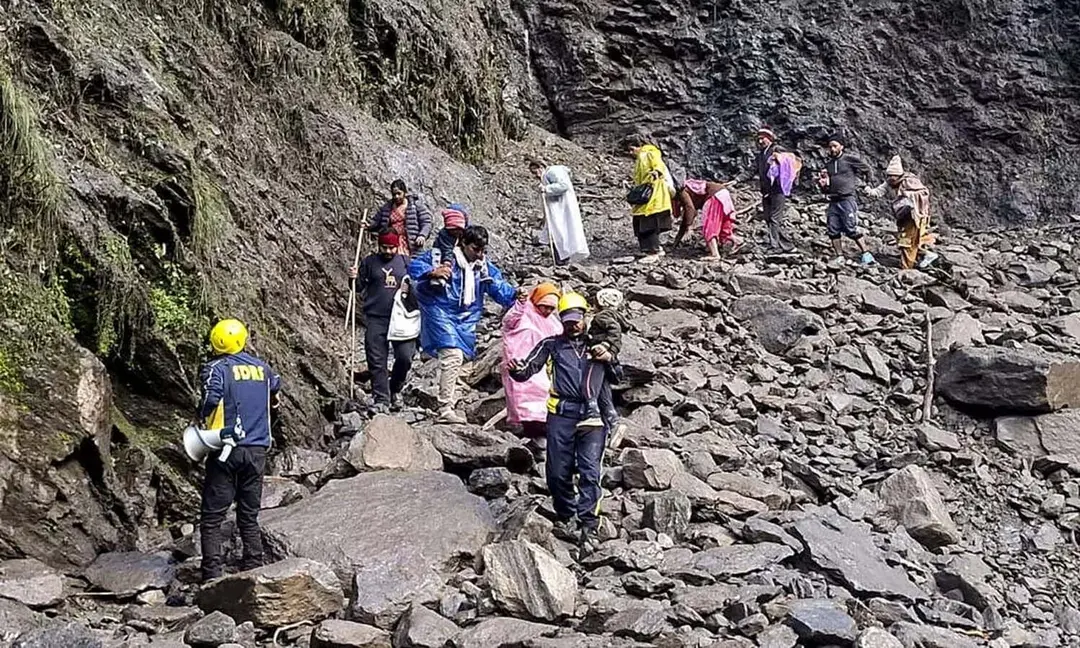
Landslide on Kedarnath route; over 6,500 pilgrims moved to safety
A landslide hit the Gaurikund-Kedarnath route near the Chirbasa helipad in Uttarakhand's Rudraprayag district on Sunday, about 2.5 km from Gaurikund, partially damaging the road and stranding pilgrims. One local person died after being struck by a boulder. Officials said more than 6,500 pilgrims, along with about 600 to 700 horses and mules, were moved to safety on Monday as the weather improved. PWD staff are clearing debris.
Source
Jagtial — వాతావరణం · read the original report ↗
Desk check · compared with the source
What the desk checked (5)
- Over 6,500 pilgrims were rescued on Monday from the Gaurikund-Kedarnath route after a landslide near Chirbasa helipad. — Attributed to officials in the source; figure appears in source text.
- Around 600 to 700 horses and mules were also moved to safety. — Figure given as a range in the source, attributed to officials.
- One local person died after being hit by a boulder dislodged in the landslide. — Stated in source without a named source; no identity given.
- The landslide occurred on Sunday near Chirbasa helipad, about 2.5 km from Gaurikund, partially damaging the route. — Distance and timing appear in source; no separate attribution given.
- PWD staff are clearing debris to restore movement on the route. — Stated in source as current status; no official quoted directly.
Analysts’ view opinion
A landslide that traps 6,500 pilgrims on the Kedarnath route is never just a weather story in Uttarakhand — it is a test of the state's administrative credibility on the yatra, which is both a devotional and an economic lifeline. The fact that the evacuation was completed within a day, once weather permitted, gives the administration a defensible record to point to; the death of a local man and the partial collapse of the route give the opposition an equally real opening on pilgrim safety and route engineering. Expect the political argument to settle not on the landslide itself, which is beyond anyone's control, but on preparedness, warning systems and how fast the road reopens.
- Yatra management is a high-visibility performance metric for any Uttarakhand government, so smooth mass evacuations are claimed as governance wins and disruptions are read as failures.
- The rescue of over 6,500 pilgrims plus 600-700 pack animals within a day of the weather clearing is the strongest card for the state machinery and the PWD.
- The death of one local resident personalises the incident and is likely to anchor opposition questions about early warning, route stabilisation and whether movement should have been halted sooner.
- Because pilgrims come from many states, any perceived mishandling travels politically well beyond Uttarakhand's own electorate.
- The economic stake is large for shopkeepers, ponywallahs and helicopter operators along the route, which creates local pressure to reopen quickly — pressure that can itself become a safety controversy.
What to watch — Watch how quickly PWD restores the Gaurikund-Kedarnath stretch, whether the state orders any review or restriction of pilgrim movement in bad weather, and whether opposition leaders convert the local death into a sustained safety campaign.
The story does not establish any official finding on cause, negligence or warning failures, nor does it report any political statement, party reaction or compensation decision — the political reading here is inference, not reported fact.
Deep dive
Research brief · 8 facts · 4 dates · exam-readyThe brief
Context
The Gaurikund-Kedarnath footpath in Uttarakhand's Rudraprayag district is the main approach route for pilgrims to the Kedarnath shrine, running through steep, landslide-prone Himalayan terrain. On Sunday, a major landslide struck the route near the Chirbasa helipad, roughly 2.5 km up from Gaurikund, partially damaging the path and trapping pilgrims on both sides. One local person was killed by a falling boulder, and continuous rockfall hampered rescue and road restoration work until the weather improved the next morning.
Key facts
- A landslide hit the Gaurikund-Kedarnath route near the Chirbasa helipad in Rudraprayag district, Uttarakhand, on Sunday.
- The landslide site is about 2.5 km up from Gaurikund, according to officials.
- More than 6,500 stranded pilgrims were moved to safety on Monday, officials said.
- Around 600 to 700 horses and mules were also shifted to safe areas.
- One local person died after being struck by a boulder dislodged in the landslide.
- The road was partially damaged, leaving pilgrims unable to proceed further.
- Continuous falling rocks from the hillside severely obstructed rescue and road restoration work.
- Public Works Department (PWD) staff are clearing accumulated debris at the site to restore movement.
Timeline
- SundayHeavy landslide on the Gaurikund-Kedarnath route near Chirbasa helipad partially damages the road; one local person dies after being hit by a boulder.
- Sunday (after the landslide)Continuous rockfall from the hillside halts rescue operations and road repair work; pilgrims stranded on both sides.
- Monday morningWeather improves and landslides temporarily stop; officials evacuate pilgrims in phases, including devotees returning from Kedarnath.
- MondayOver 6,500 pilgrims and 600-700 horses and mules moved to safety; PWD staff work to clear debris and restore the route.
Who has a stake
- Pilgrims on the Kedarnath route — More than 6,500 were stranded on both sides of the landslide site and had to be evacuated in phases.
- Local residents and workers — One local person was killed by a boulder; locals live and work along the vulnerable route.
- District administration, Rudraprayag — Responsible for phased rescue, alerting returning devotees and ensuring safe passage.
- Public Works Department (PWD) — Tasked with clearing debris and restoring traffic on the damaged Gaurikund-Kedarnath stretch.
- Horse and mule operators — About 600-700 animals used for pilgrim transport had to be moved to safe areas, disrupting livelihoods.
Why it matters
The Kedarnath yatra draws large crowds onto a narrow, steep Himalayan route where a single landslide can strand thousands within minutes, as this incident showed with over 6,500 pilgrims cut off. The death of a local resident and the continuous rockfall that stalled rescue work underline how weather-dependent both pilgrim safety and road restoration are in such terrain.
UPSC angle
Prelims pointers
- Kedarnath shrine lies in Rudraprayag district, Uttarakhand; Gaurikund is the base of the trek route.
- Chirbasa helipad, about 2.5 km from Gaurikund, was the site of the Sunday landslide.
- Over 6,500 pilgrims and 600-700 horses and mules were moved to safety on Monday.
- One local person died after being hit by a boulder in the landslide.
- The Public Works Department (PWD) is the agency clearing debris and restoring the route.
Mains framing
The Kedarnath landslide illustrates the structural vulnerability of high-altitude pilgrimage routes in the Himalaya: a steep, geologically fragile slope near the Chirbasa helipad gave way on Sunday, partially destroying the Gaurikund-Kedarnath path, killing a local resident and trapping over 6,500 pilgrims along with 600-700 pack animals. Two features of the event deserve attention. First, rescue capacity was dictated by nature, not administration - continuous rockfall stalled both evacuation and repair until weather improved on Monday morning, when officials could move pilgrims out in phases and escort returning devotees across. Second, the presence of hundreds of horses and mules alongside thousands of pilgrims on a single narrow stretch points to high carrying-load pressure on the route. The way forward, as far as the source supports, lies in faster debris clearance and route restoration by agencies such as the PWD, weather-linked regulation of pilgrim movement, and phased, alert-based passage at identified vulnerable points so that stranding does not turn into mass casualty.
Key terms
- Kedarnath yatra route
- The pilgrimage path to the Kedarnath shrine, trekked from the base point Gaurikund in Rudraprayag district, Uttarakhand.
- Gaurikund
- The starting point of the trek to Kedarnath; the landslide occurred about 2.5 km ahead of it.
- Chirbasa helipad
- A helipad area on the Gaurikund-Kedarnath route near which Sunday's heavy landslide struck.
- Public Works Department (PWD)
- The government department whose staff are clearing landslide debris and restoring movement on the damaged route.
- Landslide
- Collapse of rock and soil down a slope; here it partially damaged the road and sent boulders onto the pilgrim path.
Practice questions
- Discuss the challenges of ensuring pilgrim safety on Himalayan yatra routes, using the Gaurikund-Kedarnath landslide as an illustration.
- How do weather conditions determine the pace of disaster response in high-altitude terrain? Explain with reference to the Rudraprayag landslide rescue.
- Examine the role of state agencies such as the district administration and the Public Works Department in restoring connectivity after landslides on pilgrimage routes.
Grounded only in the source report — figures and dates are the source's, not inferred.